



One of the unsung workhorses of modern technology is the humble interconnect. This is essentially a wire or set of wires that link one part of an electronic system to another. In ordinary silicon chips, interconnect can take up most of the area of a chip; and the speed and efficiency with which information can travel along these interconnects, is a major limiting factor in computing performance.
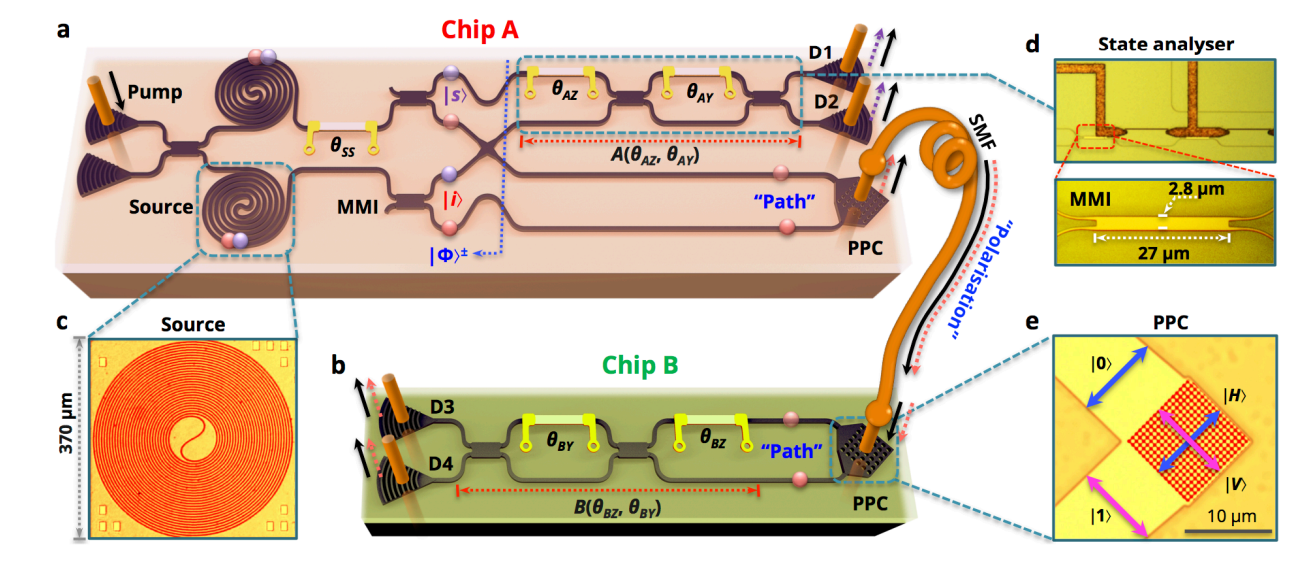
A separate entanglement stage is used to preserve the original entanglement needed as part of normal operations—demonstrating a way to connect 2 photonic chips. To allow for interconnection, they ran 2 sources of photons along one of the chips, on channels that overlapped—when the photons met in the overlap area, they became entangled and that entanglement was then carried along different paths in the chip.
They next ran the photons through a device that converted that path entanglement into a whole new type of entanglement, one that involved polarization, which also caused the creation of new entangled photons >> passed into an optical fiber that ran between the 2 chips. The whole process was then reversed in the 2nd chip, where the polarized photons were converted back to path entangled photons, which then behaved exactly like the photons in the first chip.
The team conducted multiple different types of tests to prove that entanglement was preserved throughout the interconnection process.
It is still too inefficient to be implemented into real devices, but believe further refinement will lead to a usable solution. But, they have shown that it is possible to interconnect quantum devices, which should come as a relief to those working on building a quantum computer. http://www.technologyreview.com/view/540696/physicists-unveil-first-quantum-interconnect/



Recent Comments