Category Astronomy/Space

Pillars of Creation star in New Visualization from NASA’s Hubble and Webb Telescopes

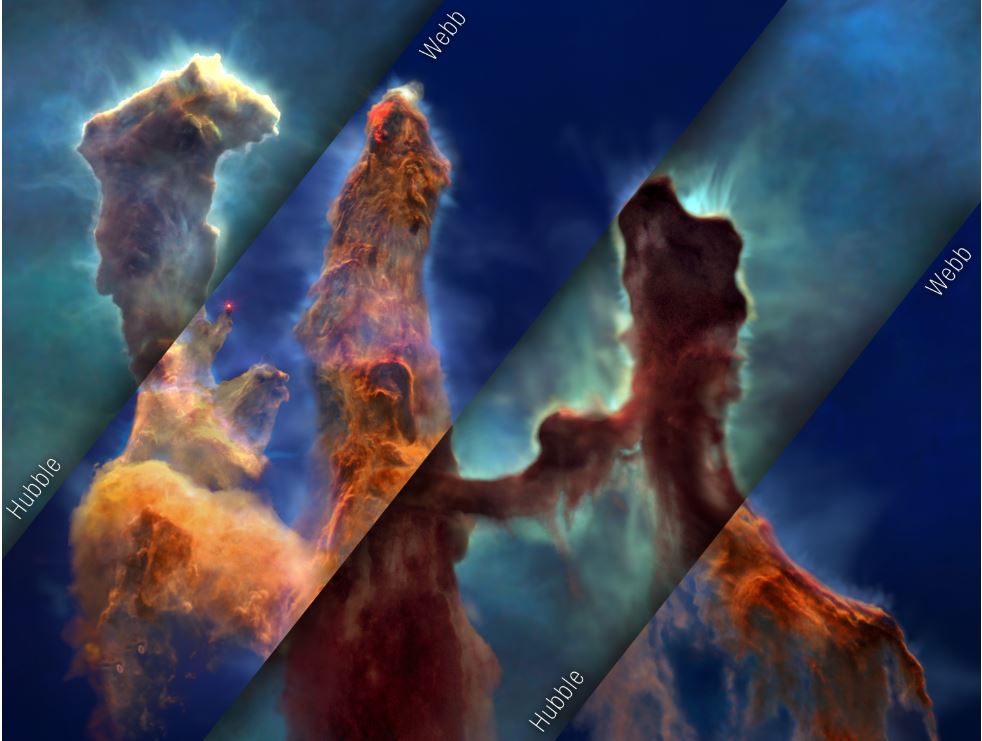
A mosaic of visible-light (Hubble) and infrared-light (Webb) views of the same frame from the Pillars of Creation visualization. The visualization sequence fades back and forth between these two models as the camera flies past and amongst the pillars. These contrasting views illustrate how observations from the two telescopes complement each other.
Greg Bacon, Ralf Crawford, Joseph DePasquale, Leah Hustak, Christian Nieves, Joseph Olmsted, Alyssa Pagan, and Frank Summers (STScI), NASA’s Universe of Learning

Made famous in 1995 by NASA’s Hubble Space Telescope, the Pillars of Creation in the heart of the Eagle Nebula have captured imaginations worldwide with their arresting, ethereal beauty.

Now, NASA has released a new 3D visualization of these towering celestial structures using dat...

Read More
First of its kind Detection made in Striking New Webb Image

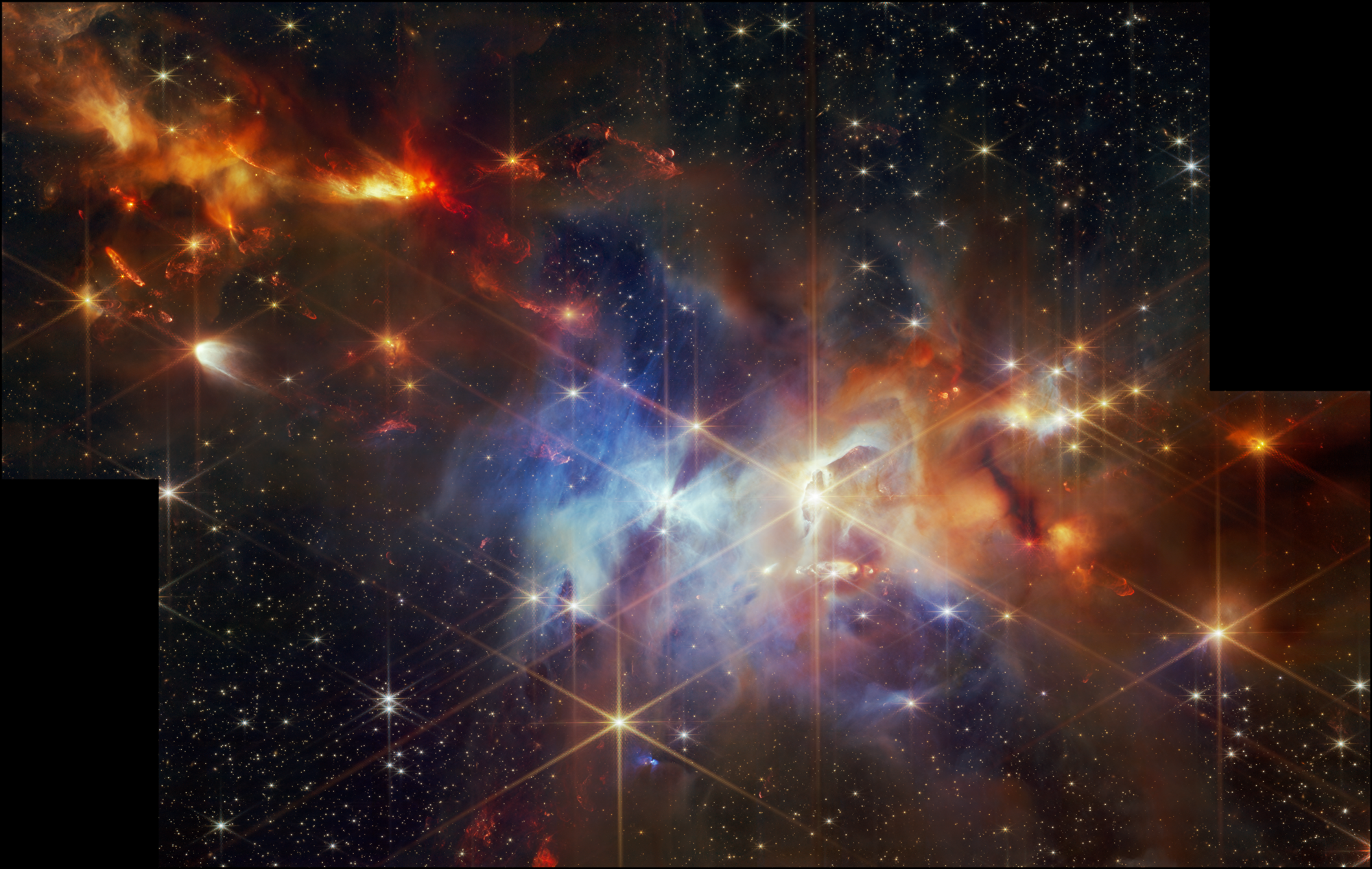
A rectangular image with black vertical rectangles at the bottle left and top right to indicate missing data. A young star-forming region is filled with wispy orange, red, and blue layers of gas and dust. The upper left corner of the image is filled with mostly orange dust, and within that orange dust, there are several small red plumes of gas that extend from the top left to the bottom right, at the same angle. The center of the image is filled with mostly blue gas. At the center, there is one particularly bright star, that has an hourglass shadow above and below it. To the right of that is what looks a vertical eye-shaped crevice with a bright star at the center. The gas to the right of the crevice is a darker orange. Small points of light are sprinkled across the field, brightest sources in the field have extensive eight-pointed diffraction spikes that are characteristic of the Webb Telescope.
In this image of the Serpens Nebula from NASA’s James Webb Space Telescope, astronomers found a grouping of aligned protostellar outflows within one small region (the top left corner). Serpens is a reflection nebula, which means it’s a cloud of gas and dust that does not create its own light, but instead shines by reflecting the light from stars close to or within the nebula.
NASA, ESA, CSA, K. Pontoppidan (NASA’s Jet Propulsion Laboratory) and J. Green (Space Telescope Science Institute).

For the first time, a phenomenon astronomers have long hoped to directly image has been captured by NASA’s James Webb Space Telescope’s Near-Infrared Camera (NIRCam)...

Read More

A Hidden Treasure in the Milky Way – Astronomers uncover Ultrabright X-ray Source

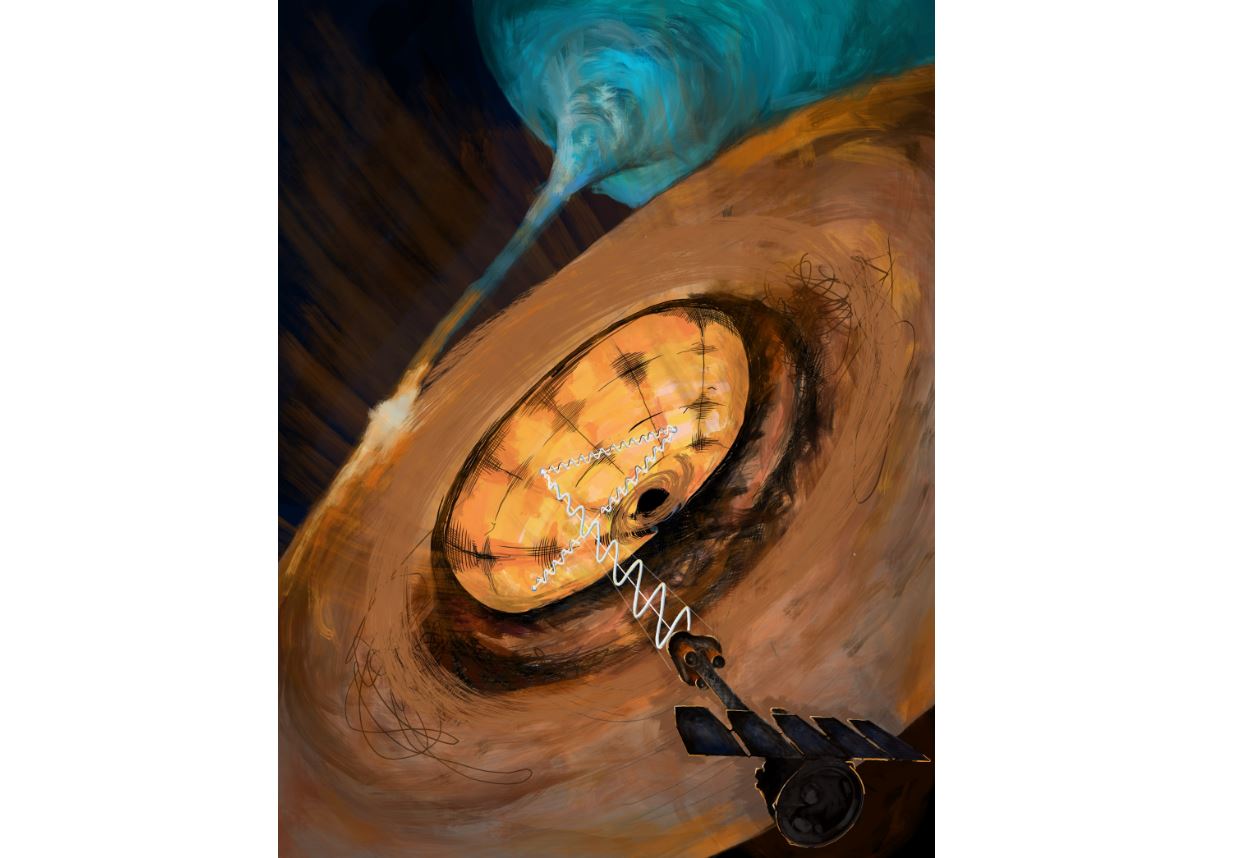
Illustration: Alexander Mushtukov: A view towards the black hole in an X-ray binary and the X-rays we see that are reflected from the inner surface of the powerful outflow surrounding the hole. 

Astronomers uncovered that a well-known X-ray binary, whose exact nature has been a mystery to scientists until now, is actually a hidden ultraluminous X-ray source. X-ray binaries are intriguing systems consisting of two celestial bodies: a normal star and a compact, dead object such as a black hole or a neutron star that sucks material from its stellar companion. A few hundred such sources have been identified thus far in our Galaxy...

Read More

Slingshotting Around the Sun would make a Spacecraft the Fastest Ever

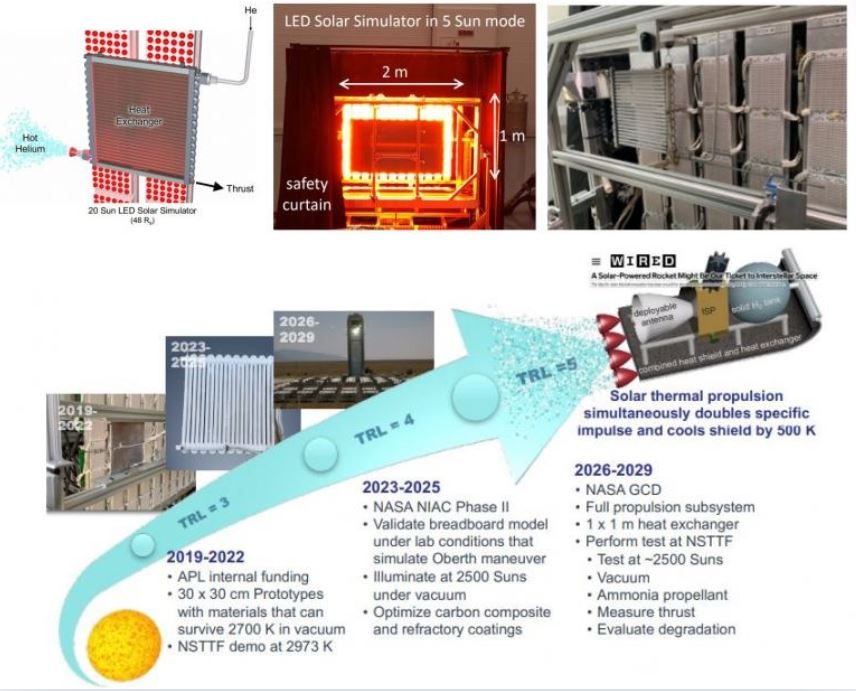
Top: Image of the test set-up for the thermal shield.
Credit – Benkoski et al.
Bottom: Graphic depicting the development path for the solar thermal propulsion system.
Credit – Benkoski et al.

NASA is very interested in developing a propulsion method to allow spacecraft to go faster. We’ve reported several times on different ideas to support that goal, and most of the more successful have utilized the sun’s gravity well, typically by slingshotting around it, as is commonly done with Jupiter currently.

But, there are still significant hurdles when doing so, not the least of which is the energy radiating from the sun simply vaporizing anything that gets close enough to utilize a gravity assist...

Read More