Category Astronomy/Space

NASA is considering Other Ways of getting its Mars Samples Home

In 2021, NASA’s Perseverance rover landed in the Jezero Crater on Mars. For the next three years, this astrobiology mission collected soil and rock samples from the crater floor for eventual return to Earth. The analysis of these samples is expected to reveal much about Mars’ past and how it transitioned from being a warmer, wetter place to the frigid and desiccated place we know today. Unfortunately, budget cuts have placed the future of the proposed NASA-ESA Mars Sample Return (MSR) mission in doubt.

As a result, NASA recently announced that it was seeking proposals for more cost-effective and rapid methods of bringing the samples home. This will consist of three studies by NASA and the Johns Hopkins University Applied Physics Laboratory (JHUAPL).

In addition, NASA has selecte...

Read More
Laser Tests reveal New Insights into Key Mineral for Super-Earths

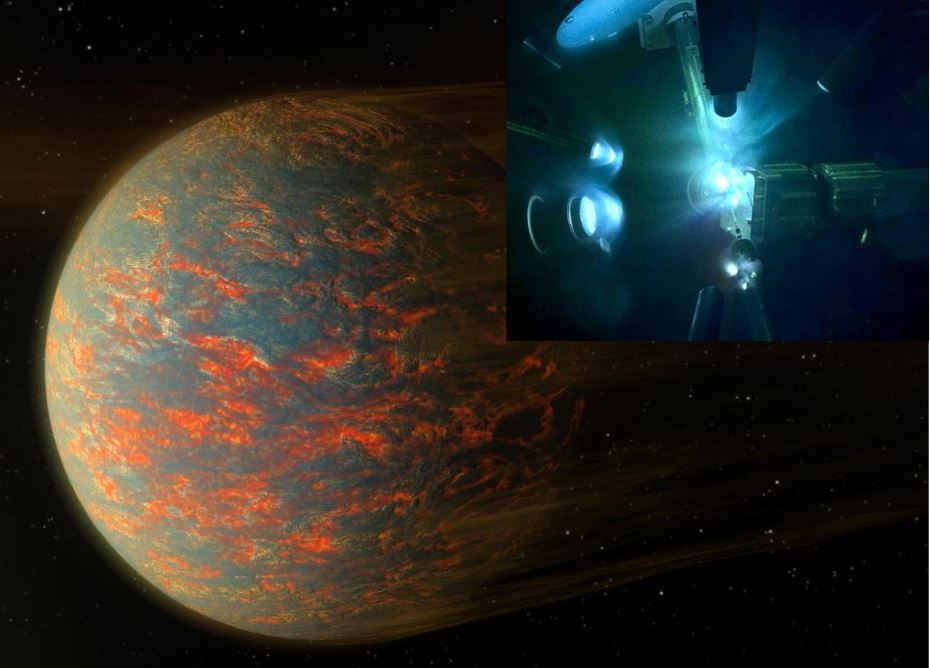
View of laser-driven experiments of shock-compressed magnesium oxide (MgO) within the chamber at the Laboratory for Laser Energetics. High-power laser beams are used to compress MgO samples to pressures beyond those found in the center of Earth. A secondary source of X-rays is used to probe MgO’s crystal structure. Brighter regions are glowing plasma emission over nanosecond timescales.
IMAGE CREDIT: JUNE WICKS/JOHNS HOPKINS UNIVERSITY

Scientists have for the first time observed how atoms in magnesium oxide morph and melt under ultra-harsh conditions, providing new insights into this key mineral within Earth’s mantle that is known to influence planet formation.

High-energy laser experiments — which subjected tiny crystals of the mineral to the type of heat and pressure found deep ...

Read More

NASA’s Roman Mission Gets Cosmic ‘Sneak Peek’ From Supercomputers

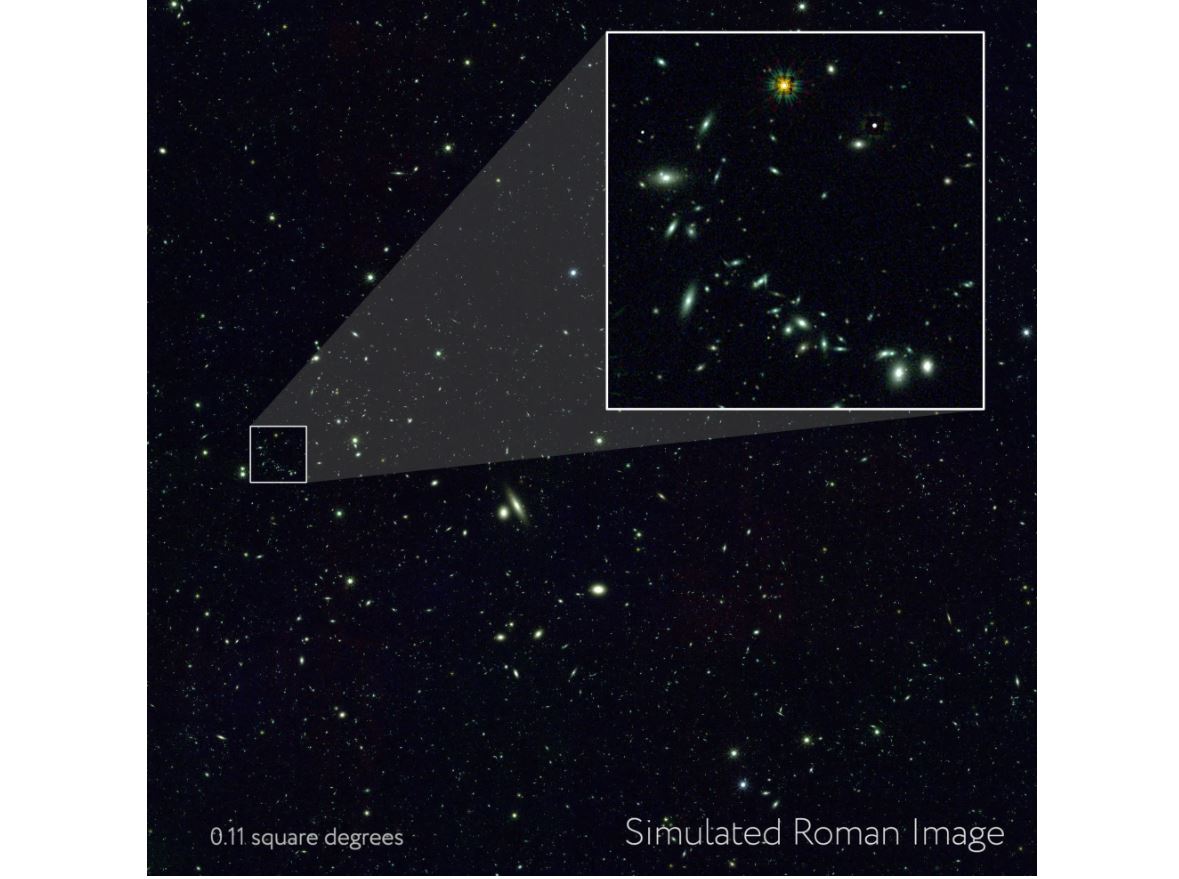
This graphic highlights part of a new simulation of what NASA’s Nancy Grace Roman Space Telescope could see when it launches by May 2027. The background spans about 0.11 square degrees (roughly equivalent to half of the area of sky covered by a full Moon), representing less than half the area Roman will see in a single snapshot. The inset zooms in to a region 300 times smaller, showcasing a swath of brilliant synthetic galaxies at Roman’s full resolution. Having such a realistic simulation helps scientists study the physics behind cosmic images –– both synthetic ones like these and future real ones. Researchers will use the observations for many types of science, including testing our understanding of the origin, evolution, and ultimate fate of the universe.
C. Hirata and K...
Read More

Webb Telescope reveals Asteroid Collision in Neighboring Star System

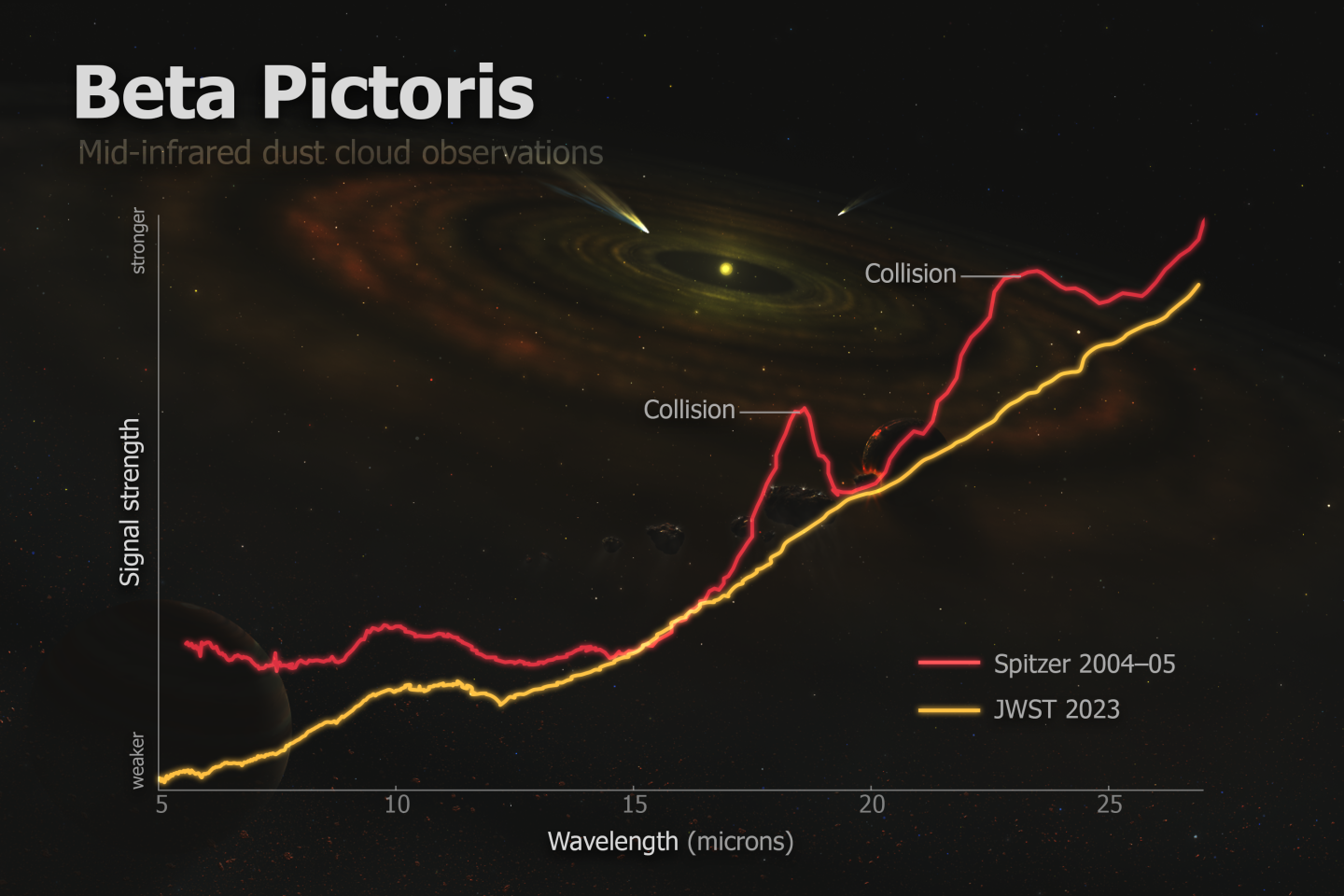
Beta Pictoris
Two different space telescopes took snapshots 20 years apart of the same area around the star called Beta Pictoris. Scientists theorize that the massive amount of dust seen in the 2004–05 image from the Spitzer Space Telescope indicates a collision of asteroids that had largely cleared by the time the James Webb Space Telescope captured its images in 2023.
IMAGE CREDIT: ROBERTO MOLAR CANDANOSA/JOHNS HOPKINS UNIVERSITY, WITH BETA PICTORIS CONCEPT ART BY LYNETTE COOK/NASA

Astronomers have captured what appears to be a snapshot of a massive collision of giant asteroids in Beta Pictoris, a neighboring star system known for its early age and tumultuous planet-forming activity.

The observations spotlight the volatile processes that shape star systems like our own, offering a unique glim...

Read More