Category Astronomy/Space

Astronomers find most Distant Galaxy using James Webb Space Telescope

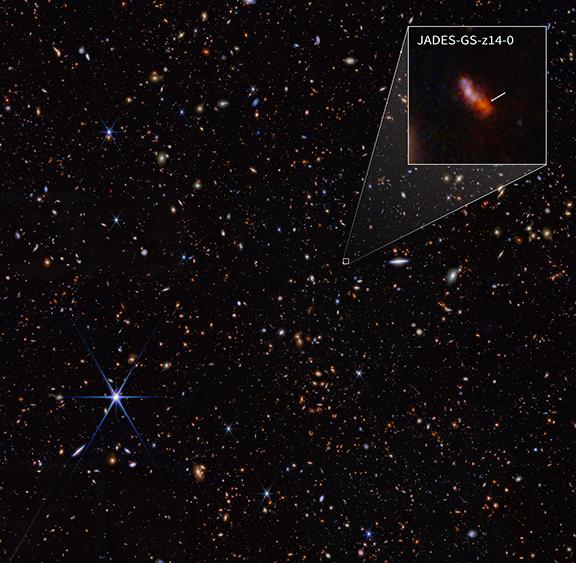
This infrared image from NASA’s James Webb Space Telescope (also called Webb or JWST) was taken by the NIRCam (Near-Infrared Camera) for the JWST Advanced Deep Extragalactic Survey, or JADES, program.
Credit. NASA, ESA, CSA, STScI, Brant Robertson (UC Santa Cruz), Ben Johnson (CfA), Sandro Tacchella (Cambridge), Phill Cargile (CfA)

An international team of astronomers today announced the discovery of the two earliest and most distant galaxies ever seen, dating back to only 300 million years after the Big Bang. These results, using NASA’s James Webb Space Telescope (JWST), mark a major milestone in the study of the early universe.

The discoveries were made by the JWST Advanced Deep Extragalactic Survey (JADES) team. Daniel Eisenstein from the Center for Astrophysics | Harvard & Smithsonian (CfA) is one of the team leaders of JADES and Principal Investigator of the observing program that revealed these galaxies...

Read More
New Technique Offers More Precise Maps of the Moon’s Surface

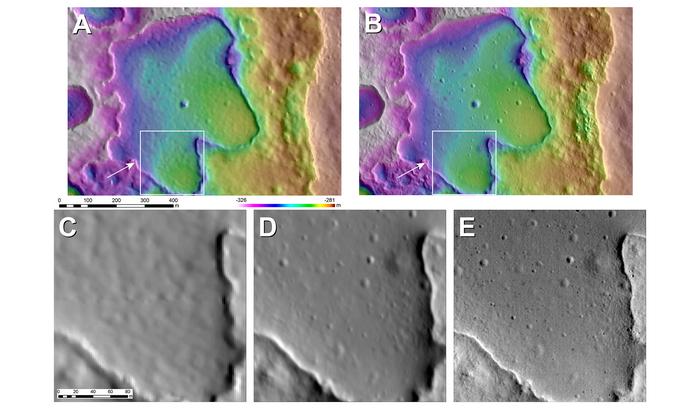
Pre-existing models for the Ina irregular mare patch (A, C, D) compared to more detailed and sharper shape-from-shading models from the study (B, E).

A new study by Brown University researchers may help redefine how scientists map the surface of the Moon, making the process more streamlined and precise than ever before.

Published in the Planetary Science Journal, the research by Brown scholars Benjamin Boatwright and James Head describes enhancements to a mapping technique called shape-from-shading. The technique is used to create detailed models of lunar terrain, outlining craters, ridges, slopes and other surface hazards...

Read More

Mystery of ‘Slow’ Solar Wind Unveiled by Solar Orbiter Mission

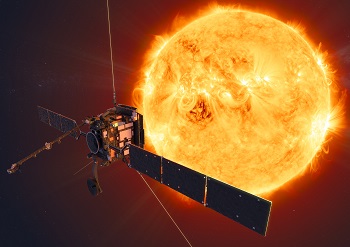
Caption:The ESA Solar Orbiter
The ESA Solar Orbiter

Scientists have come a step closer to identifying the mysterious origins of the “slow” solar wind, using data collected during the Solar Orbiter spacecraft’s first close journey to the sun.

Solar wind, which can travel at hundreds of kilometers per second, has fascinated scientists for years, and new research published in Nature Astronomy, is finally shedding light on how it forms.

Solar wind describes the continuous outflow of charged plasma particles from the sun into space—with wind traveling at over 500km per second known as ‘fast’ and under 500km per second described as “slow.”

When this wind hits the Earth’s atmosphere it can result in the stunning aurora we know as the Northern Lights...

Read More

The Earth’s Changing, Irregular Magnetic Field is Causing Headaches for Polar Navigation

The Earth's changing, irregular magnetic field is causing headaches for polar navigation
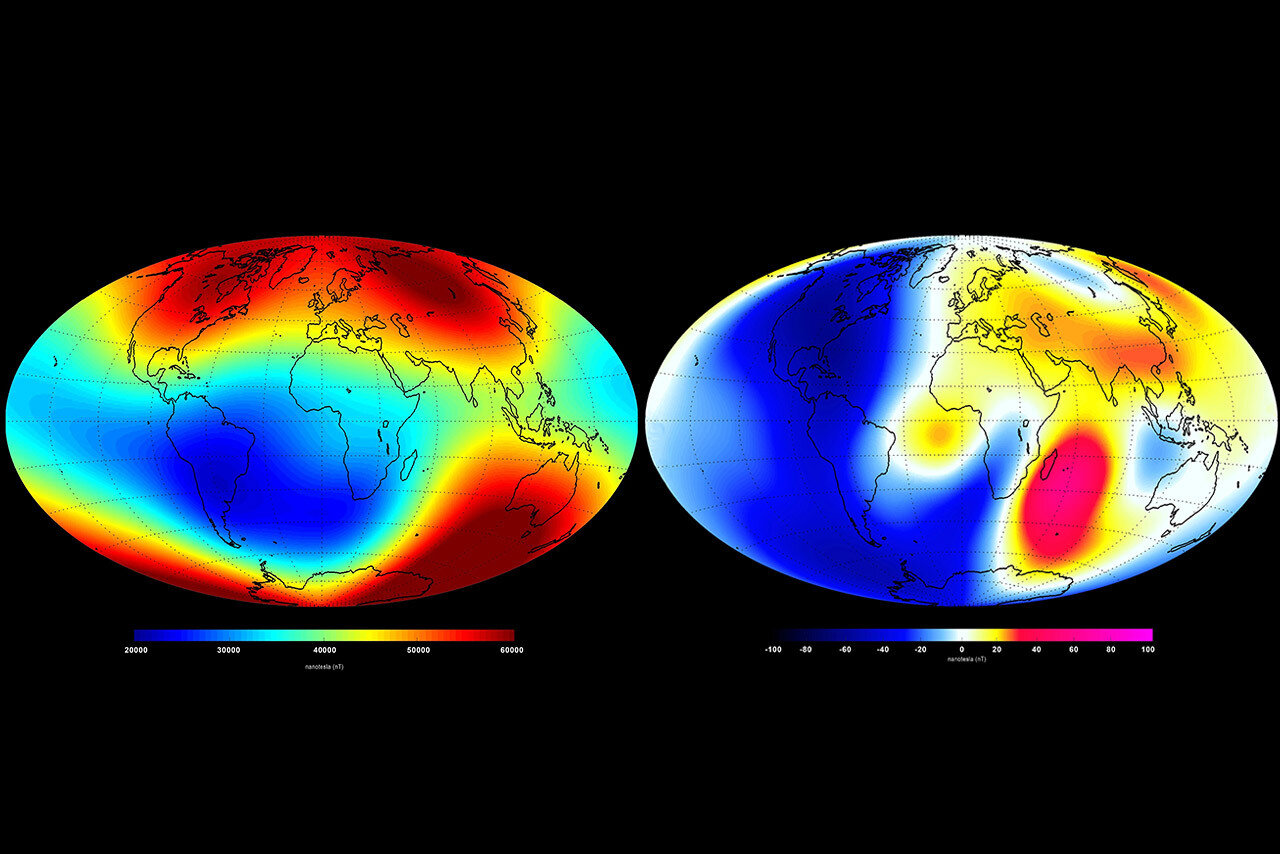
Changes in the Earth’s global magnetic field over six months in 2014 as measured by the European Space Agency’s three-satellite Swarm constellation. The left map shows the average magnetic field and the right shows changes in magnetic field strength during that period. Credit: European Space Agency/Technical University of Denmark (ESA/DTU Space).

The Earth’s liquid molten outer core, composed mostly of iron and nickel, exerts an electromagnetic field extending from the north and south pole that protects the planet from harmful solar particle radiation.

Fluctuations in the strength of Earth’s magnetic field—caused by daily changes in solar wind structure and intermittent solar storms—can impact the use of geomagnetic field models which are essential for navigation in satellites, plan...

Read More