Category Astronomy/Space

Webb Cracks Case of Inflated Exoplanet

Graphic titled “Hot Gas-Giant Exoplanet WASP-107 b Transmission Spectrum: Hubble WFC3 Grism Spectroscopy; Webb NIRCam Grism Spectroscopy; Webb MIRI Low-Resolution Spectroscopy” has 3 sets of data points with error bars and a best-fit model on a graph of Amount of Light Blocked on the y-axis versus Wavelength of Light in microns on the x-axis. Y-axis ranges from less light blocked at bottom to more light blocked at top. X-axis ranges from 0.8 to 12 microns. Data are identified in a legend. Hubble WFC3: 30 green data points ranging from 0.9 to 1.6 microns; Webb NIRCam: 177 orange data points ranging from 2.5 to 5 microns; Webb MIRI: 46 pink data points ranging from 5 to 12 microns. Best-fit model is a gray line with numerous peaks and valleys. The model and data are closely aligned. Ten features on the graph are labeled: Water H2O; Water H2O and Carbon Dioxide CO2; Ammonia NH3; Methane CH4; Sulfur Dioxide SO2; Carbon Dioxide CO2; Carbon Monoxide CO; Water H2O; Sulfur Dioxide SO2; and Ammonia NH3.
Warm Gas-Giant Exoplanet WASP-107 b Transmission Spectrum (Hubble WFC3, Webb NIRCam, Webb MIRI)

Why is the warm gas-giant exoplanet WASP-107 b so puffy? Two independent teams of researchers have an answer.

Data collected using NASA’s James Webb Space Telescope, combined with prior observations from NASA’s Hubble Space Telescope, show surprisingly little methane (CH4) in the planet’s atmosphere, indicating that the interior of WASP-107 b must be significantly hotter and the core much more massive than previously estimated.

The unexpectedly high temperature is thought to be a result of tidal heating caused by the planet’s slightly non-circular orbit, and can explain how WASP-107 b can be so inflated without resorting to extreme theories of how it formed.

The results, which were ...

Read More

‘Danger Behind the Beauty’: More Solar Storms could be Heading Our Way

Auroras may be pretty, but the solar storms that cause them can cause serious havoc on Earth, scientists have warned

Tourists normally have to pay big money and brave cold climates for a chance to see an aurora, but last weekend many people around the world simply had to look up to see these colorful displays dance across the sky.

Usually banished to the poles of Earth, the auroras strayed as far as Mexico, southern Europe and South Africa on the evening of May 10, delighting skygazers and filling social media with images of exuberant pinks, greens and purples.

But for those charged with protecting Earth from powerful solar storms such as the one that caused the auroras, a threat lurks beneath the stunning colors.

“We need to understand that behind this beauty, there is danger,” Quentin Verspieren, the European Space Agency’s space safety program coordinator, told AFP.

Mike Bettwy of the...

Read More

Hubble Views the Dawn of a Sun-like Star

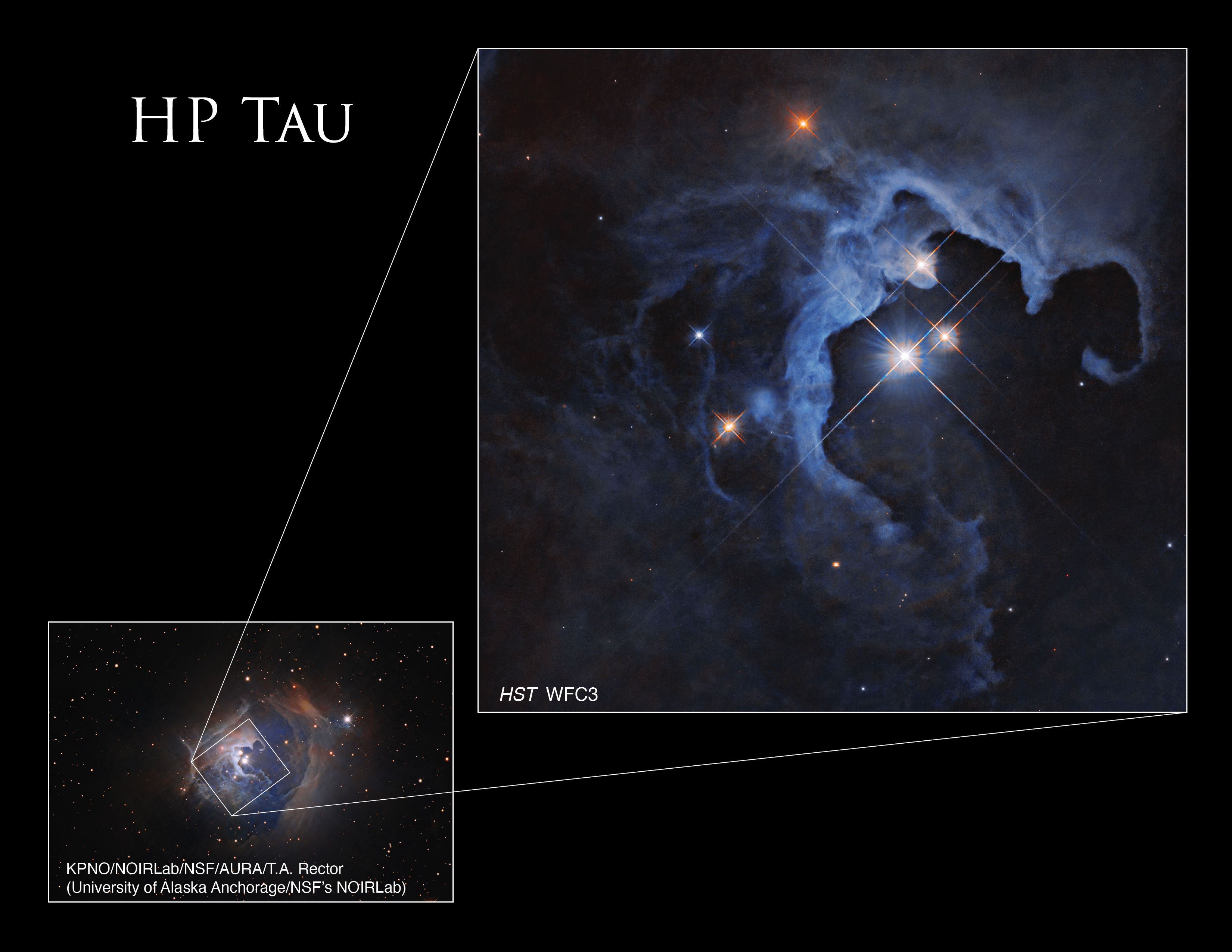
Large image at upper right: Three bright stars with diffraction spikes shine near the center-right of the image, illuminating nearby clouds that glow in pale blue. The clouds darken at the edges of the image, and are dotted with smaller stars, some also with diffraction spikes. Small inset image in the lower-left corner: A colorful nebula or gas cloud. A white square outlines the area of the nebula that Hubble image captures.

Looking like a glittering cosmic geode, a trio of dazzling stars blaze from the hollowed-out cavity of a reflection nebula in this new image from NASA’s Hubble Space Telescope. The triple-star system is made up of the variable star HP Tau, HP Tau G2, and HP Tau G3. HP Tau is known as a T Tauri star, a type of young variable star that hasn’t begun nuclear fusion yet but is beginning to evolve into a hydrogen-fueled star similar to our Sun. T Tauri stars tend to be younger than 10 million years old ― in comparison, our Sun is around 4.6 billion years old ― and are often found still swaddled in the clouds of dust and gas from which they formed.

As with all variable stars, HP Tau’s brightness changes over time.

T Tauri stars are known to have both periodic and random fluctuation...

Read More

NASA’s Juno provides High-Definition views of Europa’s Icy Shell

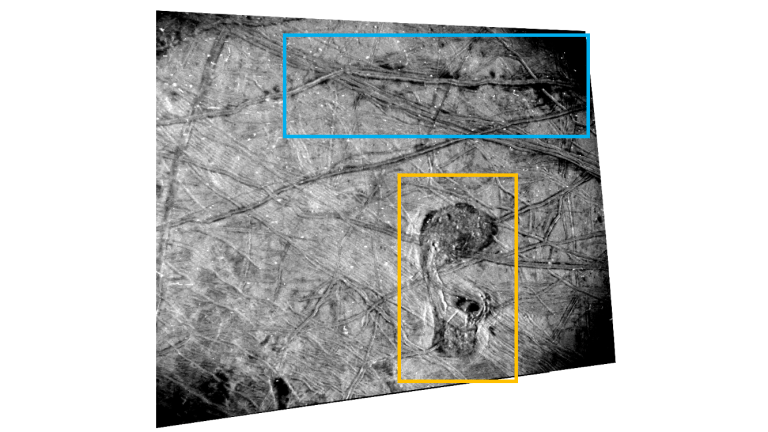
This annotated image of Europa’s surface from Juno’s SRU shows the location of a double ridge running east-west (blue box) with possible plume stains and the chaos feature the team calls “the Platypus” (orange box). These features hint at current surface activity and the presence of subsurface liquid water on the icy Jovian moon.

Images from the JunoCam visible-light camera aboard NASA’s Juno spacecraft supports the theory that the icy crust at the north and south poles of Jupiter’s moon Europa is not where it used to be. Another high-resolution picture of the icy moon, by the spacecraft’s Stellar Reference Unit (SRU), reveals signs of possible plume activity and an area of ice shell disruption where brine may have recently bubbled to the surface.

The JunoCam results recentl...

Read More