Category Astronomy/Space

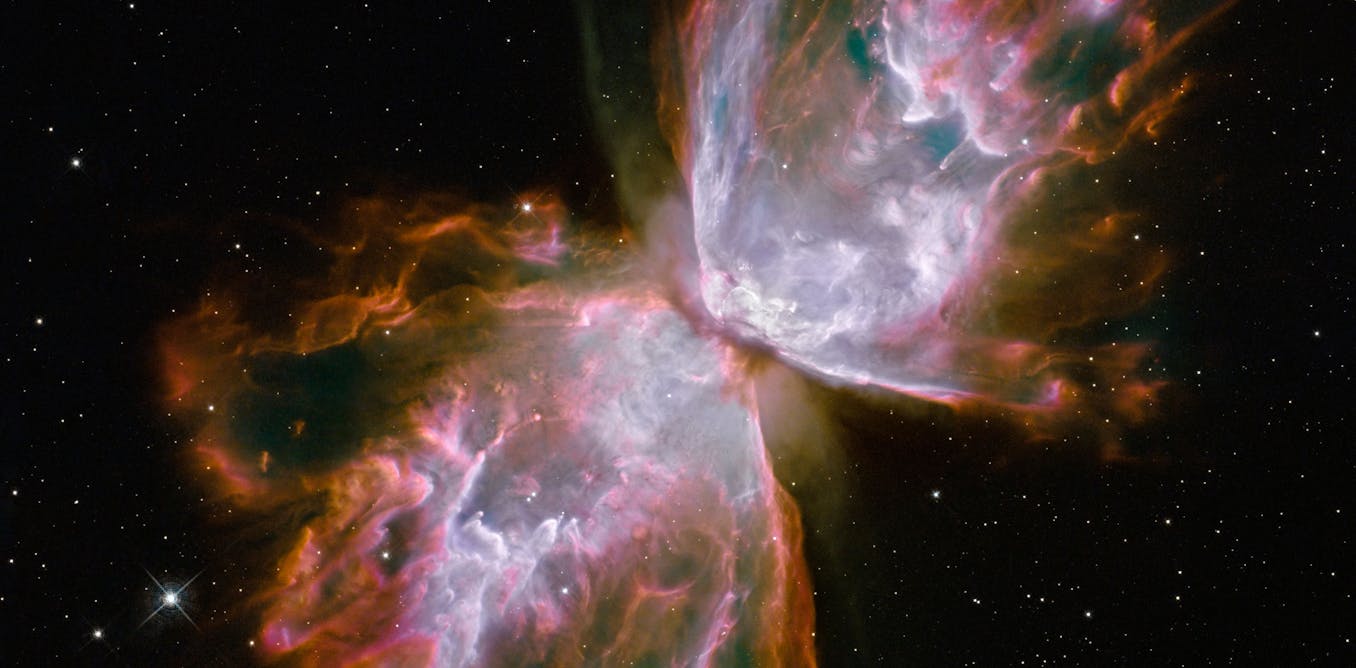
Exploding Stars are Rare but Emit Torrents of Radiation—one close enough to Earth could Threaten Life on the Planet

Massive dying stars emit large amounts of radiation. NASA/ESA/Hubble SM4 ERO Team via AP

Stars like the sun are remarkably constant. They vary in brightness by only 0.1% over years and decades, thanks to the fusion of hydrogen into helium that powers them. This process will keep the sun shining steadily for about 5 billion more years, but when stars exhaust their nuclear fuel, their deaths can lead to pyrotechnics.

The sun will eventually die by growing large and then condensing into a type of star called a white dwarf. But stars more than eight times more massive than the sun die violently in an explosion called a supernova.

Supernovae happen across the Milky Way only a few times a century, and these violent explosions are usually remote enough that people here on Earth don’t n...

Read More
Distant ‘Space Snowman’ unlocks mystery of how some Dormant Deep Space Objects become ‘Ice Bombs’

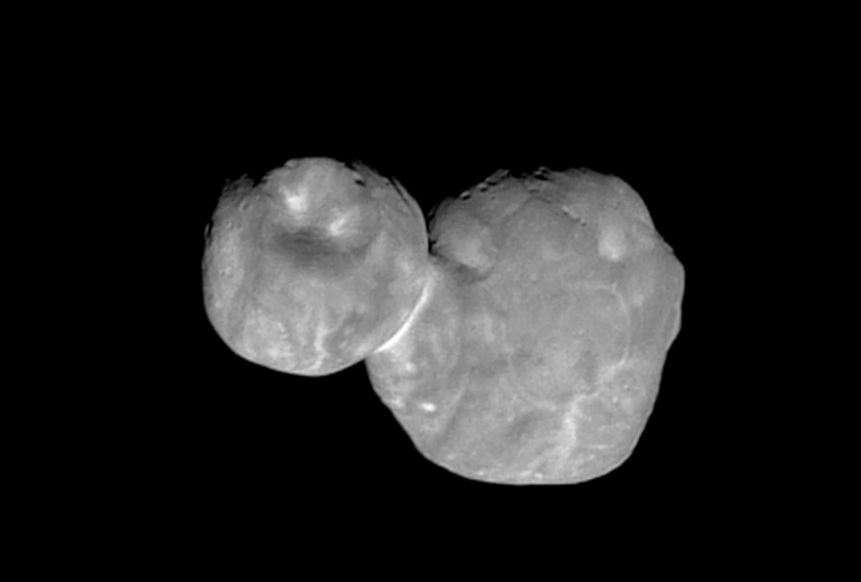
This image was taken by NASA’s New Horizons spacecraft on Jan. 1, 2019 during a flyby of Kuiper Belt object 2014 MU69. Photo by NASA/Johns Hopkins University Applied Physics Laboratory/Southwest Research Institute

A new study is shaking up what scientists thought they knew about distant objects in the far reaches of the solar system, starting with an object called the space snowman.

Researchers from Brown University and the SETI Institute found that the double-lobed object, which is officially named Kuiper Belt Object 486958 Arrokoth and resembles a snowman, may have ancient ices stored deep within it from when the object first formed billions of years ago. But that’s just the beginning of their findings.

Using a new model they developed to study how comets evolve, the researcher...

Read More

‘Cosmic Cannibals’ Expel Jets into Space at 40 percent the Speed of Light

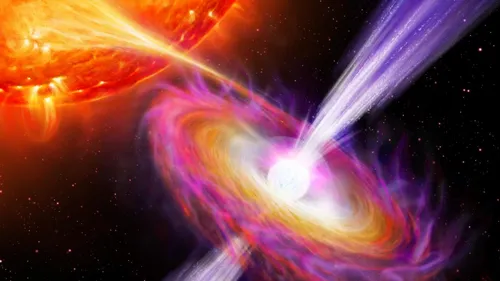
Artist's impression of neutron star jet
Nuclear explosions on a neutron star feed its jets
File name: 
Burst_jet_concept_v10_final.jpg
Credit: Danielle Futselaar and Nathalie Degenaar, Anton Pannekoek Institute, University of Amsterdam. License CC BY-SA 3.0

For the first time, astronomers have measured the speed of fast-moving jets in space, crucial to star formation and the distribution of elements needed for life.

The jets of matter, expelled by stars deemed ‘cosmic cannibals’, were measured to travel at over one-third of the speed of light — thanks to a groundbreaking new experiment published in Nature today.

The study sheds new light on these violent processes, making clever use of runaway nuclear explosions on the surface of stars.

Co-Author Jakob van den Eijnden, Warwick Prize Fellow at the Department of Physic...

Read More

Sleeping Supermassive Black Holes Awakened briefly by Shredded Stars

An illustration of the formation of CSOs.
This illustration shows how Compact Symmetric Objects, or CSOs, likely form. When a single, massive star wanders too close to a black hole (left), it is devoured. This causes the black hole to shoot out an ultrafast, bipolar jet (center). The jet extends outward and its hot ends glow with radio emissions (right).Credit: B. Saxton/NRAO/AUI/NSF

Radio observations of Compact Symmetric Objects (CSOs) provide new window on black holes. Astronomers have concluded that an obscure class of galaxies known as Compact Symmetric Objects, or CSOs, are not young as previously thought but rather lead relatively short lives.

A new investigation into an obscure class of galaxies known as Compact Symmetric Objects, or CSOs, has revealed that these objects are not entirely what they seem...

Read More