Category Astronomy/Space

Astronomers Discover 49 New Galaxies in Under Three Hours

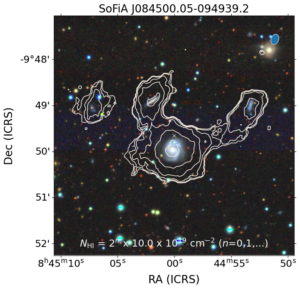
Four nearby galaxies as part of the set of 49 found by MeerKAT, shown by the white contours. Three of the galaxies are connected together by their gas content. The largest galaxy is stealing gas from two neighbouring galaxies. The background colour image is from the DECaLS DR10 optical survey. Glowacki et al. 2024

Dr. Marcin Glowacki, from the Curtin University node of the International Centre for Radio Astronomy Research (ICRAR) in Western Australia, led the research, which aimed to study the star-forming gas in a single radio galaxy.

Although the team didn’t find any star-forming gas in the galaxy they were studying, Dr. Glowacki instead discovered other galaxies while inspecting the data.

In total, the gas of 49 galaxies was detected. Dr Glowacki said this was a great example of how fantastic an instrument like MeerKAT is for finding the star-forming gas in galaxies.

“I did not expect to find almost fifty new galaxies in such a short time,” he said.

“By implementing different techniques for finding galaxies, which are used for other MeerKAT surveys, we were able to detect all...

Read More
‘Dark Stars’: Dark Matter may Form Exploding Stars, and Observing the Damage could help Reveal what it’s Made of

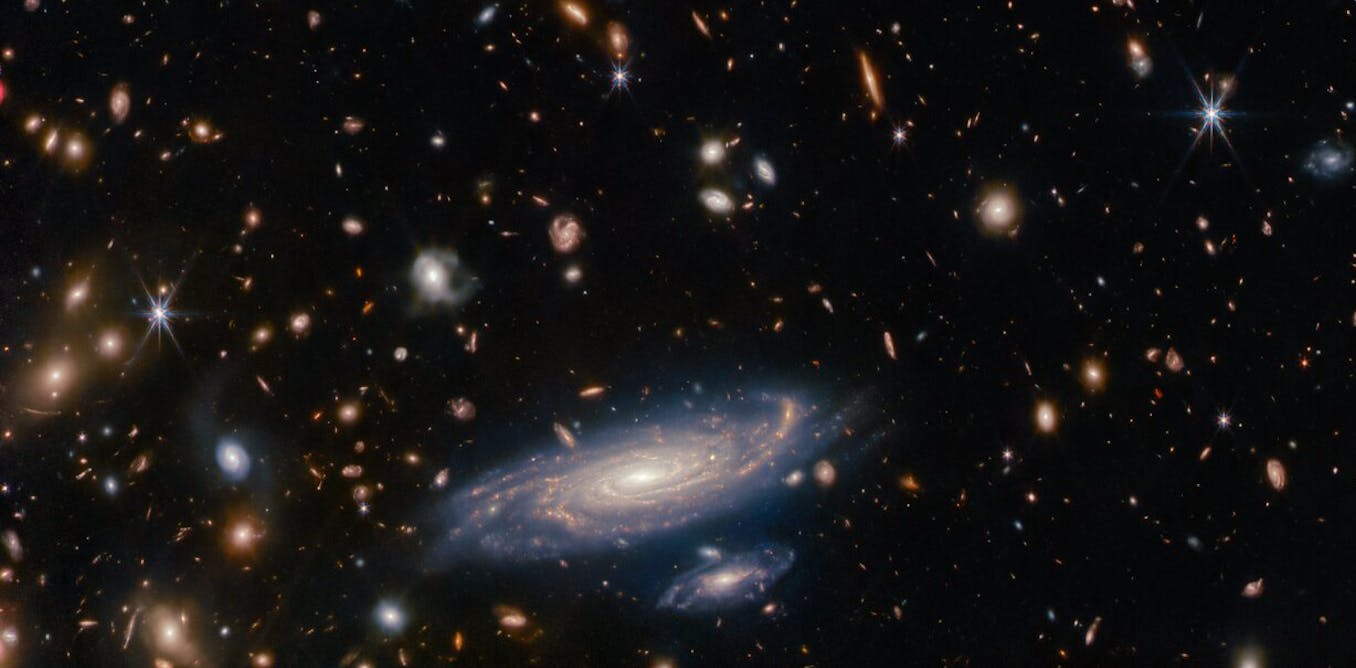
We wouldn’t be able to see them directly, but they could be out there. ESA/Webb, NASA & CSA, A. Martel

Dark matter is a ghostly substance that astronomers have failed to detect for decades, yet which we know has an enormous influence on normal matter in the universe, such as stars and galaxies. Through the massive gravitational pull it exerts on galaxies, it spins them up, gives them an extra push along their orbits, or even rips them apart.

Like a cosmic carnival mirror, it also bends the light from distant objects to create distorted or multiple images, a process which is called gravitational lensing.

And recent research suggests it may create even more drama than this, by producing stars that explode.

For all the havoc it plays with galaxies, not much is known about whet...

Read More

Signs of Life would be Detectable in Single Ice Grain Emitted from Extraterrestrial Moons

cartoon of icy moon with ocean interior covered with thin yellow stripe
The drawing on the left depicts Enceladus and its ice-covered ocean, with cracks near the south pole that are believed to penetrate through the icy crust. The middle panel shows where authors believe life could thrive: at the top of the water, in a proposed thin layer (shown yellow) like on Earth’s oceans. The right panel shows that as gas bubbles rise and pop, bacterial cells could get lofted into space with droplets that then become the ice grains that were detected by Cassini.European Space Agency

Could life be found in frozen sea spray from moons orbiting Saturn or Jupiter? New research finds that life can be detected in a single ice grain containing one bacterial cell or portions of a cell...

Read More

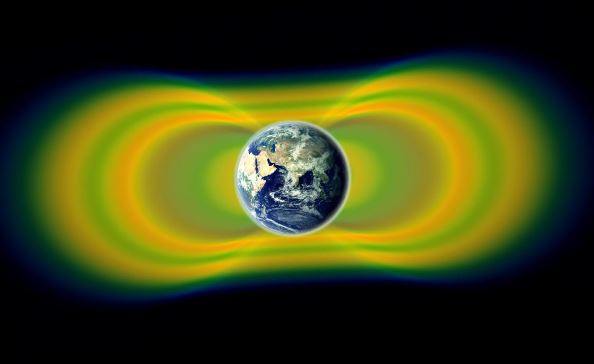
Secrets of the Van Allen Belt revealed in New Study

Image Credit: NASA

A challenge to space scientists to better understand our hazardous near-Earth space environment has been set in a new study led by the University of Birmingham.

The research represents the first step towards new theories and methods that will help scientists predict and analyse the behaviour of particles in space.

It has implications for theoretical research, as well as for practical applications such as space weather forecasting.

The research focused on two bands of energetic particles in near earth space, referred to as the Radiation Belts, or the Van Allen Belts.

These particles are trapped within the Earth’s magnetosphere and can damage electronics on satellites and spacecraft passing through, as well as posing risks to astronauts.

Understanding ho...

Read More