Category Astronomy/Space

Ice Shell Thickness reveals Water Temperature on Ocean Worlds

Encedalus
The frozen ocean world of Enceladus, a moon of Saturn.

Cornell University astrobiologists have devised a novel way to determine ocean temperatures of distant worlds based on the thickness of their ice shells, effectively conducting oceanography from space.

Available data showing ice thickness variation already allows a prediction for the upper ocean of Enceladus, a moon of Saturn, and a NASA mission’s planned orbital survey of Europa’s ice shell should do the same for the much larger Jovian moon, enhancing the mission’s findings about whether it could support life.

The researchers propose that a process called “ice pumping,” which they’ve observed below Antarctic ice shelves, likely shapes the undersides of Europa’s and Enceladus’ ice shells, but should also operate at Ganymede a...

Read More
Gas on the run – ALMA spots the Shadow of a Molecular Outflow from a Quasar when the Universe was less than one billion years old

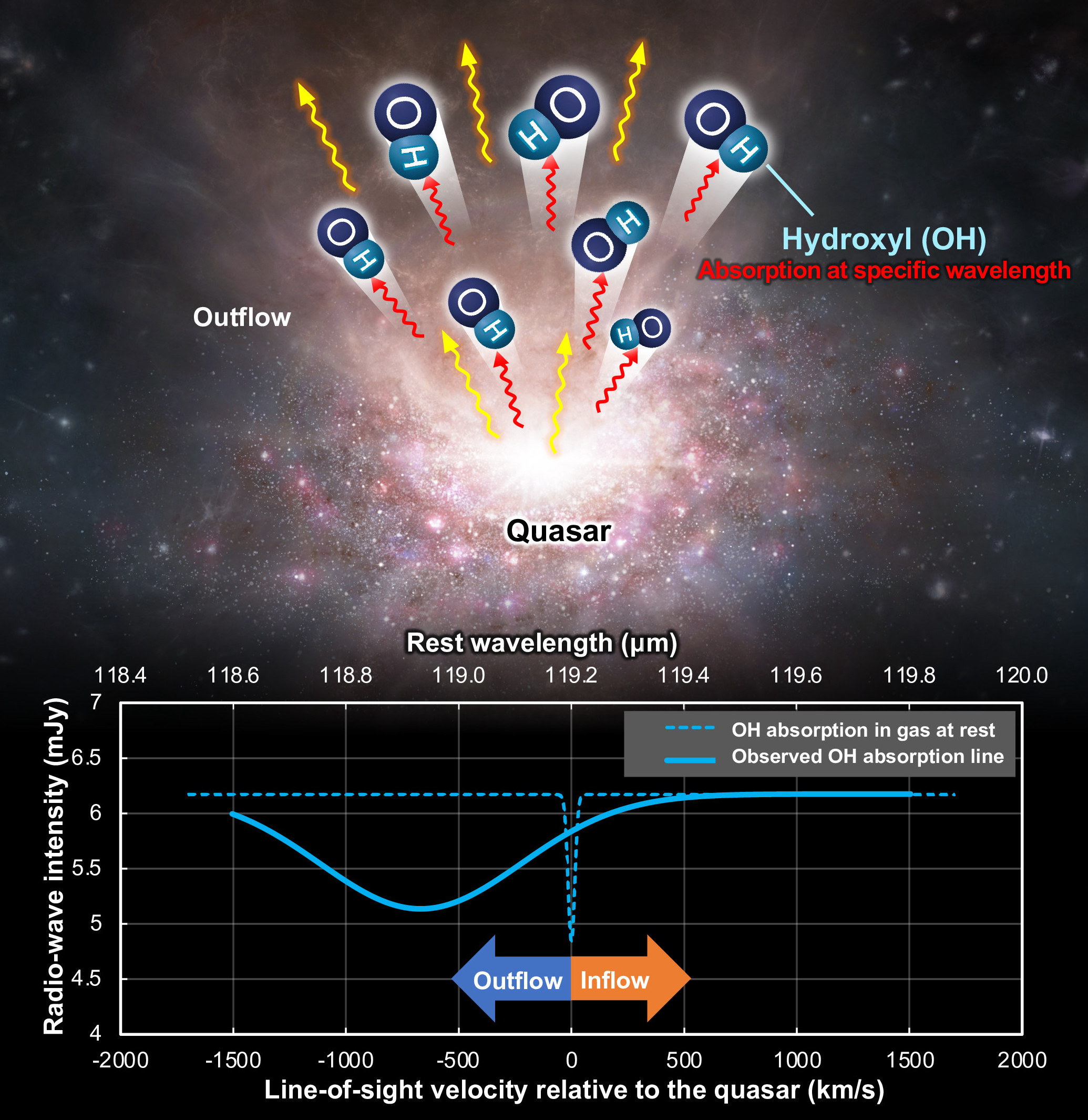
The molecular gas outflow from the quasar includes hydroxyl (OH) (top). Due to the motion of the molecular gas toward the observer, the OH peak in the absorption spectrum (bottom, dashed blue line) appears at a shorter wavelength (solid blue line), a phenomenon known as the Doppler effect. (Illustration: ALMA (ESO/NAOJ/NRAO) modified from Dragan Salak, et al. The Astrophysical Journal. February 1, 2024)
The molecular gas outflow from the quasar includes hydroxyl (OH) (top). Due to the motion of the molecular gas toward the observer, the OH peak in the absorption spectrum (bottom, dashed blue line) appears at a shorter wavelength (solid blue line), a phenomenon known as the Doppler effect. (Illustration: ALMA (ESO/NAOJ/NRAO) modified from Dragan Salak, et al. The Astrophysical Journal. February 1, 2024)

Theoretical predictions have been confirmed with the discovery of an outflow of molecular gas from a quasar when the Universe was less than a billion years old.

A quasar is a compact region powered by a supermassive black hole located in the center of a massive galaxy.

They are extremely luminous, with a point-like appearance similar to stars, and are extremely distant from Earth...

Read More

Team of Astronomers discovers Galaxy that Shouldn’t Exist

Image of outer space.
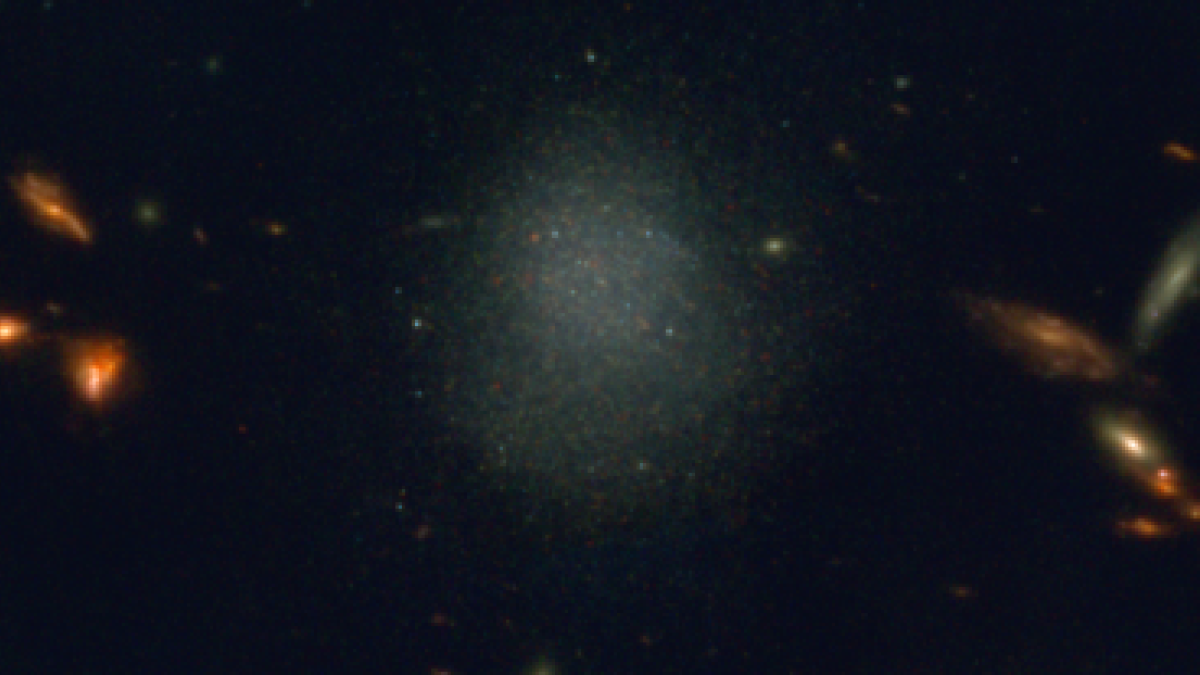
A color-composite image of PEARLSDG made with JWST NIRCAM data. Individual stars are visible as small points of light in the image. Its somewhat dull color and lack of many bright stars is consistent with its old age and lack of ongoing star formation. Image Credit: NASA, ESA, CSA, Jake Summers (ASU), Jordan C. J. D’Silva (UWA), Anton M. Koekemoer (STScI), Aaron Robotham (UWA) and Rogier Windhorst (ASU)

A team of astronomers, led by Arizona State University Assistant Research Scientist Tim Carleton, has discovered a dwarf galaxy that appeared in James Webb Space Telescope imaging that wasn’t the primary observation target.

Galaxies are bound together by gravity and made up of stars and planets, with vast clouds of dust and gas as well as dark matter...

Read More

Are Space Elevators possible? Physicist says they could Transform Humanity into a ‘Spacefaring Civilization’

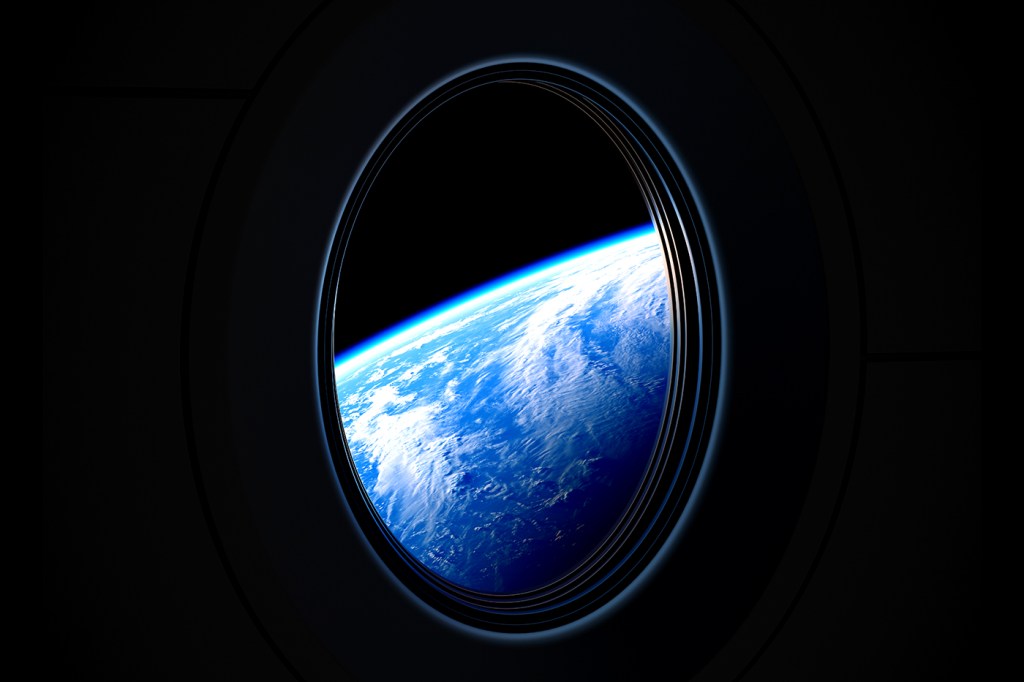
View of planet earth from the porthole of a spacecraft in space.
The concept of a space elevator has been championed by some industry experts as a way to overcome the astronomical costs associated with sending people and cargo into space by rocket. 3D Illustration by Getty Images

Humanity’s quest to explore—and, perhaps eventually, colonize—outer space has prompted a great many ideas about how precisely to go about it.

While conventional wisdom suggests that space launch via rockets is the best way to send human beings into orbit, other “non-rocket” methods have been proposed, including a futuristic “space elevator.”

The concept of a space elevator—essentially a sky-high cable that would let humans climb into space—has been championed by some industry experts as a way to overcome the astronomical costs associated with sending people and ca...

Read More