Category Astronomy/Space

The Hottest Catalog of the Year: Comprehensive List of Slow-building Solar Flares

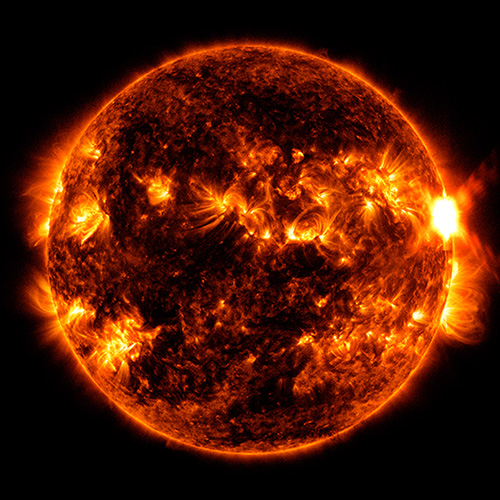
sun with bright solar falres
This image, taken on Aug. 5, 2023, shows a blend of extreme ultraviolet light that highlights the intensely hot material in flares and which is colorized in red and orange. (cr: NASA/GSFC/SDO)

Although solar flares have been classified based on the amount of energy they emit at their peak, there has not been significant study into differentiating flares since slow-building flares were first discovered in the 1980s. Scientists have now shown that there is a significant amount of slower-type flares worthy of further investigation.

Solar flares occur when magnetic energy builds up in the Sun’s atmosphere and is released as electromagnetic radiation. Lasting anywhere from a few minutes to a few hours, flares usually reach temperatures around 10 million degrees Kelvin...

Read More
Staggering Structure in 19 Nearby Spiral Galaxies

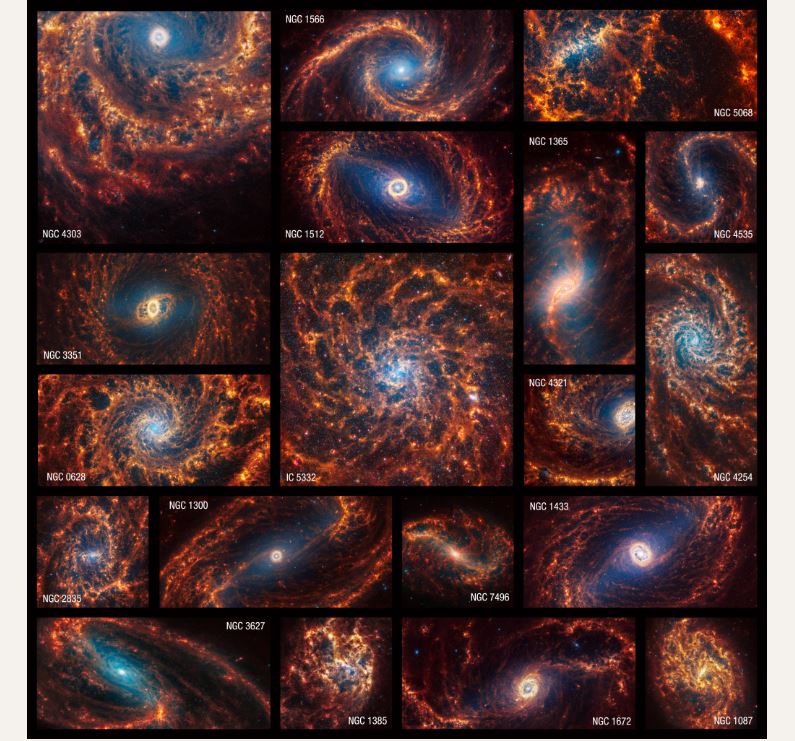
The James Webb Space Telescope observed 19 nearby face-on spiral galaxies in near- and mid-infrared light as part of its contributions to the Physics at High Angular resolution in Nearby GalaxieS (PHANGS) program.

It’s oh-so-easy to be absolutely mesmerized by these spiral galaxies. Follow their clearly defined arms, which are brimming with stars, to their centers, where there may be old star clusters and – sometimes – active supermassive black holes. Only NASA’s James Webb Space Telescope can deliver highly detailed scenes of nearby galaxies in a combination of near- and mid-infrared light — and a set of these images was publicly released today.

These Webb images are part of a large, long-standing project, the Physics at High Angular resolution in Nearby GalaxieS (PHANGS) progr...

Read More

Black Hole at the Center of a Galaxy in the Early Universe received Less Mass Influx than expected, astronomers find

Reddish vortex seen from from the side above with a bright centre and a thin ray protruding vertically from the plane
Cosmic powerhouse: Artist’s impression of a quasar whose core region was literally set in motion in the early universe. While galaxies often merged with each other at that time, large amounts of matter were thrown into the centres of the galaxies. When matter orbits the supermassive black hole in the centre of a galaxy, energy is released, which explains the enormous brightness of an active galaxy. The quasar can therefore still be observed from a great distance today.
© ESO / M. Kornmesser

With the upgraded GRAVITY-instrument at the Very Large Telescope Interferometer of the European Southern Observatory, a team of astronomers led by the Max Planck Institute for Extraterrestrial Physics has determined the mass of a black hole in a galaxy only 2 billion years after the Big Bang...

Read More

Lopsided Galaxies Shed Light on the Speed of Dark Matter

Lopsided galaxies shed light on the speed of dark matter
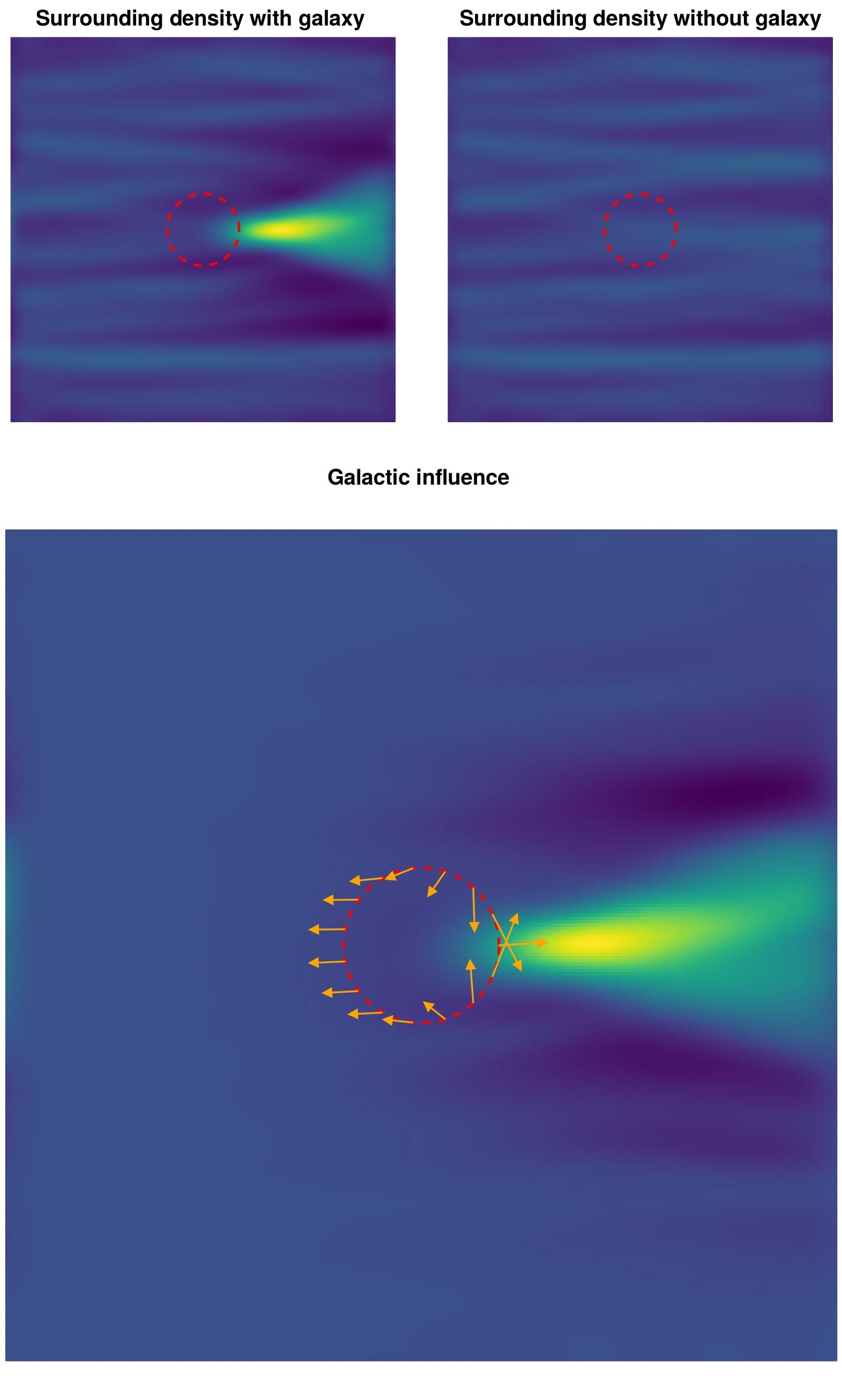
Fig. 1. Dynamical friction. The panels depict sparse areas of the universe with dark color and dense areas with light color. The upper panels show the density around a galaxy if the galaxy’s gravity bends (left) or does not bend (right) the trajectories of dark matter particles. The lower panel shows the difference between them, or how the galaxy affects the distribution of dark matter. The arrows represent the acceleration caused by the overdensity behind the galaxy, from which the friction on the center of the galaxy is deducted. Since the arrows have different directions and strengths in different areas, the tidal forces are able to change the shape of a galaxy. Credit: Rain Kipper

In new research published in Astronomy & Astrophysics, researchers have figured out how to precisely c...

Read More