
Category Astronomy/Space

‘Old Smokers’ and ‘Squalling Newborns’ among Hidden Stars Spotted for First Time

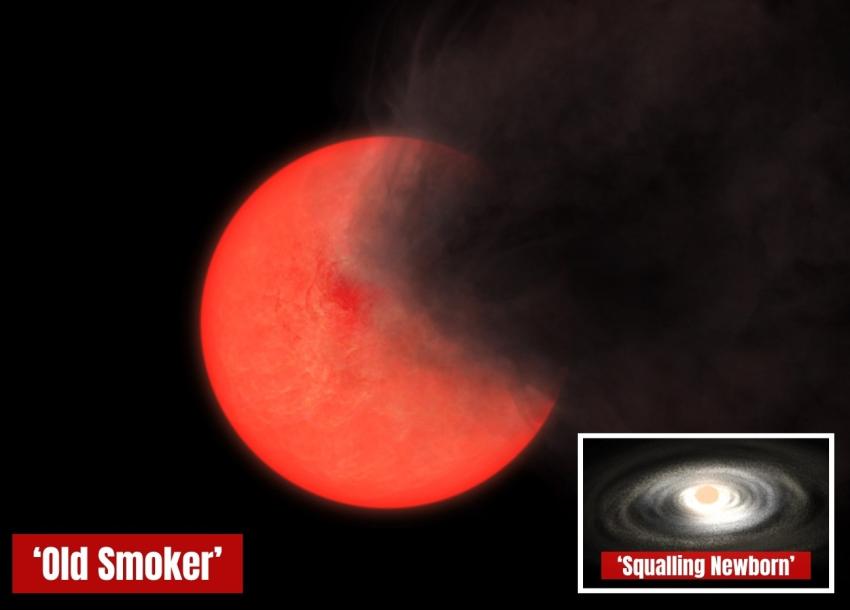
Artist impressions of a so-called 'Old Smoker' red giant star and 'Squalling Newborn' protostar, both observed as part of new research.
Discovery: Pictured main is an artist’s impression of a cloud of gas and dust being thrown out by a new type of red giant star dubbed an ‘old smoker’. It was spotted along with dozens of so-called ‘squalling newborn’ protostars (inset) at the heart of the Milky Way by an international team of astronomers.
Credit
Philip Lucas/University of Hertfordshire
Licence type Attribution (CC BY 4.0)

‘Hidden’ stars including a new type of elderly giant nicknamed an ‘old smoker’ have been spotted for the first time by astronomers.

The mystery objects exist at the heart of our Milky Way galaxy and can sit quietly for decades – fading almost to invisibility – before suddenly puffing out clouds of smoke, according to a new study published today in the Monthly Notices of the Royal Astronomical Societ...

Read More
Stars Travel More Slowly at Milky Way’s Edge

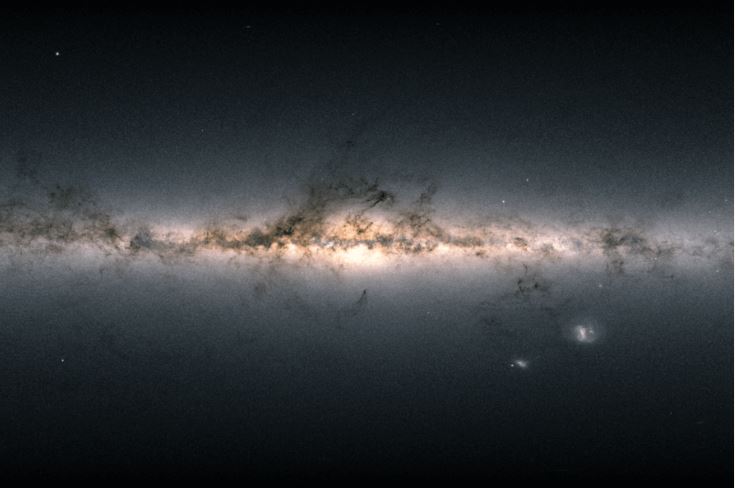
Physicists discovered stars near the edge of the Milky Way travel more slowly than those closer to its center — a surprise suggesting our galaxy’s gravitational core may have less dark matter than previously thought.

By clocking the speed of stars throughout the Milky Way galaxy, MIT physicists have found that stars further out in the galactic disk are traveling more slowly than expected compared to stars that are closer to the galaxy’s center. The findings raise a surprising possibility: The Milky Way’s gravitational core may be lighter in mass, and contain less dark matter, than previously thought.

The new results are based on the team’s analysis of data taken by the Gaia and APOGEE instruments...

Read More

Astrophysical Jet caught in a ‘Speed Trap’

Violett leuchtende und wabernde Gasblase in Cocoon-Form vor schwarzem Hintergrund mit blauen Lichtstrahlen entlang einer Linie im Inneren
Artist’s impression of the SS 433 system, depicting the large-scale jets (blue) and the surrounding Manatee Nebula (red). The jets are initially observable only for a short dis-tance from the microquasar after launch — too small to be visible in this picture. The jets then travel undetected for a distance of approximately 80 light-years (25 parsecs) before un-dergoing a transformation, abruptly reappearing as bright sources of non-thermal emission (X-ray and gamma-ray). Particles are efficiently accelerated at this location, likely indicating the presence of a strong shock: a discontinuity in the medium capable of accelerating particles.
© Science Communication Lab for MPIK/H.E.S.S.

The science fiction author Arthur C...

Read More

Atmospheric Pressure Changes could be Driving Mars’ Elusive Methane Pulses

2024-01-24
New simulations are helping inform the Curiosity rover’s ongoing sampling campaign. Credit:NASA/JPL-Caltech/MSSS

Simulations will help Curiosity search for signs of past or present life on the Red Planet. New research shows that atmospheric pressure fluctuations that pull gases up from underground could be responsible for releasing subsurface methane into Mars’ atmosphere; knowing when and where to look for methane can help the Curiosity rover search for signs of life.

“Understanding Mars’ methane variations has been highlighted by NASA’s Curiosity team as the next key step towards figuring out where it comes from,” said John Ortiz, a graduate student at Los Alamos National Laboratory who led the research team.

“There are several challenges associated with meeting that goal, an...

Read More
