Category Astronomy/Space

A New Way to Characterize Habitable Planets

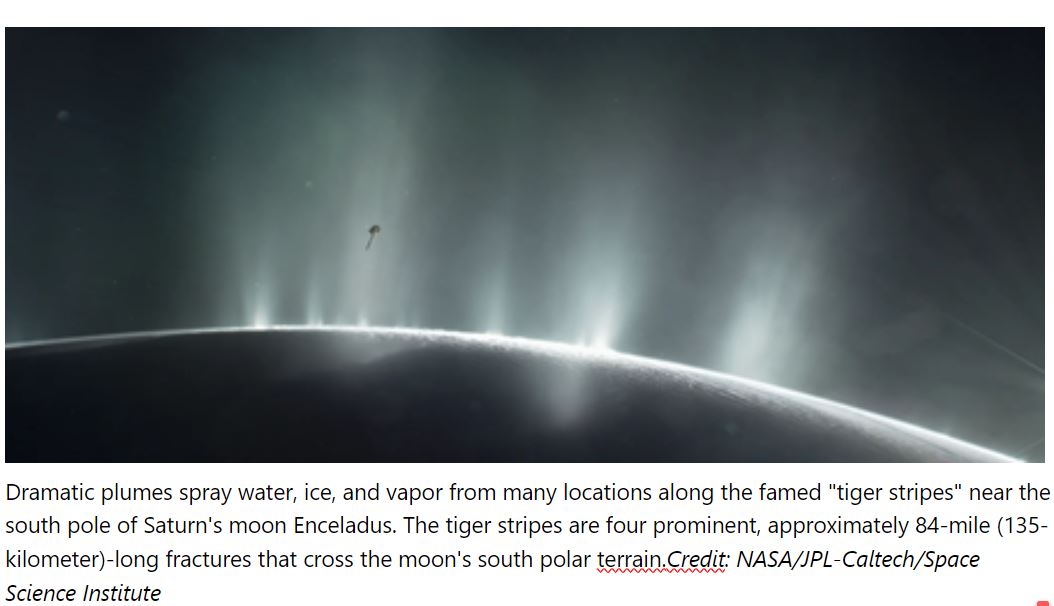
For decades, science fiction authors have imagined scenarios in which life thrives on the harsh surfaces of Mars or our moon, or in the oceans below the icy surfaces of Saturn’s moon Enceladus and Jupiter’s moon Europa. But the study of habitability—the conditions required to support and sustain life—is not just confined to the pages of fiction. As more planetary bodies in our solar system and beyond are investigated for their potential to host conditions favorable to life, researchers are debating how to characterize habitability.

While many studies have focused on the information obtained by orbiting spacecraft or telescopes that provide snapshot views of ocean worlds and exoplanets, a new paper emphasizes the importance of investigating complex geophysical factors that can b...

Read More
A Carbon-lite Atmosphere could be a Sign of Water and Life on other Terrestrial Planets

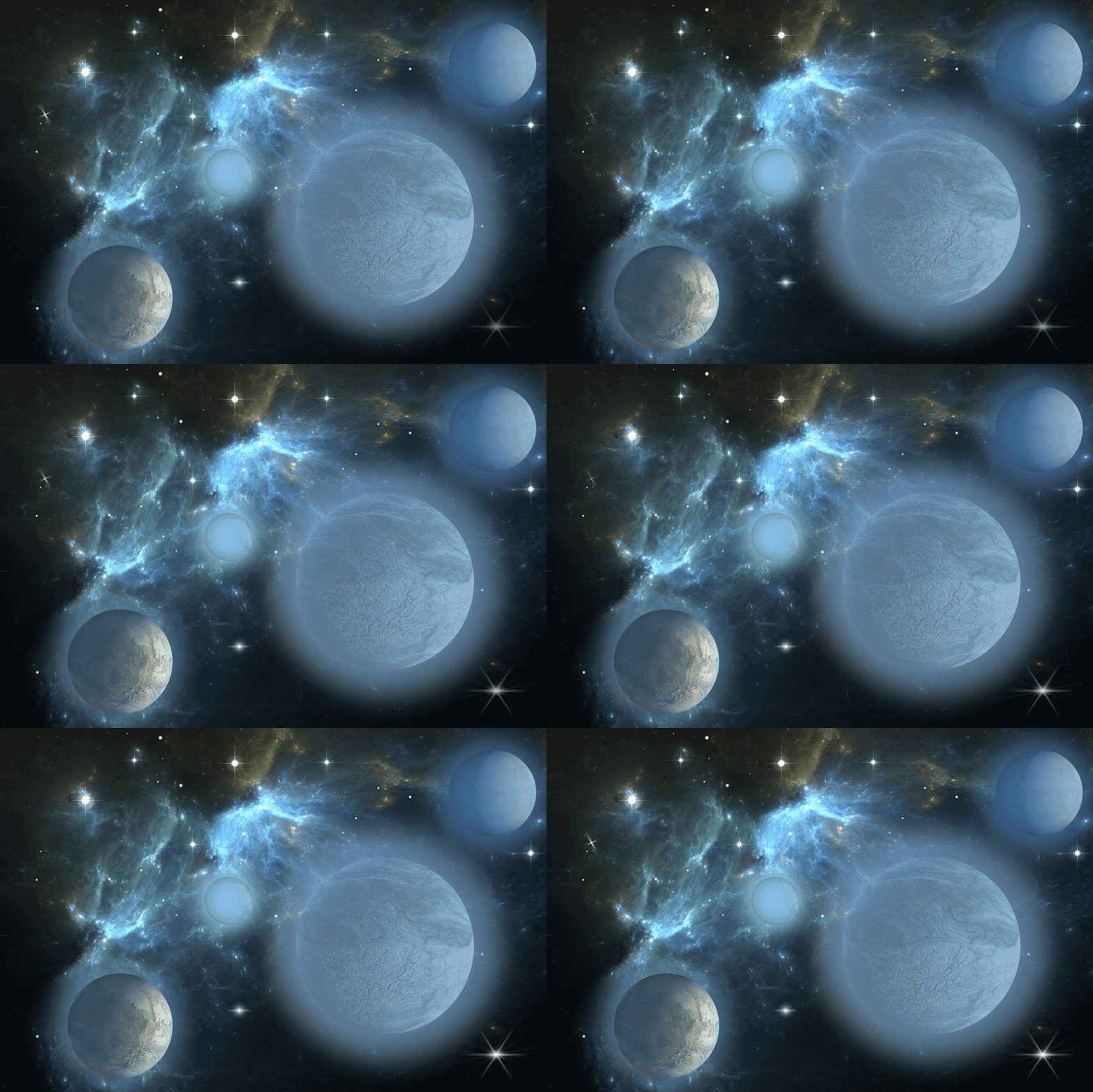
Four planets in space with one having a thinner atmosphere cloud than the rest
Caption:In the search for extraterrestrial life, MIT scientists say a planet’s carbon-lite atmosphere, relative to its neighbors, could be a sure and detectable signal of habitability.
Credits:Image: Christine Daniloff, MIT; iStock

A low carbon abundance in planetary atmospheres could be a signature of habitability. Scientists at MIT, the University of Birmingham, and elsewhere say that astronomers’ best chance of finding liquid water, and even life on other planets, is to look for the absence, rather than the presence, of a chemical feature in their atmospheres.

The researchers propose that if a terrestrial planet has substantially less CO2 in its atmosphere compared to other planets in the same system, it could be a sign of liquid water — and possibly life — on that planet’s surf...

Read More

Tatahouine: ‘Star Wars Meteorite’ Sheds Light on the Early Solar System

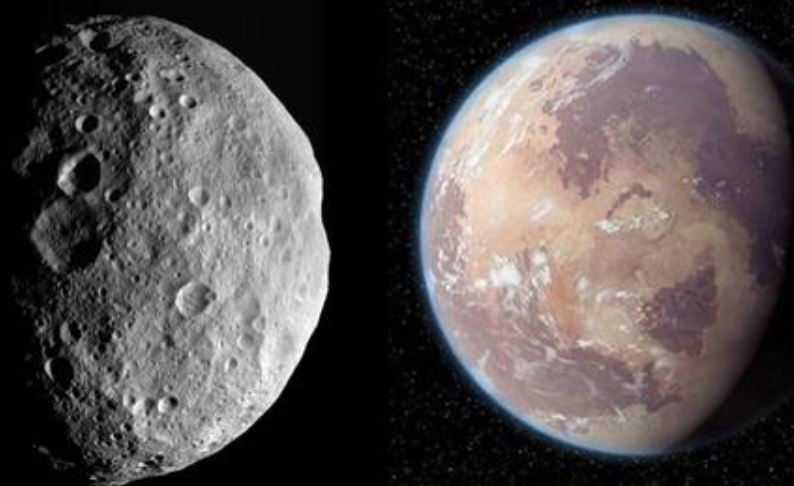
The asteroid 4 vesta, left, and Tatooine, as seen in Star Wars, on the right. Nasa and wikipedia

Locals watched in awe as a fireball exploded and hundreds of meteorite fragments rained down on the city of Tatahouine, Tunisia, on June 27, 1931. Fittingly, the city later became a major filming location for the Star Wars movie series. The desert climate and traditional villages became a huge inspiration to the director, George Lucas, who proceeded to name the fictional home planet of Luke Skywalker and Darth Vader, “Tatooine.”

The mysterious 1931 meteorite, a rare type of achondrite (a meteorite that has experienced melting) known as a diogenite, is obviously not a fragment of Skywalker’s home planet. But it was similarly named after the city of Tatahouine...

Read More

New study shows Small Magellanic Cloud is actually Two Smaller Galaxies

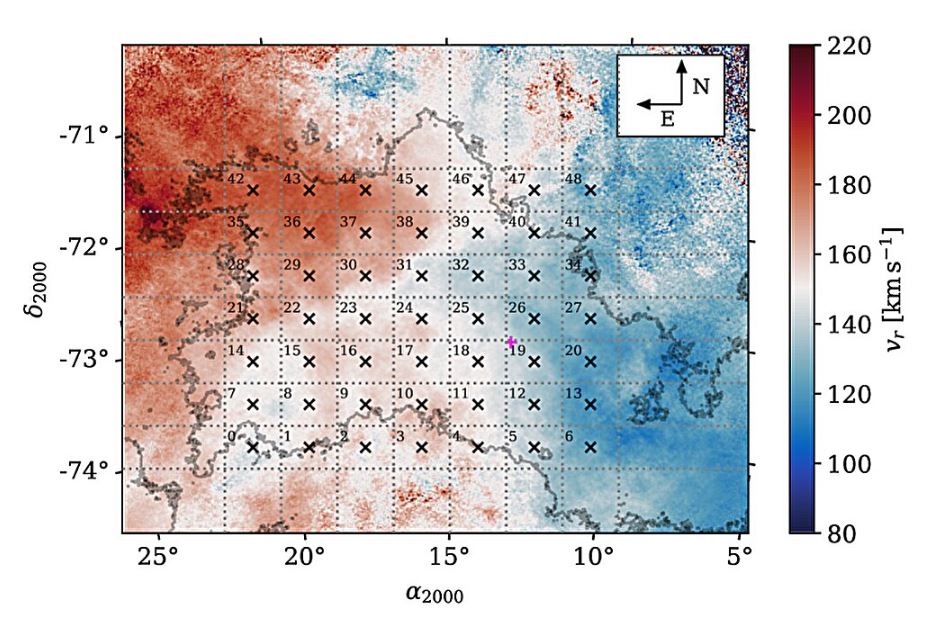
Top: Intensity-weighted mean velocity map of the SMC from Pingel et al (2022). The single contour indicates an Hi column density of 15×1020⁢cm−2. The center of the SMC used in this work (defined based on the stellar populations observed by Gaia Zivick et al, 2021) is marked with a magenta cross. Spatial bins are overlaid and identified with numbers. Bottom: The average Hi brightness temperature spectra (Tb⁢(vr)) profiles from spatial bins marked at left (black). Each panel includes shaded gray envelopes denoting the 16th through 84th percentile of the Tb⁢(vr) within each spatial bin. We observe that the radial velocity structure of Hi emission features multiple, distinct velocity peaks (and typically two, dominant components). Credit: arXiv (2023). DOI: 10.48550/arxiv.2312...
Read More