Category Astronomy/Space

Hubble Sights a Galaxy with ‘Forbidden’ Light

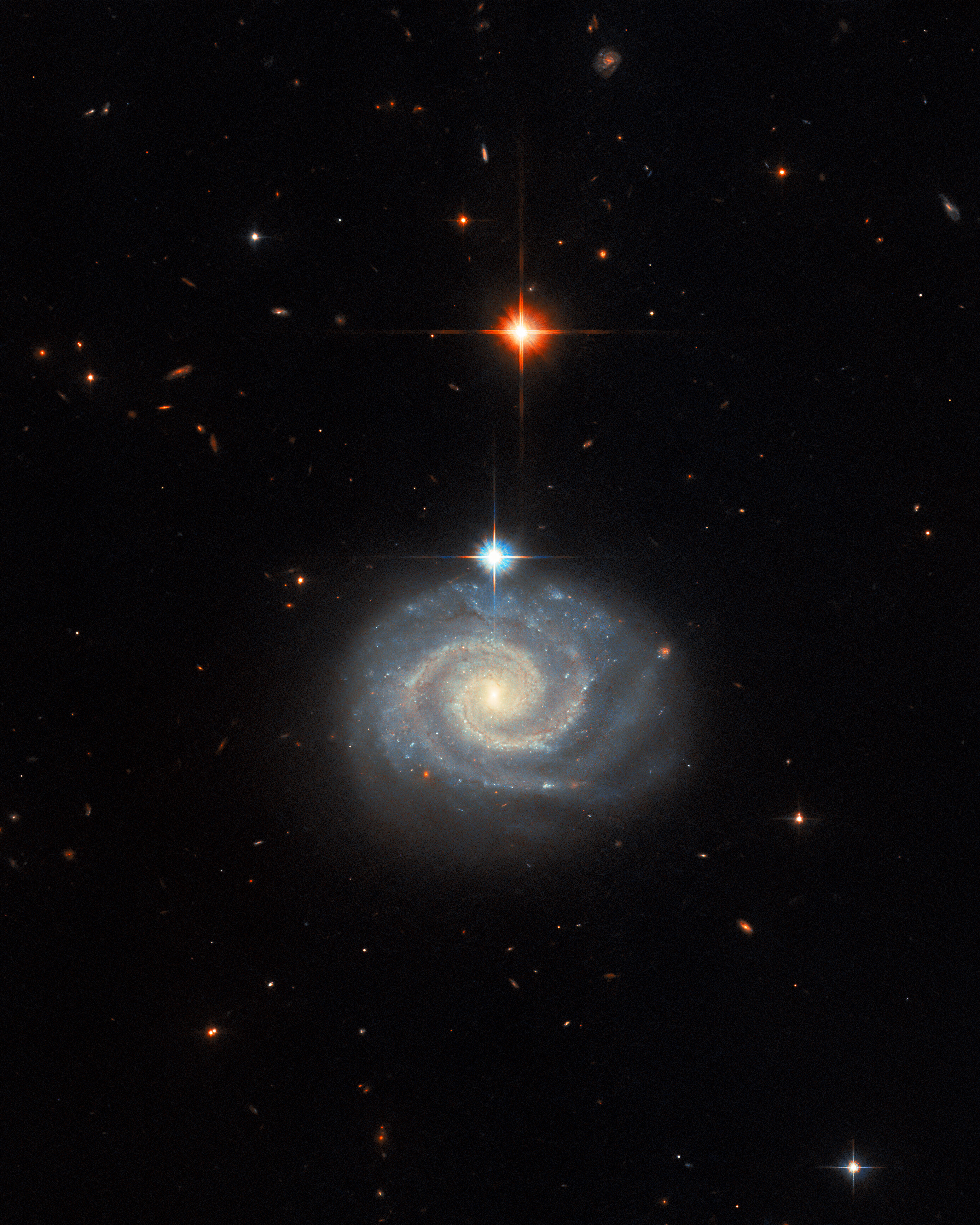
A spiral galaxy. It appears to be almost circular and seen face-on, with two prominent spiral arms winding out from a glowing core. It is centered in the frame as if a portrait. Most of the background is black, with only tiny, distant galaxies, but there are two large bright stars in the foreground, one blue and one red, directly above the galaxy.
This NASA Hubble Space Telescope image features a bright spiral galaxy known as MCG-01-24-014, which is located about 275 million light-years from Earth.
ESA/Hubble & NASA, C. Kilpatrick

This whirling image features a bright spiral galaxy known as MCG-01-24-014, which is located about 275 million light-years from Earth. In addition to being a well-defined spiral galaxy, MCG-01-24-014 has an extremely energetic core known as an active galactic nucleus (AGN) and is categorized as a Type-2 Seyfert galaxy.

Seyfert galaxies, along with quasars, host one of the most common subclasses of AGN...

Read More
Research Charts Stellar Birthplaces in the Whirlpool Galaxy for the first time

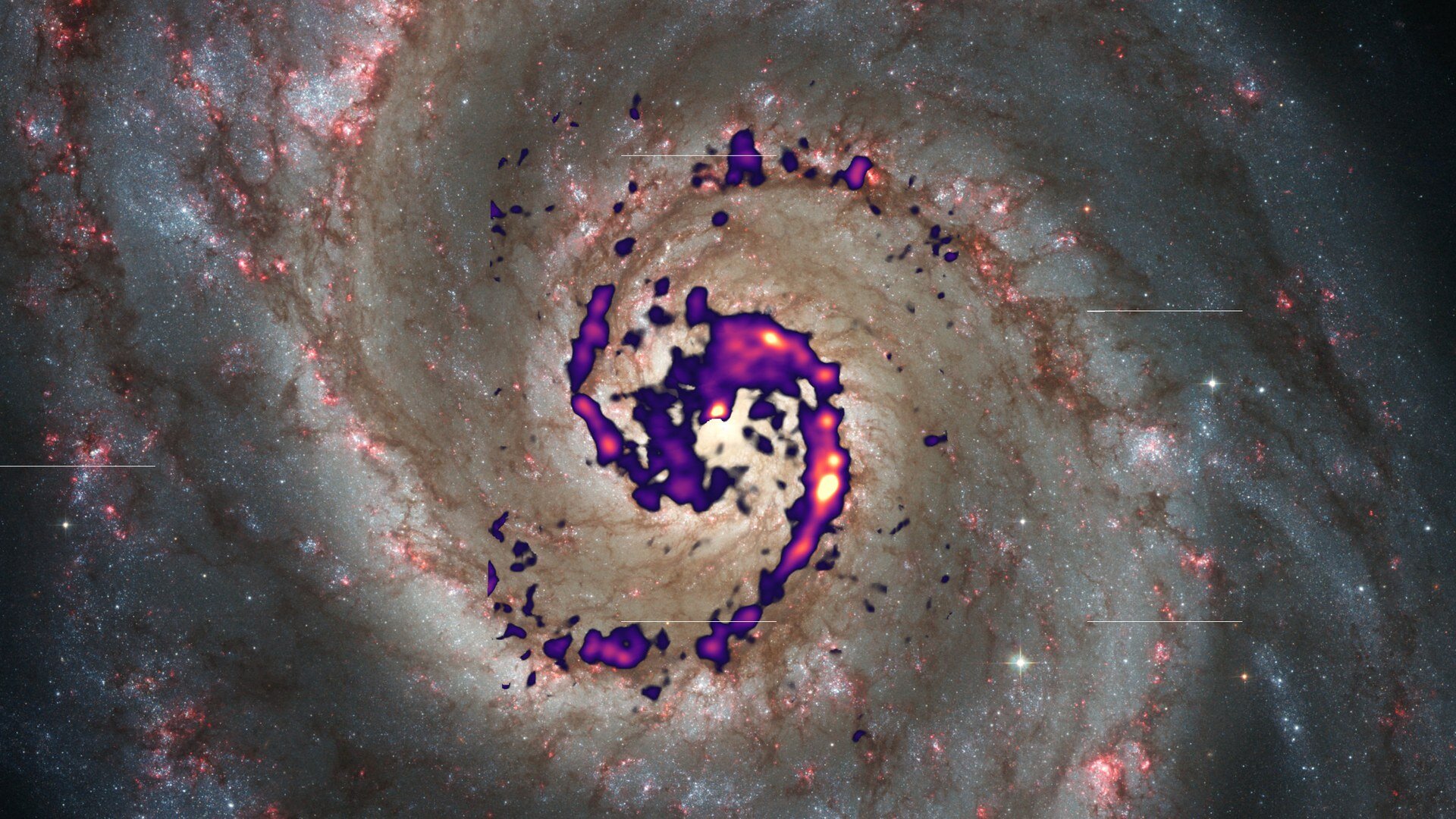
Stellar Birthplaces in the Whirlpool Galaxy
This illustration depicts the distribution of diazenylium molecule radiation (false colors) in the Whirlpool Galaxy, compared with an optical image. The reddish areas in the photograph represent luminous gas nebulae containing hot, massive stars traversing dark zones of gas and dust in the spiral arms. The presence of diazenylium in these dark regions suggests particularly cold and dense gas clouds. Credit: Thomas Müller (HdA/MPIA), S. Stuber et al. (MPIA), NASA, ESA, S. Beckwith (STScI) und das Hubble Heritage Team (STScI/AURA)

An international research team led by the Max Planck Institute for Astronomy (MPIA) and involving the University of Bonn has mapped the cold, dense gas of future star nurseries in one of our neighboring galaxies with an unprecedented degree of detail...

Read More

Second Radio Relic discovered in the Galaxy Cluster Abell 2108

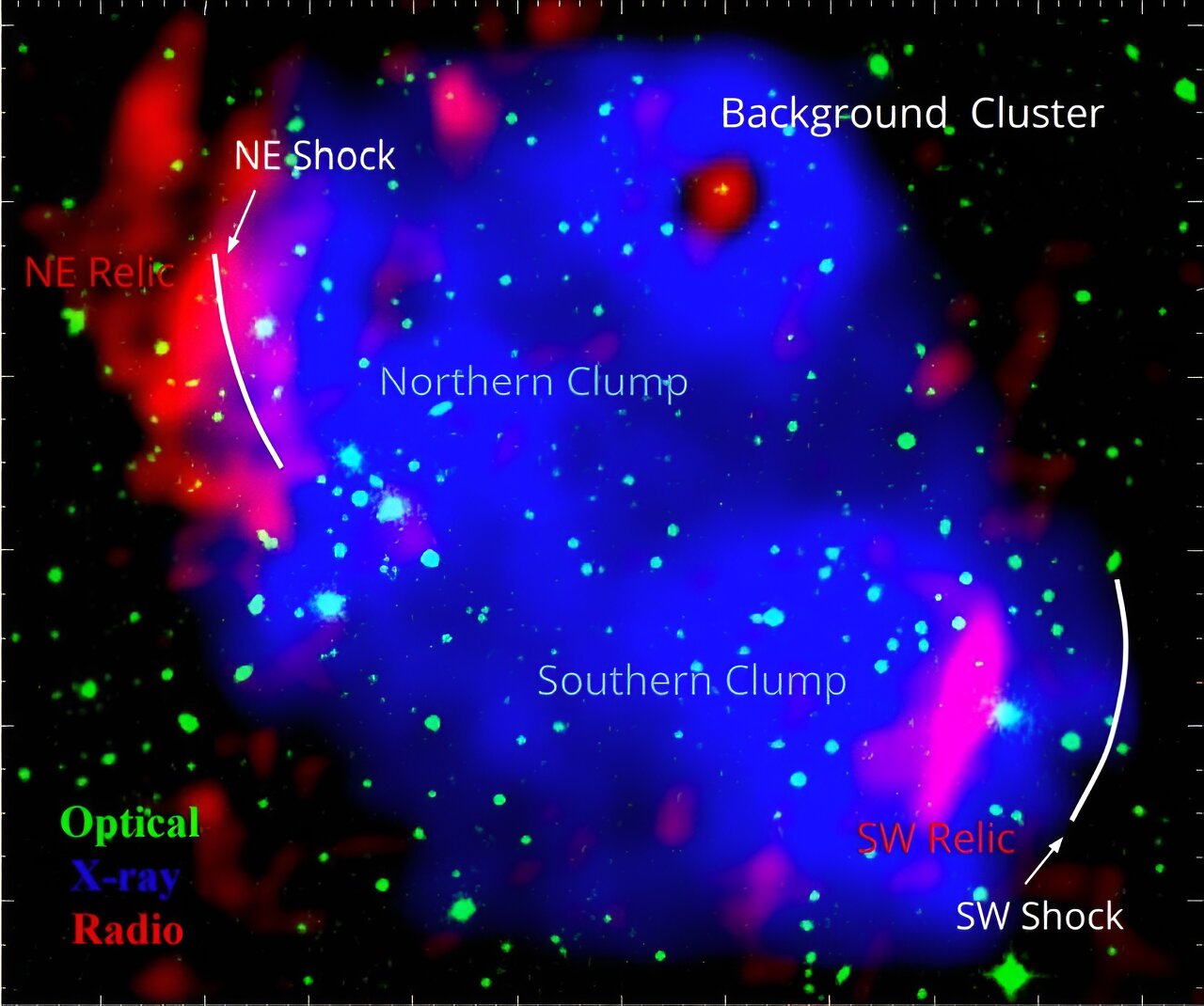
Second radio relic discovered in the galaxy cluster Abell 2108
Color composite image of Abell 2108 showing Pan-STARRS ‘r’ band optical image in green, XMM-Newton X-ray in blue, and uGMRT point source removed radio image in red. Credit: arXiv (2023). DOI: 10.48550/arxiv.2312.04170

Astronomers from India and Taiwan have used the upgraded Giant Metrewave Radio Telescope (uGMRT) to perform radio observations of a galaxy cluster known as Abell 2108. As a result, they detected a second radio relic, which is much larger and differs in morphology from the previously identified relic in this cluster. The finding was reported in a paper published Dec. 7 on the pre-print server arXiv.

Radio relics are diffuse, elongated radio sources of synchrotron origin...

Read More

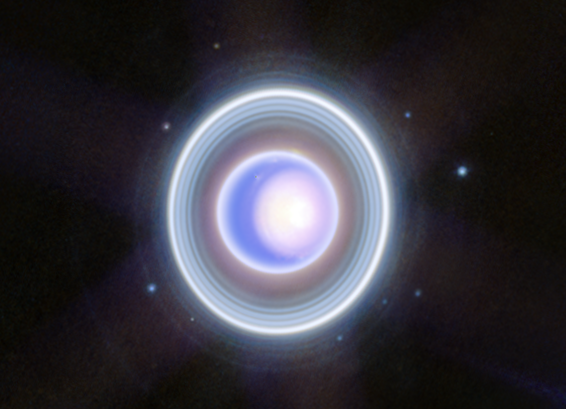
Webb Rings in Holidays with Ringed Planet Uranus

The planet Uranus on a black background. The planet appears blue with a large, white patch taking up the right half. The patch is whitest at the center, then fades into blue at it expands from right to left. A thin outline of Uranus is also white. Around the planet is a system of nested rings. The outermost ring is the brightest while the innermost ring is the faintest. Unlike Saturn’s horizontal rings, the rings of Uranus are vertical and so they appear to surround the planet in an oval shape. There are 9 blueish white dots scattered around the rings.
This image of Uranus from NIRCam (Near-Infrared Camera) on NASA’s James Webb Space Telescope exquisitely captures Uranus’s seasonal north polar cap and dim inner and outer rings. This Webb image also shows 9 of the planet’s 27 moons – clockwise starting at 2 o’clock, they are: Rosalind, Puck, Belinda, Desdemona, Cressida, Bianca, Portia, Juliet, and Perdita.
NASA, ESA, CSA, STScI

The James Webb Space Telescope recently trained its sights on unusual and enigmatic Uranus, an ice giant that spins on its side. Webb captured this dynamic world with rings, moons, storms, and other atmospheric features—including a seasonal polar cap. The image expands upon a two-color version released earlier this year, adding additional wavelength coverage for a more detailed look.

With its exq...

Read More