Category Astronomy/Space

KiDS in the sky: New Stellar system discovered by the Kilo-Degree Survey

KiDS in the sky: new stellar system discovered by the Kilo-Degree Survey
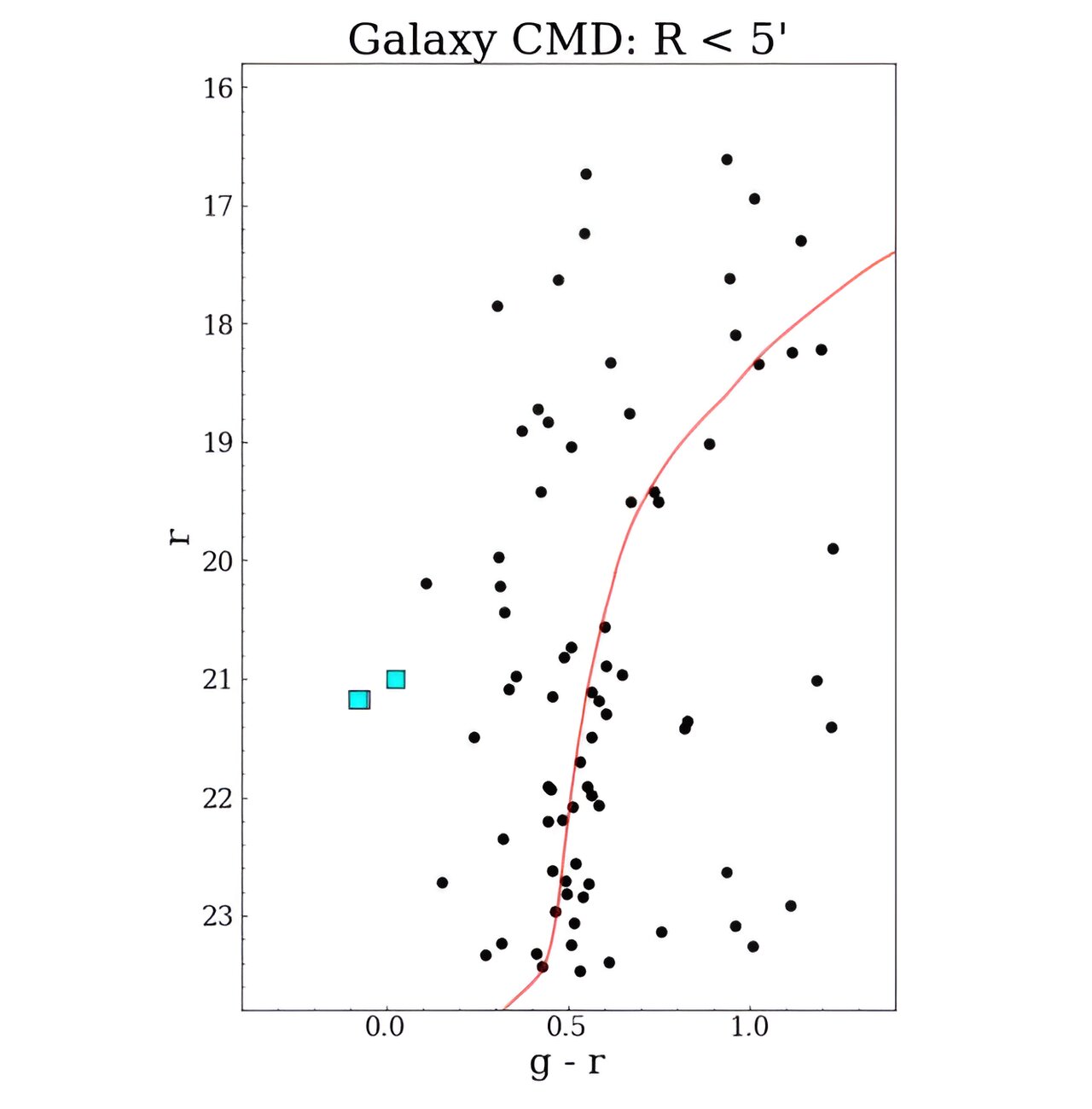
Color-magnitude diagram of stars located within 5′ from the newfound stellar overdensity center. Credit: arXiv (2023). DOI: 10.48550/arxiv.2311.06037

Astronomers have discovered a new stellar system in the outskirts of the Milky Way as part of the Kilo-Degree Survey (KiDS). The newfound system, named Sextans II, is most likely an ultra-faint dwarf galaxy. The finding is reported in a paper published November 10 on the pre-print server arXiv.

KiDS is an extensive multi-band photometric survey utilizing the VLT Survey Telescope (VST) at ESO’s Paranal Observatory in Chile. Since 2011, the survey has been mapping 1,350 square degrees of the night sky in four broad-band filters (u, g, r, i)...

Read More
Why the Vast Supergalactic Plane is Teeming with Only One Type of Galaxy

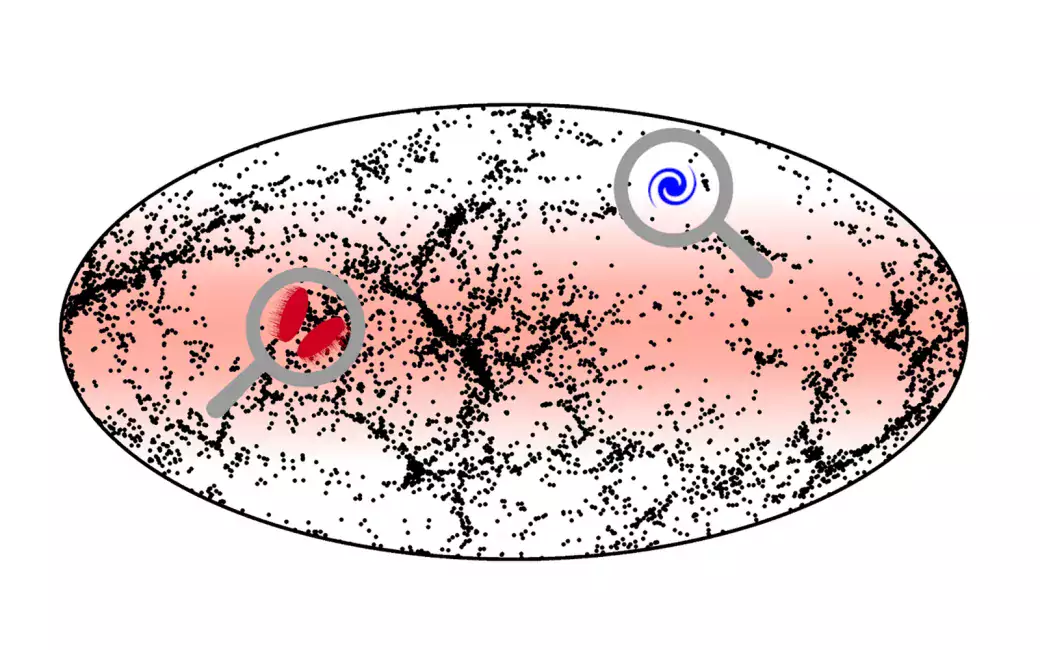
Mustia pisteitä ellipsin sisällä, keskiosassa punainen ellipsigalaksi, reunalla sininen kiekkogalaksi.
In the supergalactic plane, which lies on the equator of the picture, galaxies experience frequent interactions and mergers, leading to the formation of massive elliptical galaxies. By contrast, galaxies away from the plane evolve in relative isolation, allowing them to preserve their disk-like structure. (Image: Till Sawala)

Our own Milky Way galaxy is part of a much larger formation, the local Supercluster structure, which contains several massive galaxy clusters and thousands of individual galaxies. Due to its pancake-like shape, which measures almost a billion light years across, it is also referred to as the Supergalactic Plane.

Most galaxies in the universe fall into one of two categories: firstly, elliptical galaxies, made mostly of old stars and containing typically extremel...

Read More

‘Triple Star’ Discovery could Revolutionize Understanding of Stellar Evolution

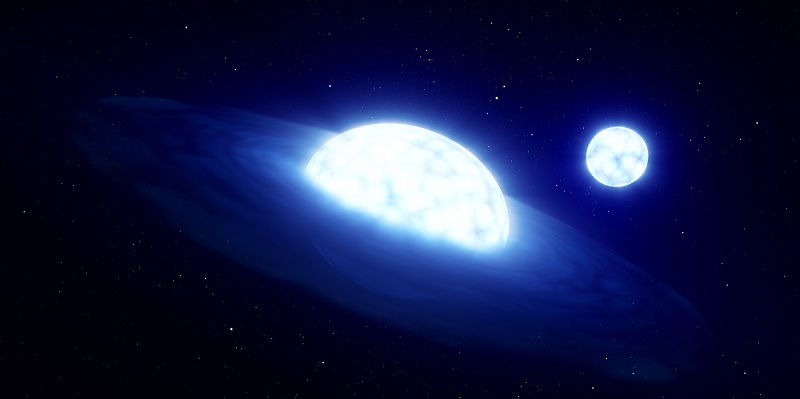
Large ball of light surrounded by blue disc of light and smaller ball of light hovering above
Artist’s impression composed of a star with a disc around it (a Be “vampire” star; foreground) and its companion star that has been stripped of its outer parts (background). Credit: ESO/L. Calçada

A ground-breaking new discovery by University of Leeds scientists could transform the way astronomers understand some of the biggest and most common stars in the Universe.

Research by PhD student Jonathan Dodd and Professor René Oudmaijer, from the University’s School of Physics and Astronomy, points to intriguing new evidence that massive Be stars — until now mainly thought to exist in double stars — could in fact be “triples.”

The remarkable discovery could revolutionise our understanding of the objects — a subset of B stars — which are considered an important “test bed” for d...

Read More

‘Teenage Galaxies’ are Unusually Hot, Glowing with Unexpected Elements

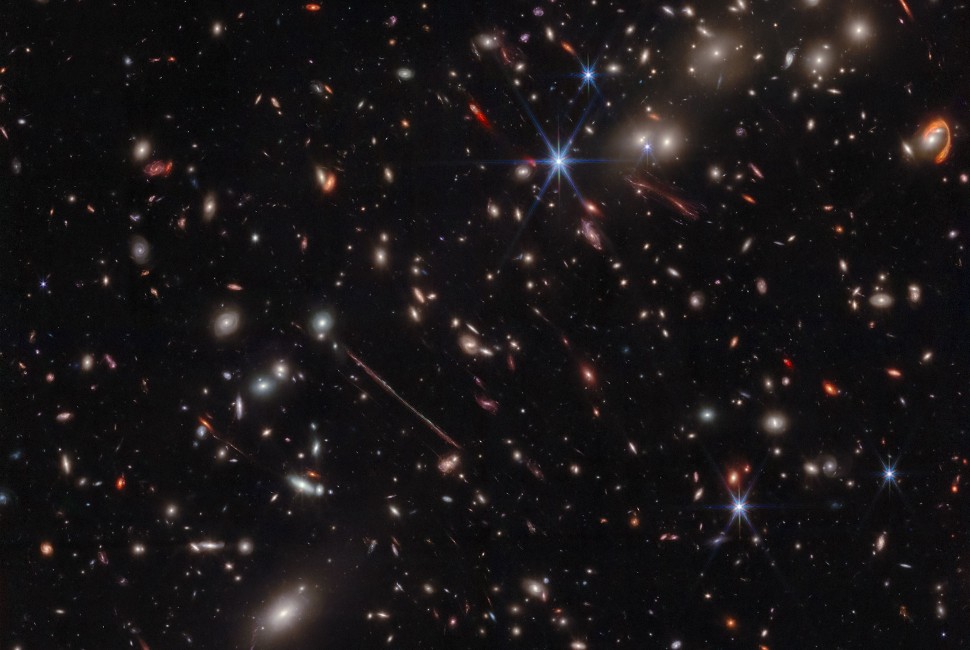
A Webb telescope image of a galaxy cluster known as “El Gordo,” which is an example of a “cosmic teenager.” Credit: NASA, ESA, CSA

Similar to human teenagers, teenage galaxies are awkward, experience growth spurts and enjoy heavy metal — nickel, that is.

A Northwestern University-led team of astrophysicists has just analyzed the first results from the CECILIA (Chemical Evolution Constrained using Ionized Lines in Interstellar Aurorae) Survey, a program that uses NASA’s James Webb Space Telescope (JWST) to study the chemistry of distant galaxies.

According to the early results, so-called “teenage galaxies” — which formed two-to-three billion years after the Big Bang — are unusually hot and contain unexpected elements, like nickel, which are notoriously difficult to observe.

The...

Read More