Category Astronomy/Space

Galactic ‘Lightsabers’: Answering Longstanding Questions about Jets from Black Holes

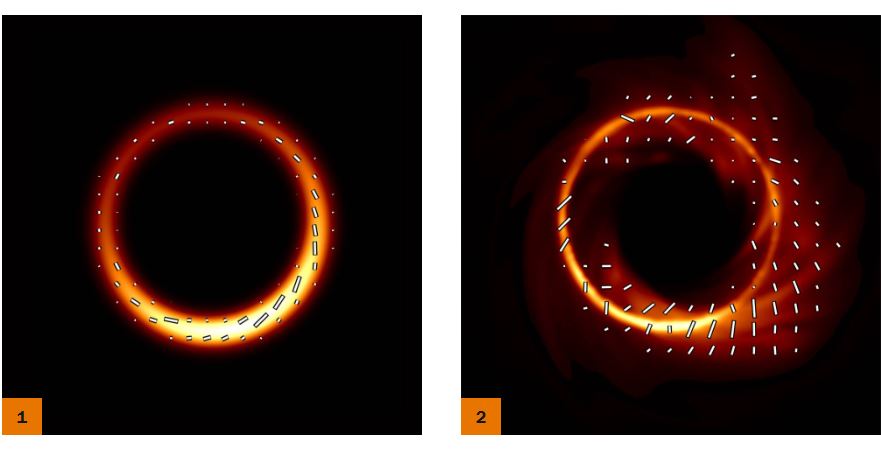
1. A simple black hole model.
To test the connection between black hole images and energy flow around black holes, the team used both simple models of a glowing ring of gas (left) and full 3D supercomputer simulations (right). By verifying that the connection between the spiral of polarization in the images persisted in both cases, they established that it could be potentially be used with real images of black holes from the Event Horizon Telescope (EHT) to test if magnetic fields are extracting energy and spinning down the black hole.
Images by Andrew Chael, George Wong, Alexandru Lupsasca and Eliot Quataert, Princeton Gravity Initiative
2. A 3D supercomputer simulation of M87*

The one thing everyone knows about black holes is that absolutely everything nearby gets sucked into them.

A...

Read More
Second-most Distant Galaxy discovered using James Webb Space Telescope

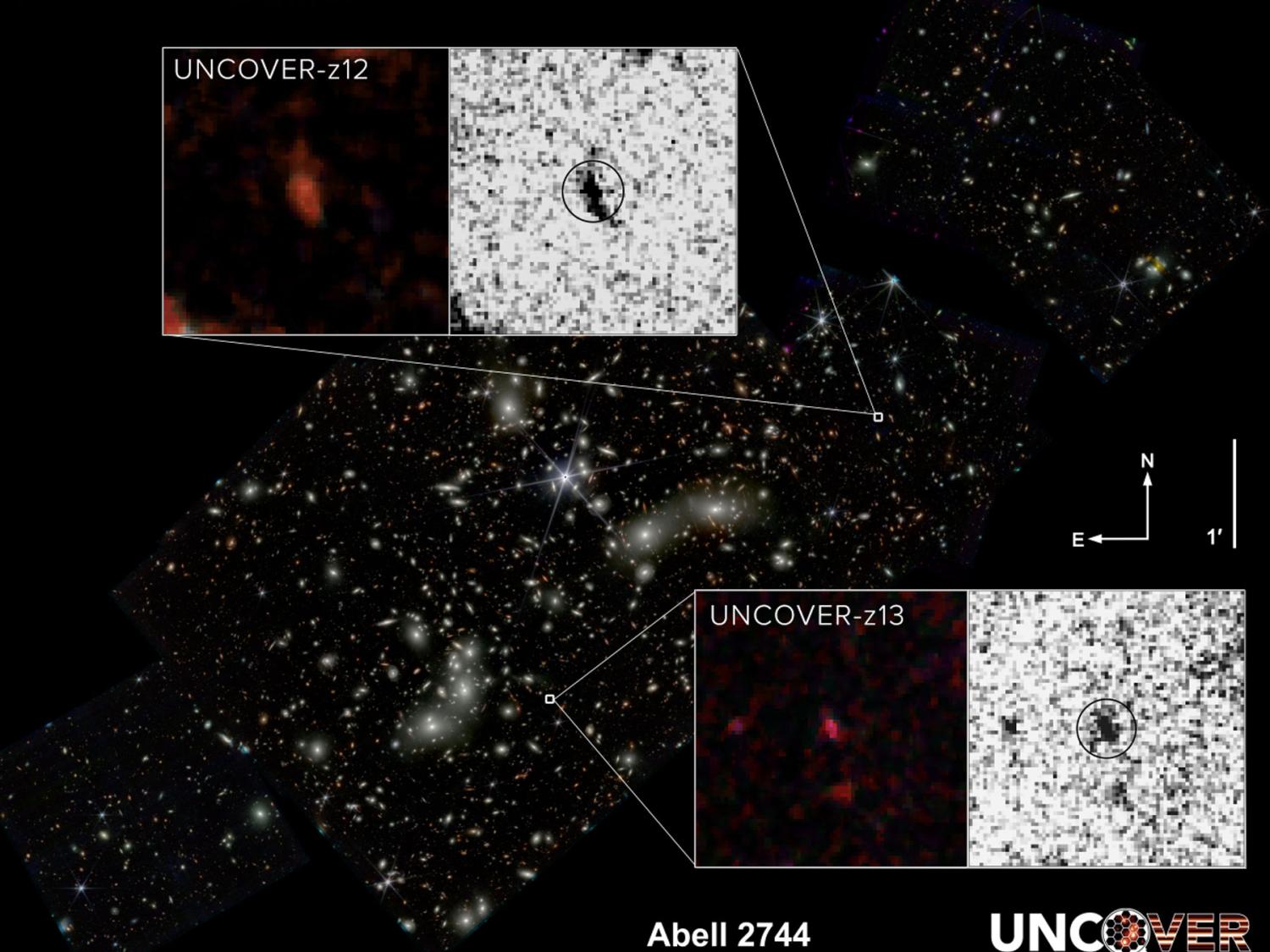
composite image of pandora's cluster, with two close-up inset images
The second- and fourth-most distant galaxies ever seen (UNCOVER z-13 and UNCOVER z-12) have been confirmed using the James Webb Space Telescope’s Near-Infrared Camera (NIRCam). The galaxies are located in Pandora’s Cluster (Abell 2744), shown here as near-infrared wavelengths of light that have been translated to visible-light colors. The scale of the main cluster image is labelled in arcseconds, which is a measure of angular distance in the sky. The circles on the black-and-white images, showing the galaxies in the NIRCam-F277W filter band onboard JWST, indicate an aperture size of 0.32 arcsec. Credit: Cluster image: NASA, UNCOVER (Bezanson et al., DIO: 10.48550/arXiv.2212.04026). Insets: Nasa, UNCOVER (Wang et al., 2023). Composition: Dani Zemba/Penn State. All Rights Reserved.
...Read More

Oldest Black Hole Discovered Dating Back to 470 million years after the Big Bang

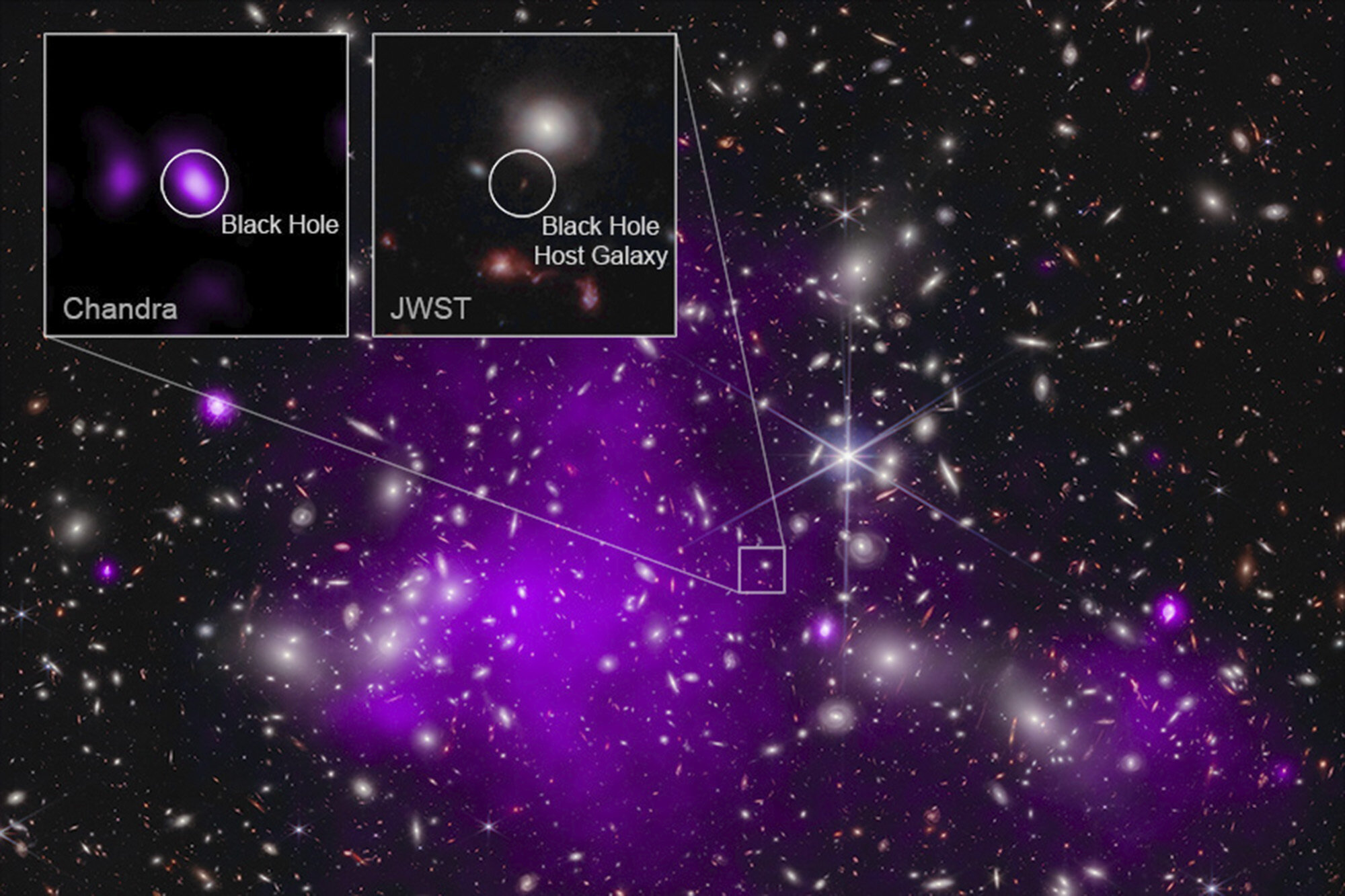
Oldest black hole discovered dating back to 470 million years after the Big Bang
This annotated image provided by NASA on Monday, Nov. 6, 2023, shows a composite view of data from NASA’s Chandra X-ray Observatory and James Webb Space Telescope indicating a growing black hole just 470 million years after the big bang. It is the oldest black hole yet discovered. Credit: NASA via AP

Scientists have discovered the oldest black hole yet, a cosmic beast formed a mere 470 million years after the Big Bang. The findings, published Monday, confirm what until now were theories that supermassive black holes existed at the dawn of the universe. NASA’s James Webb Space Telescope and Chandra X-Ray Observatory teamed up over the past year to make the observations.

Given the universe is 13.7 billion years old, that puts the age of this black hole at 13.2 billion years.

Even...

Read More

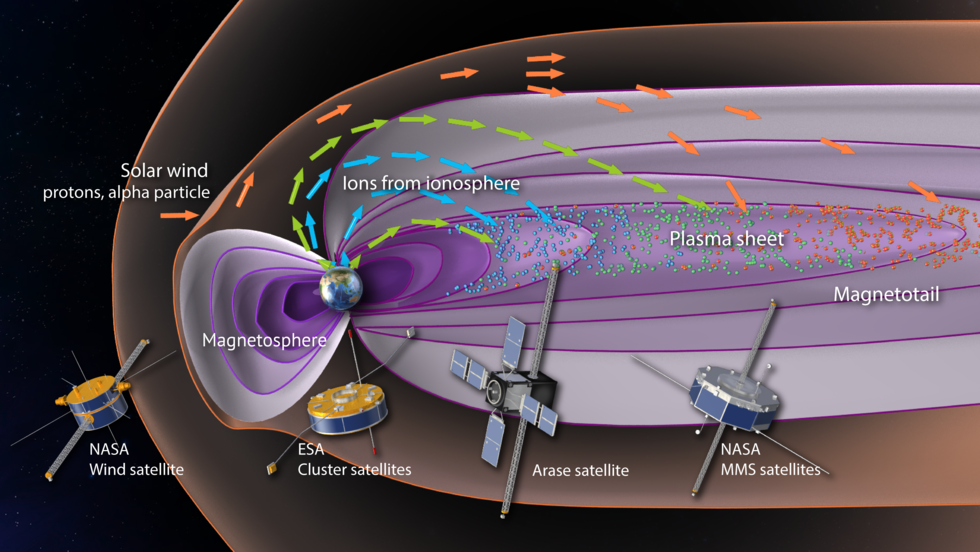
The Importance of the Earth’s Atmosphere in Creating the Large storms that Affect Satellite Communications

A study from an international team led by researchers from Nagoya University in Japan and the University of New Hampshire in the United States has revealed the importance of the Earth’s upper atmosphere in determining how large geomagnetic storms develop. Their findings reveal the previously underestimated importance of the Earth’s atmosphere. Understanding the factors that cause geomagnetic storms is important because they can have a direct impact on the Earth’s magnetic field such as causing unwanted currents in the power grid and disrupting radio signals and GPS. This research may help predict the storms that will have the greatest consequences.

Scientists have long known that geomagnetic storms are associated with the activities of the Sun...

Read More