Category Astronomy/Space

Minerals in Ancient Meteorites offer Insights into the Origin of Most of the Earth’s Surface

meteorites
Credit: Pixabay/CC0 Public Domain

Dr. Alice Stephant, an astrophysicist, is helping to solve a longstanding mystery about water on Earth: where it came from.

Scientists long thought that water, which covers 70% of the Earth, is probably rare or non-existent on other planets. The assumption was that water on Earth resulted from a unique series of galactic events billions of years ago.

Stephant, who works at the National Institute of Astrophysics in Italy’s capital Rome, is challenging these longstanding assumptions.

She has produced research that suggests the chemical components of water—hydrogen and oxygen—could have come from the giant cloud of dust and gas that gave rise to Earth’s solar system.

If water from that cloud could go directly into forming planets, it could...

Read More
Solar Farms in Space are possible

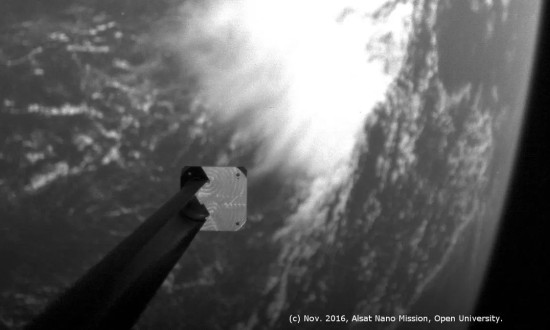
It’s viable to produce low-cost, lightweight solar panels that can generate energy in space, according to new research from the Universities of Surrey and Swansea.

The first study of its kind followed a satellite over six years, observing how the panels generated power and weathered solar radiation over 30,000 orbits.

The findings could pave the way for commercially viable solar farms in space.

Professor Craig Underwood, Emeritus Professor of Spacecraft Engineering at the Surrey Space Centre at the University of Surrey, said:

“We are very pleased that a mission designed to last one year is still working after six...

Read More

Researchers Capture First Images of a Radio ‘Ring of Fire’ Solar Eclipse

Upper row: Radio images of the 2023 Oct. 14 solar eclipse observed by the Long Wavelength Array at the Owens Valley Radio Observatory Bottom row: Schematic representation of what visible images of the eclipse looked like at the same time Credit: Sijie Yu

Researchers at New Jersey Institute of Technology’s Center for Solar-Terrestrial Research (NJIT-CSTR) have captured the Oct. 14 solar eclipse in a way never seen before — recording the first radio images of an annular eclipse’s famous “ring of fire” effect.

The eclipse was partially visible to much of the continental U.S. for several hours that Saturday, though the full “ring of fire” effect was only visible for less than five minutes, and only for those within its 125-mile-wide path of annularity.

However, the new observations o...

Read More

Black Holes could come in ‘Perfect Pairs’ in an ever Expanding Universe

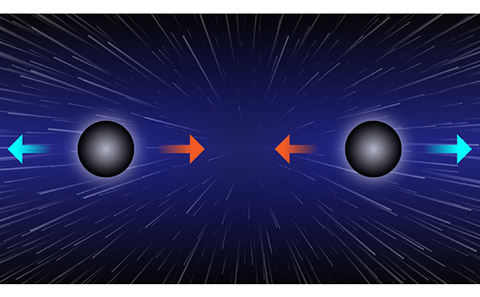
Graphic explaining forces holding two black holes at a distance.
Two black holes at fixed distance. Credit: APS/Alan Stonebraker

Researchers from the University of Southampton, together with colleagues from the universities of Cambridge and Barcelona, have shown it’s theoretically possible for black holes to exist in perfectly balanced pairs — held in equilibrium by a cosmological force — mimicking a single black hole.

Black holes are massive astronomical objects that have such a strong gravitational pull that nothing, not even light, can escape. They are incredibly dense. A black hole could pack the mass of the Earth into a space the size of a pea.

Conventional theories about black holes, based on Einstein’s theory of General Relativity, typically explain how static or spinning black holes can exist on their own, isolated in space...

Read More