Category Astronomy/Space

We Should Find Extraterrestrial Life within 60 light-years if Earth is Average, professor claims

If earth is average, we should find extraterrestrial life within 60 light-years

In 1960, while preparing for the first meeting on the Search for Extraterrestrial Intelligence (SETI), legendary astronomer and SETI pioneer Dr. Frank Drake unveiled his probabilistic equation for estimating the number of possible civilizations in our galaxy—aka The Drake Equation. A key parameter in this equation was ne, the number of planets in our galaxy capable of supporting life—aka “habitable.” At the time, astronomers were not yet certain other stars had systems of planets. But thanks to missions like Kepler, 5,523 exoplanets have been confirmed, and another 9,867 await confirmation.

Based on this data, astronomers have produced various estimates for the number of habitable planets in our galaxy—at least 100 billion, according to one estimate...

Read More
Extreme Weight Loss: Star Sheds Unexpected Amounts of Mass just before going Supernova

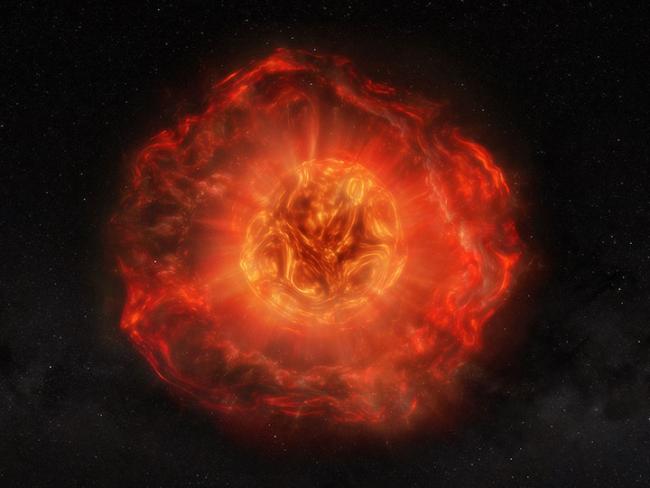
Artist’s conception of pre-explosion mass loss by the progenitor star of SN 2023ixf
Credit: Melissa Weiss/CfA

A newly discovered nearby supernova whose star ejected up to a full solar mass of material in the year prior to its explosion is challenging the standard theory of stellar evolution. The new observations are giving astronomers insight into what happens in the final year prior to a star’s death and explosion.

SN 2023ixf is a new Type II supernova discovered in May 2023 by amateur astronomer Kōichi Itagaki of Yamagata, Japan shortly after its progenitor, or origin star, exploded. Located about 20 million light-years away in the Pinwheel Galaxy, SN 2023ixf’s proximity to Earth, the supernova’s extreme brightness, and its young age make it a treasure trove of observable data for scientists studying the death of massive stars in supernova explosions.

Type II...

Read More

Did Life exist on Mars? Other Planets? With AI’s help, we may know soon

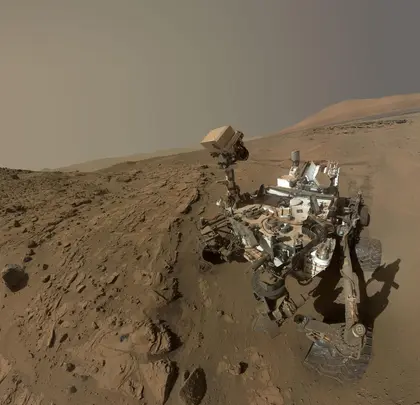
Caption: Mars Curiosity rover courtesy of NASA. 

Scientists have discovered a simple and reliable test for signs of past or present life on other planets — “the holy grail of Astrobiology.”

In the journal Proceedings of the National Academy of Sciences, a seven-member team, funded by the John Templeton Foundation and led by Jim Cleaves and Robert Hazen of the Carnegie Institution for Science, reports that, with 90% accuracy, their artificial intelligence-based method distinguished modern and ancient biological samples from those of abiotic origin.

“This routine analytical method has the potential to revolutionize the search for extraterrestrial life and deepen our understanding of both the origin and chemistry of the earliest life on Earth,” says Dr. Hazen...

Read More

Hidden Supermassive Black Holes reveal their Secrets through Radio Signals

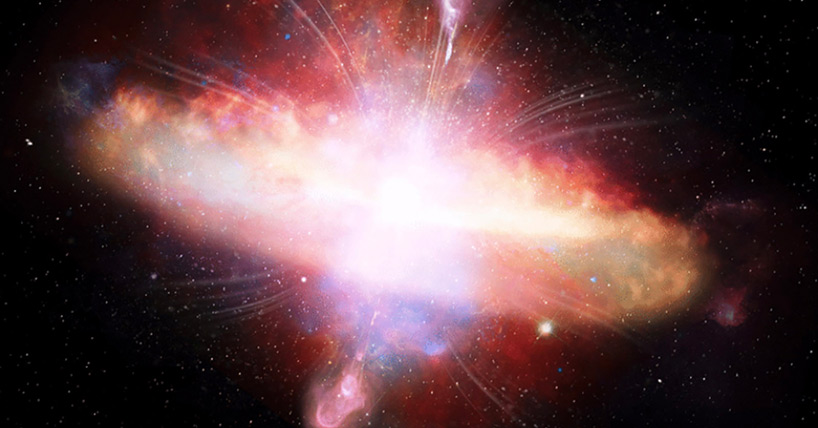
An artist’s impression of a red quasar. Red quasars are enshrouded by gas and dust, which may get blown away by outflows from the supermassive black hole, eventually revealing a typical blue quasar.
Credit: S. Munro & L. Klindt
Licence: Attribution (CC BY 4.0)
I think this is the strongest evidence so far that red quasars are a key element in how galaxies evolve
Dr Victoria Fawcett

Astronomers have found a striking link between the amount of dust surrounding a supermassive black hole and the strength of the radio emission produced in extremely bright galaxies. The findings are published in the Monthly Notices of the Royal Astronomical Society.

The team of international astronomers, led by Newcastle University and Durham University, UK, used new data from the Dark Energy Spectroscopic Instrument (DESI), which is conducting a five year survey of large scale structure in the universe that will include optical spectra for ~3 million quasars; extremely bright galaxies powered by supermassive black holes...

Read More