Category Astronomy/Space

Furthest Ever Detection of a Galaxy’s Magnetic Field

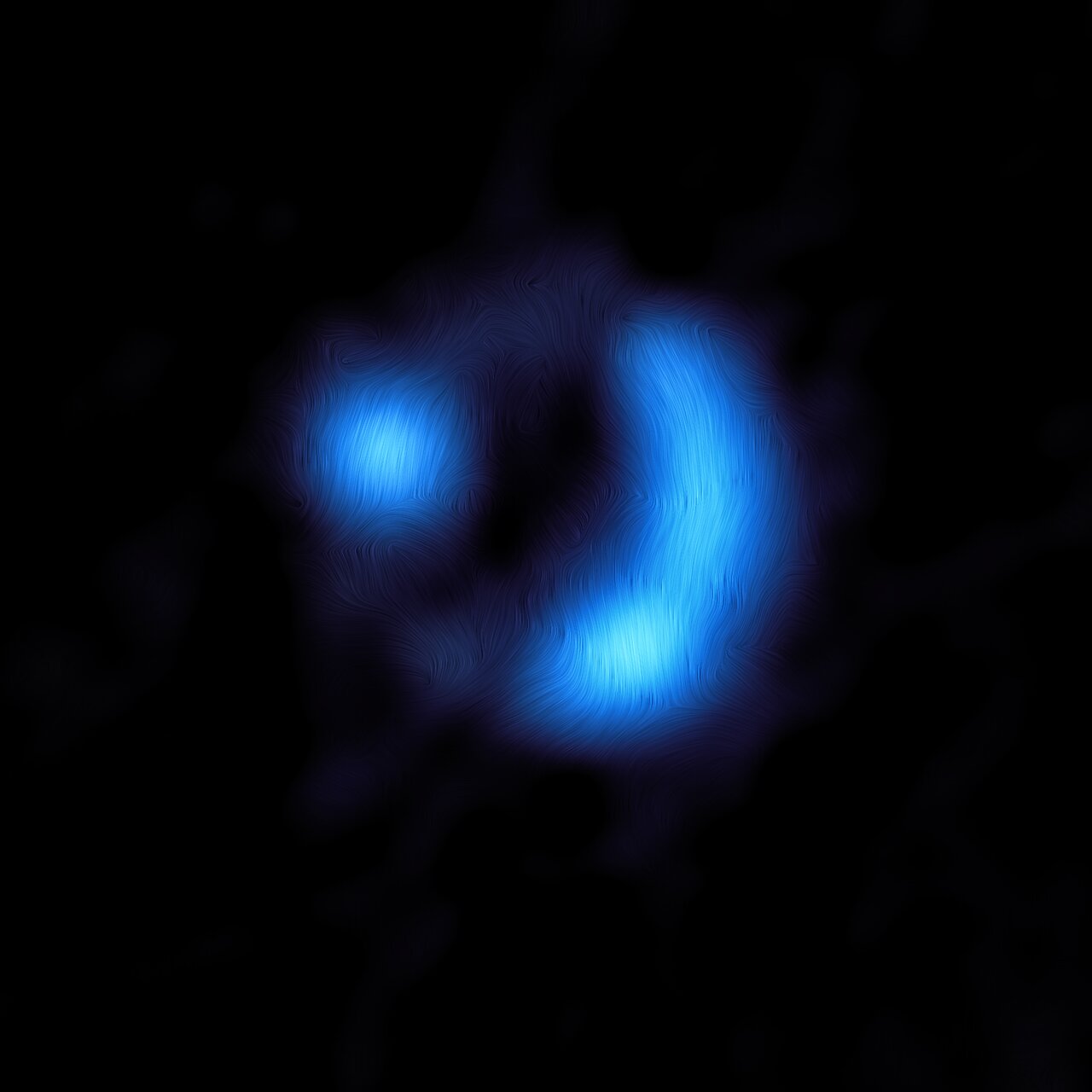
Located centrally on a dark background is an electric blue donut-shaped blob, showing the orientation of the magnetic field of the distant galaxy. The bright donut is not complete, and there are only two main features. The lines of the magnetic field give it an almost furry texture. The right-hand side of the donut forms a bright, curved banana-like shape. Instead, on the left-hand side, there is another bright region, circular in shape.
Using the Atacama Large Millimeter/submillimeter Array (ALMA), astronomers have detected the magnetic field of a galaxy so far away that its light has taken more than 11 billion years to reach us: we see it as it was when the Universe was just 2.5 billion years old. The result provides astronomers with vital clues about how the magnetic fields of galaxies like our own Milky Way came to be.

Using the Atacama Large Millimeter/submillimeter Array (ALMA), astronomers have detected the magnetic field of a galaxy so far away that its light has taken more than 11 billion years to reach us: we see it as it was when the Universe was just 2.5 billion years old. The result provides astronomers with vital clues about how the magnetic fields of galaxies like our own Milky Way came to be.

Lots of...

Read More
Webb reveals New Structures within Ionic Supernova

A pale red ring made up of small white circles surrounds a bright blue spot in the center. Three bright spots are on the outside of the ring, all against a black background speckled with stars.
Webb’s NIRCam (Near-Infrared Camera) captured this detailed image of SN 1987A (Supernova 1987A). At the center, material ejected from the supernova forms a keyhole shape. Just to its left and right are faint crescents newly discovered by Webb. Beyond them an equatorial ring, formed from material ejected tens of thousands of years before the supernova explosion, contains bright hot spots. Exterior to that is diffuse emission and two faint outer rings. In this image blue represents light at 1.5 microns (F150W), cyan 1.64 and 2.0 microns (F164N, F200W), yellow 3.23 microns (F323N), orange 4.05 microns (F405N), and red 4.44 microns (F444W).
Credits: NASA, ESA, CSA, M. Matsuura (Cardiff University), R. Arendt (NASA’s Goddard Spaceflight Center & University of Maryland, Baltimore County), C...
Read More

New Giant Planet shows evidence of possible Planetary Collisions

Impact simulationJingyao Dou

A Neptune-sized planet denser than steel has been discovered by an international team of astronomers, who believe its composition could be the result of a giant planetary clash. TOI-1853b’s mass is almost twice that of any other similar-sized planet known and its density is incredibly high, meaning that it is made up of a larger fraction of rock than would typically be expected at that scale.

In the study, published August 30 in Nature, scientists led by Luca Naponiello of University of Rome Tor Vergata and the University of Bristol suggest that this is the result of planetary collisions. These huge impacts would have removed some of the lighter atmosphere and water leaving a multitude of rock behind.

Senior Research Associate and co author Dr...

Read More

Quantum Discovery offers Glimpse into Other-Worldly Realm

Artistic illustration of an Alice ring, which researchers have just observed for the first time in nature. Credit: Heikka Valja/Aalto University

Experiments promote a curious flipside of decaying monopoles: A reality where particle physics is quite literally turned on its head. The field of quantum physics is rife with paths leading to tantalising new areas of study, but one rabbit hole offers a unique vantage point into a world where particles behave differently — through the proverbial looking glass.

Dubbed the ‘Alice ring’ after Lewis Carroll’s world-renowned stories on Alice’s Adventures in Wonderland, the appearance of this object verifies a decades-old theory on how monopoles decay...

Read More