Category Astronomy/Space

‘Thermometer’ Molecule confirmed on Exoplanet WASP31b

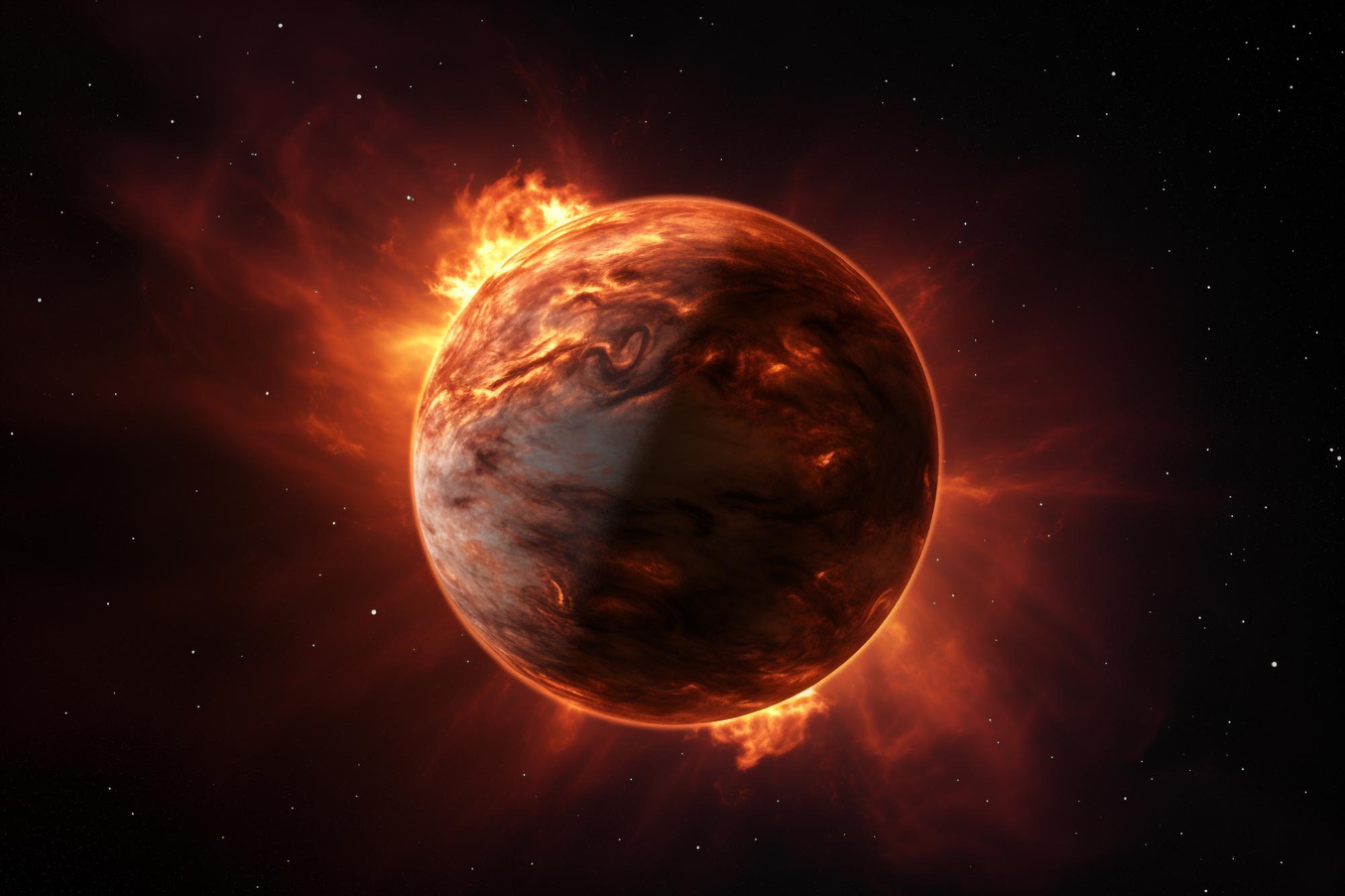
Hot Jupiter Exoplanet Art
Astronomers have confirmed the presence of chromium hydride in the atmosphere of the hot Jupiter WASP-31b using high-resolution spectral observations. This molecule, abundant only between 1,200-2,000 degrees Kelvin, has the potential to act as a “thermometer” for exoplanets.

Chromium hydride (CrH), a molecule that’s relatively rare and particularly sensitive to temperature, is useful as a “thermometer for stars,” according to astronomer Laura Flagg, because it’s abundant only in a narrow range between 1,200–2,000 degrees Kelvin.

Flagg, a research associate in astronomy in the College of Arts and Sciences (A&S), has used this and other metal hydrides to determine the temperature of cool stars and brown dwarfs...

Read More

First Observations ever of the Outskirts of a Supermassive Black Hole’s Accretion Disk

An artist’s impression of a supermassive black hole with an accretion disk orbiting it. The annotations show a hypothetical double-peaked profile with arrows indicating where in the broad line region each peak originates. Credit: NOIRLab/NSF/AURA/P. Marenfeld

Nothing can evoke an existential perspective-spiral quite like looking at an image of a galaxy. At first glance, these sublime structures may appear rather serene. But in fact the center of many galaxies is a turbulent environment containing an actively feeding supermassive black hole.

Orbiting these incomprehensibly dense objects are swirling accretion disks of gas and dust, which feed the black hole and emit copious amounts of energy all along the electromagnetic spectrum—from high-energy gamma rays and X-rays, through visi...

Read More

Mysterious Neptune Dark Spot detected from Earth for the first time

There are four telescopic images of the planet Neptune side-by-side. The rightmost one is an almost-featureless cyan disc with a faint dark spot to the upper-right. The other three, coloured in blue, green and red, show higher contrast views of dark and bright spots, as well as bands crossing the planet diagonally.

Using ESO’s Very Large Telescope (VLT), astronomers have observed a large dark spot in Neptune’s atmosphere, with an unexpected smaller bright spot adjacent to it. This is the first time a dark spot on the planet has ever been observed with a telescope on Earth. These occasional features in the blue background of Neptune’s atmosphere are a mystery to astronomers, and the new results provide further clues as to their nature and origin.

Large spots are common features in the atmospheres of giant planets, the most famous being Jupiter’s Great Red Spot. On Neptune, a dark spot was first discovered by NASA’s Voyager 2 in 1989, before disappearing a few years later...

Read More

European Astronomers Detect New Component of Radio Halo in a Nearby Galaxy Cluster

European astronomers detect new component of radio halo in a nearby galaxy cluster
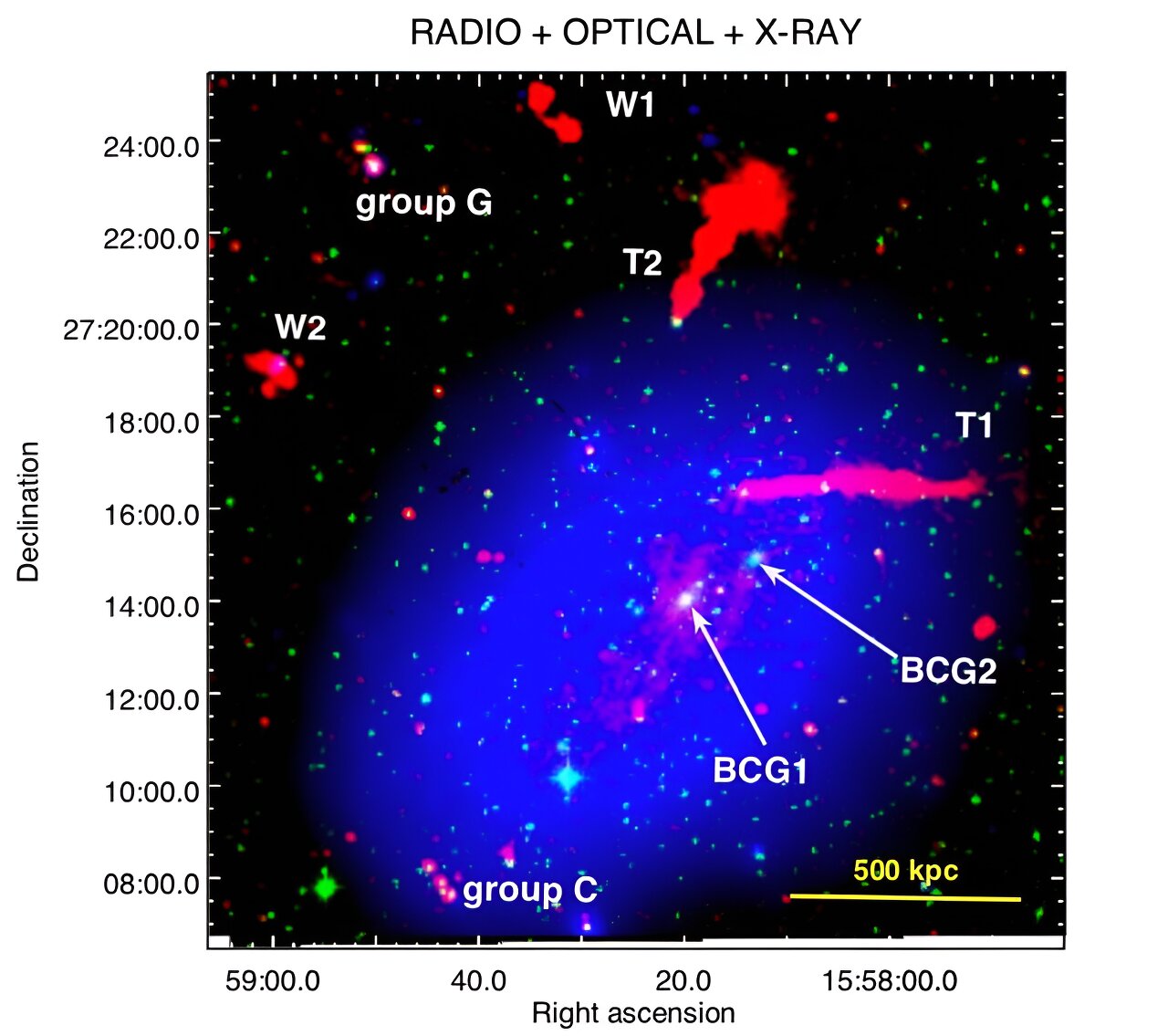
Composite RGB image of Abell 2142: radio (GMRT, 323 MHz) in red, optical (DSS-2, red filter) in green, and X-rays (XMM-Newton) in blue. Credit: Bruno et al., 2023.

Using the LOw Frequency ARray (LOFAR), astronomers from the University of Bologna, Italy and elsewhere, have conducted radio observations of the nearby galaxy cluster Abell 2142. In result, they detected a new component of the cluster’s giant radio halo. The finding was presented in a paper published August 15 on the pre-print server arXiv.

Galaxy clusters contain up to thousands of galaxies bound together by gravity. They are the largest known gravitationally bound structures in the universe, and could serve as excellent laboratories for studying galaxy evolution and cosmology.

Radio halos are enormous regions of diff...

Read More