Category Astronomy/Space

Using Supernovae to study Neutrinos’ Strange Properties

When supernovae explode, neutrinos from their core carry enormous amounts of energy in all directions.
Photo: Getty Images

New study offers hope to long-standing scientific problem. In a new study, researchers have taken an important step toward understanding how exploding stars can help reveal how neutrinos, mysterious subatomic particles, secretly interact with themselves.

One of the less well-understood elementary particles, neutrinos rarely interact with normal matter, and instead travel invisibly through it at almost the speed of light. These ghostly particles outnumber all the atoms in the universe and are always passing harmlessly through our bodies, but due to their low mass and lack of an electric charge they can be incredibly difficult to find and study.

But in a study p...

Read More
XRISM Spacecraft will Open New Window on the Xray Cosmos

Scientists studied NGC 7319, part of the visual grouping of galaxies called Stephan’s Quintet, using the Medium-Resolution Spectrometer (MRS) in the Mid-Infrared Instrument (MIRI) on NASA’s James Webb Space Telescope. The galaxy contains a supermassive black hole that is actively accreting material. The spectrometer features integral field units (IFUs) – each containing a camera and spectrograph. IFUs provided the Webb team with a collection of images of the galactic core’s spectral features, shown here. Blue-colored regions indicate movement toward the viewer and orange-colored regions represent movement away from the viewer. Powerful radiation and winds from the black hole ionize hot spots of super-heated gas, creating the argon and neon lines...
Read More

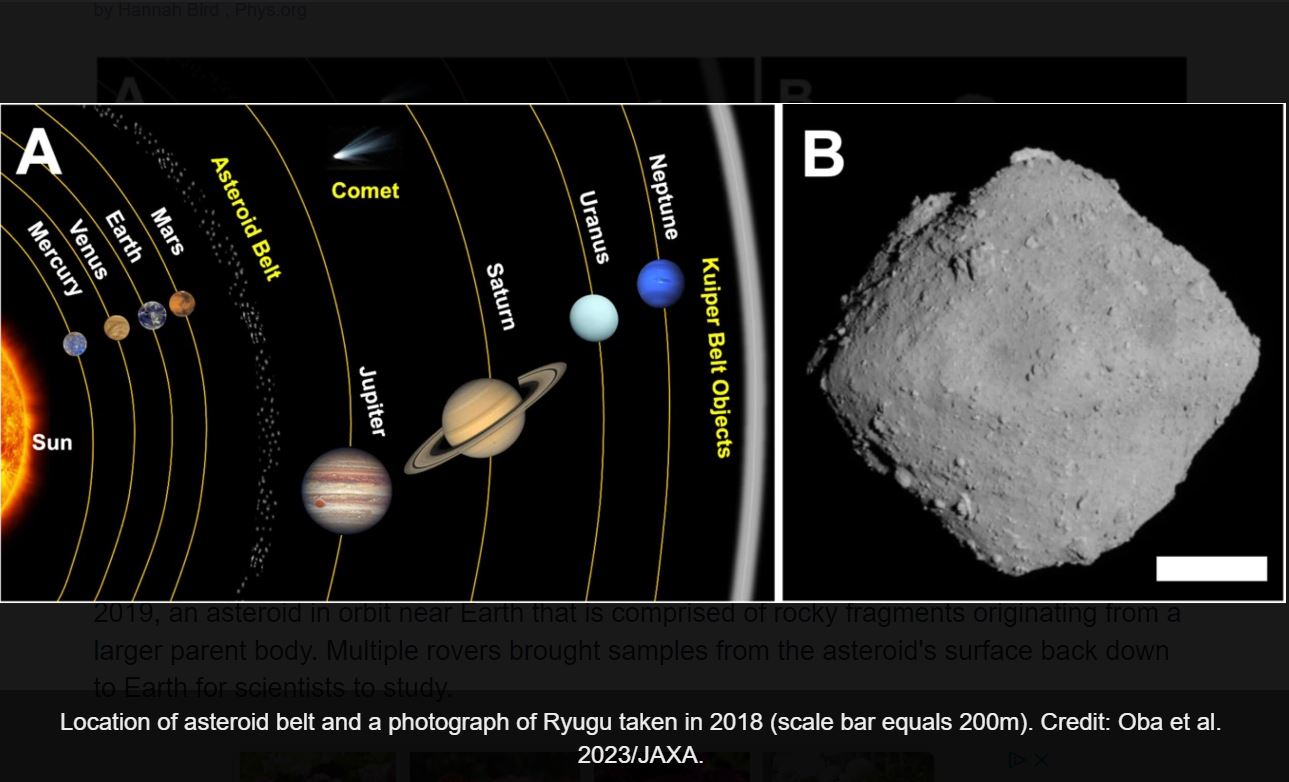
Ryugu Asteroid Origins in the Solar Nebula Decoded by Carbonates

Japan’s Aerospace Exploration Agency sent the Hayabusa2 spacecraft to 162173 Ryugu in 2019, an asteroid in orbit near Earth that is comprised of rocky fragments originating from a larger parent body. Multiple rovers brought samples from the asteroid’s surface back down to Earth for scientists to study.

The samples are indicative of chemically primitive meteorites, similar to Ivuna-type chondrites, and contain particular chemical compounds that suggest the presence of water. In particular, alterations of the asteroid’s surface by water on the parent body, at estimated temperatures up to 150°C, produced secondary minerals (including phyllosilicates, carbonates, sulfides and oxides) and the researchers aimed to understand the timescale and conditions over which these changes occurred...

Read More

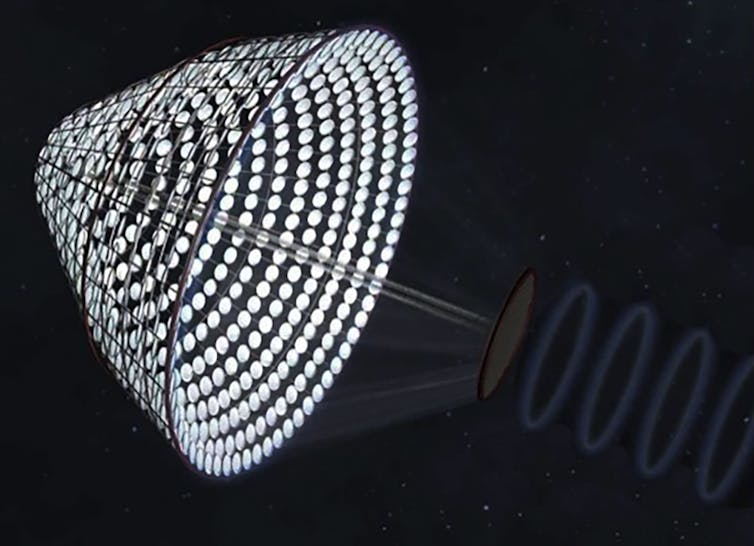
We could soon be Getting Energy from Solar Power Harvested in Space

Artistic impression of the SPS-ALPHA concept: many small refractors, or heliostats, are visible, focusing light into the satellite.
Artistic impression of the SPS-ALPHA concept. NASA/John Mankins

The idea of space-based solar power (SBSP)—using satellites to collect energy from the sun and “beam” it to collection points on Earth—has been around since at least the late 1960s. Despite its huge potential, the concept has not gained sufficient traction due to cost and technological hurdles.

Can some of these problems now be solved? If so, SBSP could become a vital part of the world’s transition away from fossil fuels to green energy.

We already harvest energy from the sun. It’s collected directly through what we generally call solar power. This comprises different technologies such as photovoltaics (PV) and solar-thermal energy...

Read More