
Category Astronomy/Space

NASA InSight Study finds Mars is Spinning Faster

NASA’s InSight lander captured this selfie on April 24, 2022, the 1,211th Martian day, or sol, of the mission. Dust on its solar panels caused the lander to lose power in December of that year, but data recorded by InSight’s instruments is still leading to new science.
Credits: NASA/JPL-Caltech

Scientists have made the most precise measurements ever of Mars’s rotation, for the first time detecting how the planet wobbles due to the “sloshing” of its molten metal core. The findings, detailed in a recent Nature paper, rely on data from NASA’s InSight Mars lander, which operated for four years before running out of power during its extended mission in December 2022.

To track the planet’s spin rate, the study’s authors relied on one of InSight’s instruments: a radio transponder and an...

Read More
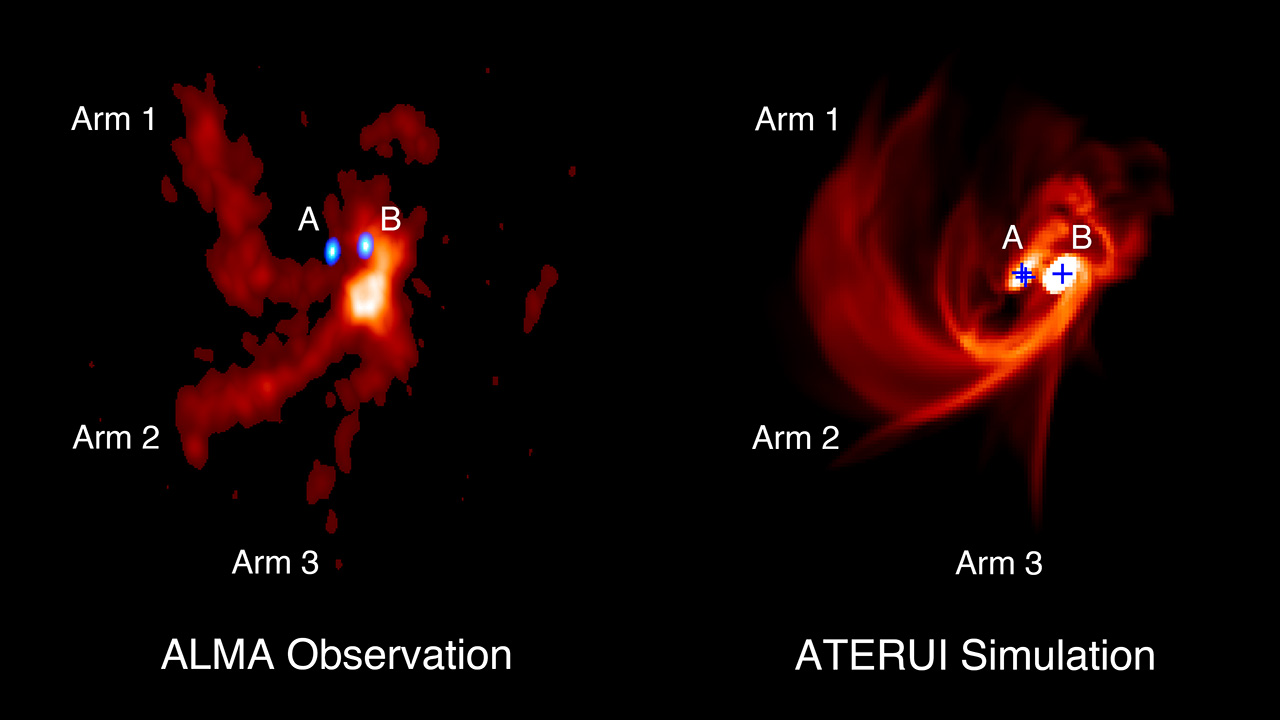

Gas Streamers Feed Triple Baby Stars

Gas distribution around the trinary protostars IRAS 04239+2436, (left) ALMA observations of SO emissions, and (right) as reproduced by the numerical simulation on the supercomputer ATERUI. In the left panel, protostars A and B, shown in blue, indicate the radio waves from the dust around the protostars. Within protostar A, two unresolved protostars are thought to exist. In the right panel, the locations of the three protostars are shown by the blue crosses. (Credit: ALMA (ESO/NAOJ/NRAO), J.-E. Lee et al.) 

New observations and simulations of three spiral arms of gas feeding material to three protostars forming in a trinary system have clarified the formation of multi-star systems.

Most stars with a mass similar to the Sun form in multi-star systems together with other stars...

Read More

Geomagnetic Field Protects Earth from Electron Showers

The Field Protects Earth from Electron Showers

Geophysicists studied the activity of high energy electrons and clarified the unexpected protective role of the geomagnetic field surrounding the Earth.

Understanding the ionosphere high in the Earth’s atmosphere is important due to its effects on communications systems, satellites and crucial chemical features including the ozone layer. New insights into the activity of high energy electrons have come from a simulation study led by geophysicist Yuto Katoh at Tohoku University, reported in the journal Earth, Planets and Space.

“Our results clarify the unexpected role of the geomagnetic field surrounding the Earth in protecting the atmosphere from high energy electrons,” says Katoh.

The ionosphere is a wide region between roughly 6...

Read More

James Webb Space Telescope Captures Stunning Images of the Ring Nebula

Ring Nebula

NASA’s James Webb Space Telescope (JWST) has recorded breath-taking new images of the iconic Ring Nebula, also known as Messier 57.

The images, released today by an international team of astronomers led by Professor Mike Barlow (UCL, UK) and Dr Nick Cox (ACRI-ST, France), with Professor Albert Zijlstra of The University of Manchester, showcase the nebula’s intricate and ethereal beauty in unprecedented detail, providing scientists and the public with a mesmerizing view of this celestial wonder.

For many sky enthusiasts, the Ring Nebula is a well-known object that is visible all summer long and is located in the constellation Lyra.

A small telescope will already reveal the characteristic donut-like structure of glowing gas that gave the Ring Nebula its name.

The Ring Nebula...

Read More
