Category Astronomy/Space

New Clues on the Source of the Universe’s Magnetic Fields

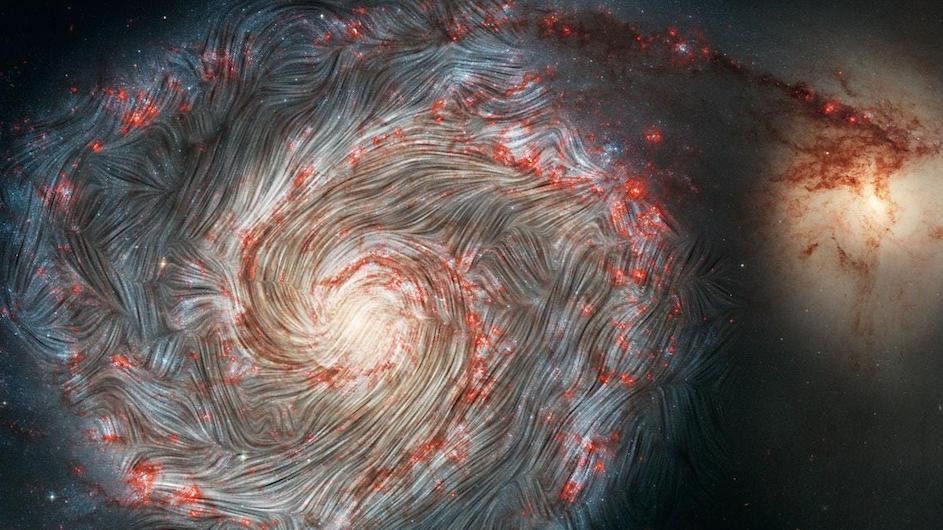
The magnetic field in the Whirlpool Galaxy (M51), captured by NASA's flying Stratospheric Observatory for Infrared Astronomy (SOFIA) observatory superimposed on a Hubble telescope picture of the galaxy. The image shows infrared images of grains of dust in the M51 galaxy. Their magnetic orientation largely follows the spiral shape of the galaxy, but it is also being pulled in the direction of the neighboring galaxy at the right of the frame.

The source of magnetic fields has long been debated: New research offers clues on their origins. It isn’t just your refrigerator that has magnets on it. The earth, the stars, galaxies, and the space between galaxies are all magnetized, too. The more places scientists have looked for magnetic fields across the universe, the more they’ve found them. But the question of why that is the case and where those magnetic fields originate from has remained a mystery and a subject of ongoing scientific inquiry.

A new paper by Columbia researchers offers insight into the source of these fields. The team used models to show that magnetic fields may spontaneously arise in turbulent plasma...

Read More
New Algorithm Ensnares its First ‘Potentially Hazardous’ Asteroid

Image showing the orbit of 2022 SF289 (green) at its closest approach to Earth (orbit in blue). Orbits of Venus and Mars are shown in orange and red, respectively.Joachim Moeyens/University of Washington/OpenSpace

An asteroid discovery algorithm – designed to uncover near-Earth asteroids for the Vera C. Rubin Observatory’s upcoming 10-year survey of the night sky – has identified its first “potentially hazardous” asteroid, a term for space rocks in Earth’s vicinity that scientists like to keep an eye on. The roughly 600-foot-long asteroid, designated 2022 SF289, was discovered during a test drive of the algorithm with the ATLAS survey in Hawaii...

Read More

Study Predicts Black Hole Chirps occur in Two Universal Frequency Ranges

The universal sound of black holes
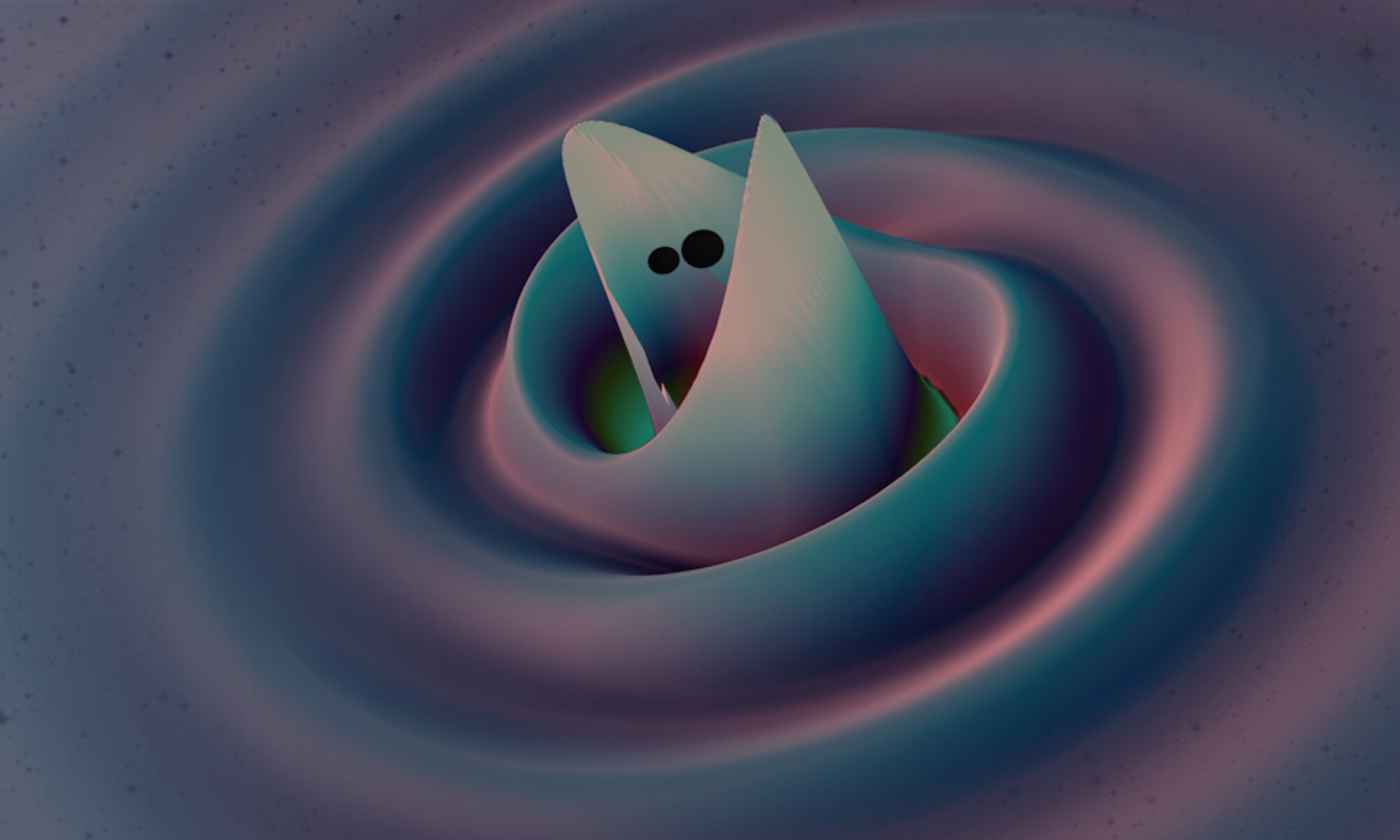
Ripples in the spacetime around a merging binary black-hole system from a numerical relativity simulation. Credit: Deborah Ferguson, Karan Jani, Deirdre Shoemaker, Pablo Laguna, Georgia Tech, MAYA Collaboration

They are mysterious, exciting and inescapable—black holes are some of the most exotic objects in the universe. With gravitational-wave detectors, it is possible to detect the chirp sound that two black holes produce when they merge, approximately 70 such chirps have been found so far.

A team of researchers at the Heidelberg Institute for Theoretical Studies (HITS) now predicts that in this “ocean of voices” chirps preferentially occur in two universal frequency ranges. The study has been published in The Astrophysical Journal Letters.

The discovery of gravitational waves...

Read More

Astronomers Shed New Light on Formation of Mysterious Fast Radio Bursts

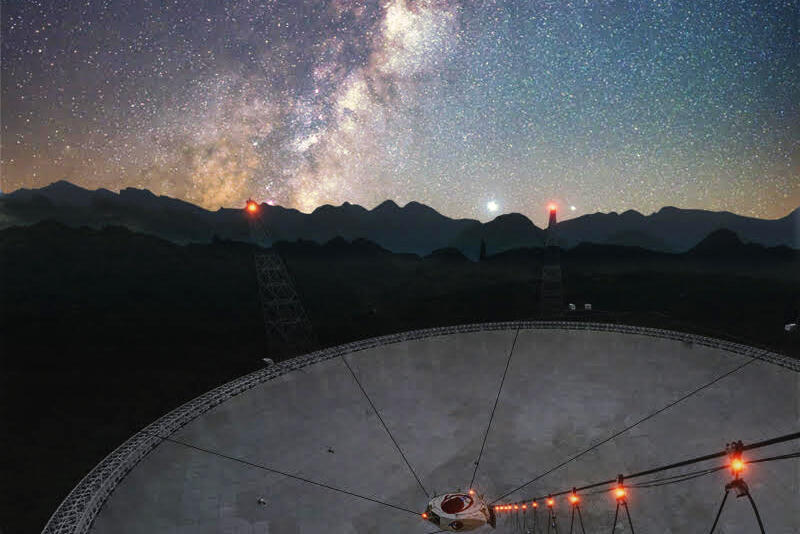
China's FAST radio telescope

More than 15 years after the discovery of fast radio bursts (FRBs)—millisecond-long, deep-space cosmic explosions of electromagnetic radiation—astronomers worldwide have been combing the universe to uncover clues about how and why they form.

Nearly all FRBs identified have originated in deep space outside our Milky Way galaxy. That is until April 2020, when the first Galactic FRB, named FRB 20200428, was detected. This FRB was produced by a magnetar (SGR J1935+2154), a dense, city-sized neutron star with an incredibly powerful magnetic field.

This groundbreaking discovery led some to believe that FRBs identified at cosmological distances outside our galaxy may also be produced by magnetars...

Read More