
Category Astronomy/Space

The Puzzle of the Galaxy with No Dark Matter

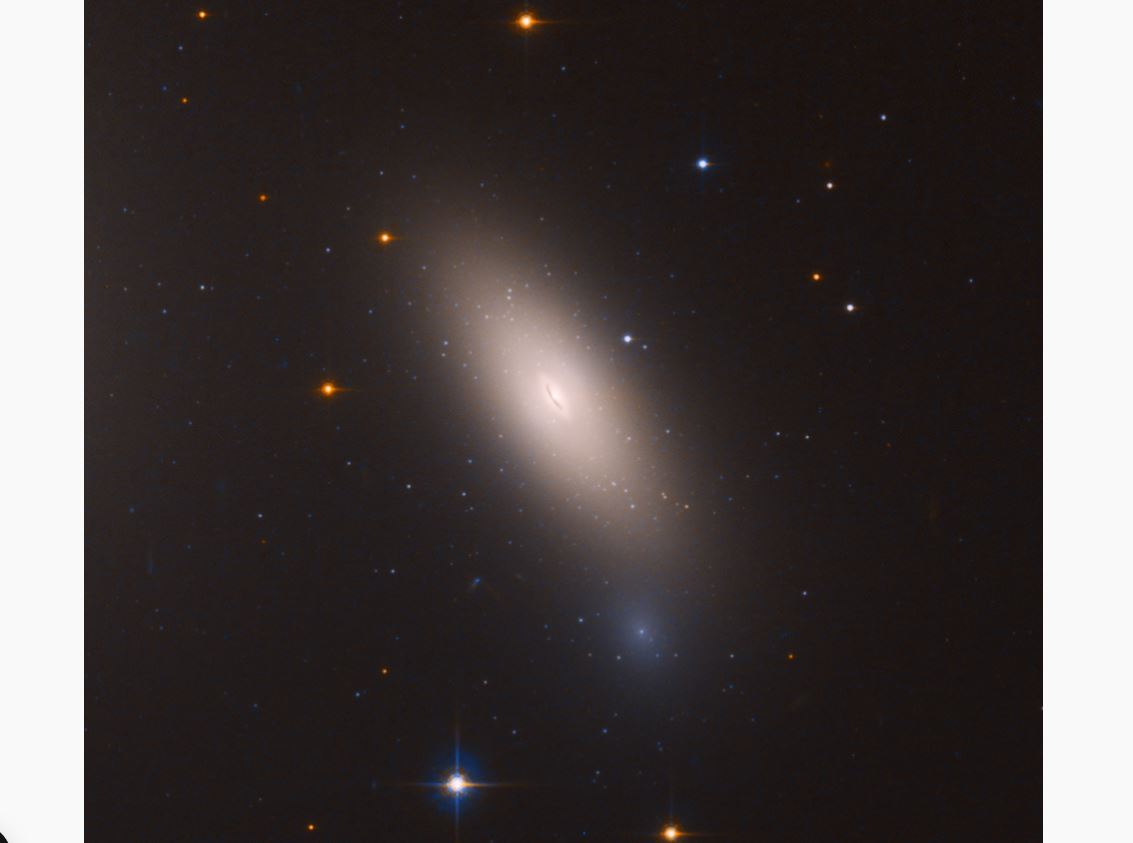
Dark matter-free galaxy NGC 1277, located near the centre of the Perseus cluster, 240 million light-years from Earth. Credit: NASA, ESA, and M. Beasley (IAC)

A team of scientists, led by the researcher at the IAC and the University of La Laguna (ULL) Sebastién Comerón, has found that the galaxy NGC 1277 does not contain dark matter. This is the first time that a massive galaxy (it has a mass several times that of the Milky Way) does not show evidence for this invisible component of the universe. “This result does not fit in with the currently accepted cosmological models, which include dark matter” explains Comerón.

In the current standard model cosmology massive galaxies contain substantial quantities of dark matter, a type of matter which does not interact in the same way as no...

Read More
VERA Unveils Surroundings of Rapidly Growing Black Holes

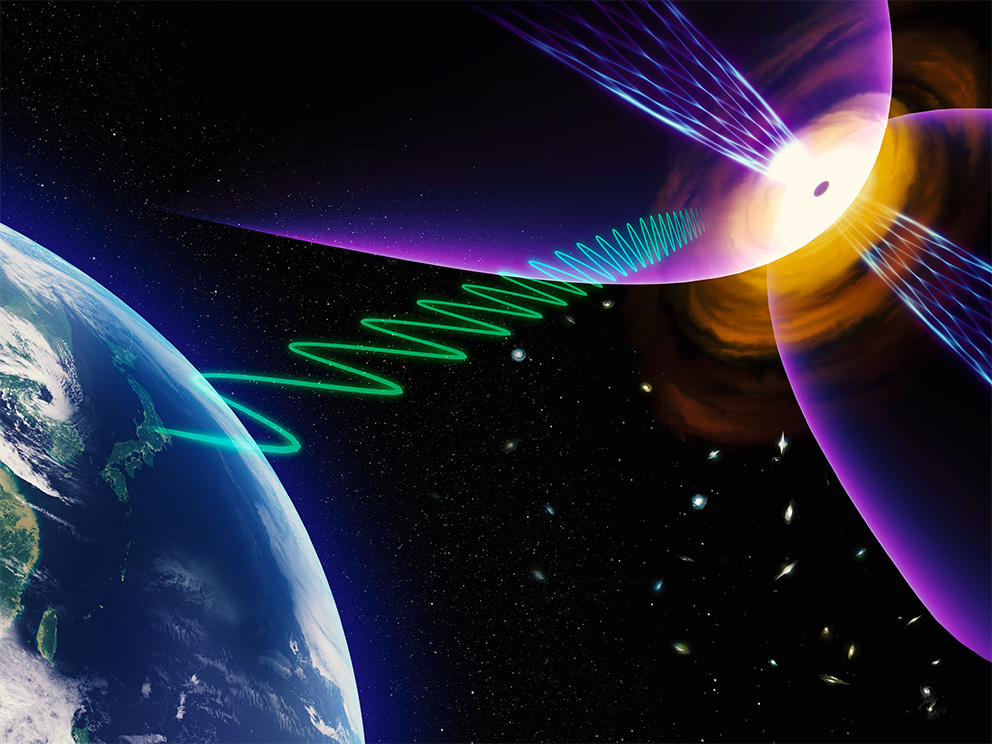
Jets ejected from a rapidly growing supermassive black hole with surrounding outflows. The polarization plane of a radio wave emitted from the vicinity of a black hole rotates as it passes through the surrounding magnetized gas. (Credit: NAOJ) 

An international team of astronomers used the state-of-the-art capability of VERA, a Japanese network of radio telescopes operated by NAOJ, to uncover valuable clues about how rapidly growing “young” supermassive black holes form, grow, and possibly evolve into more powerful quasars.

It is now widely accepted that nearly every active galaxy harbors a supermassive black hole at its core, with masses ranging from millions to billions of times that of the Sun...

Read More

Researchers Operating Gamma-ray Burst Monitor Discover Brightest Gamma-ray Burst ever detected

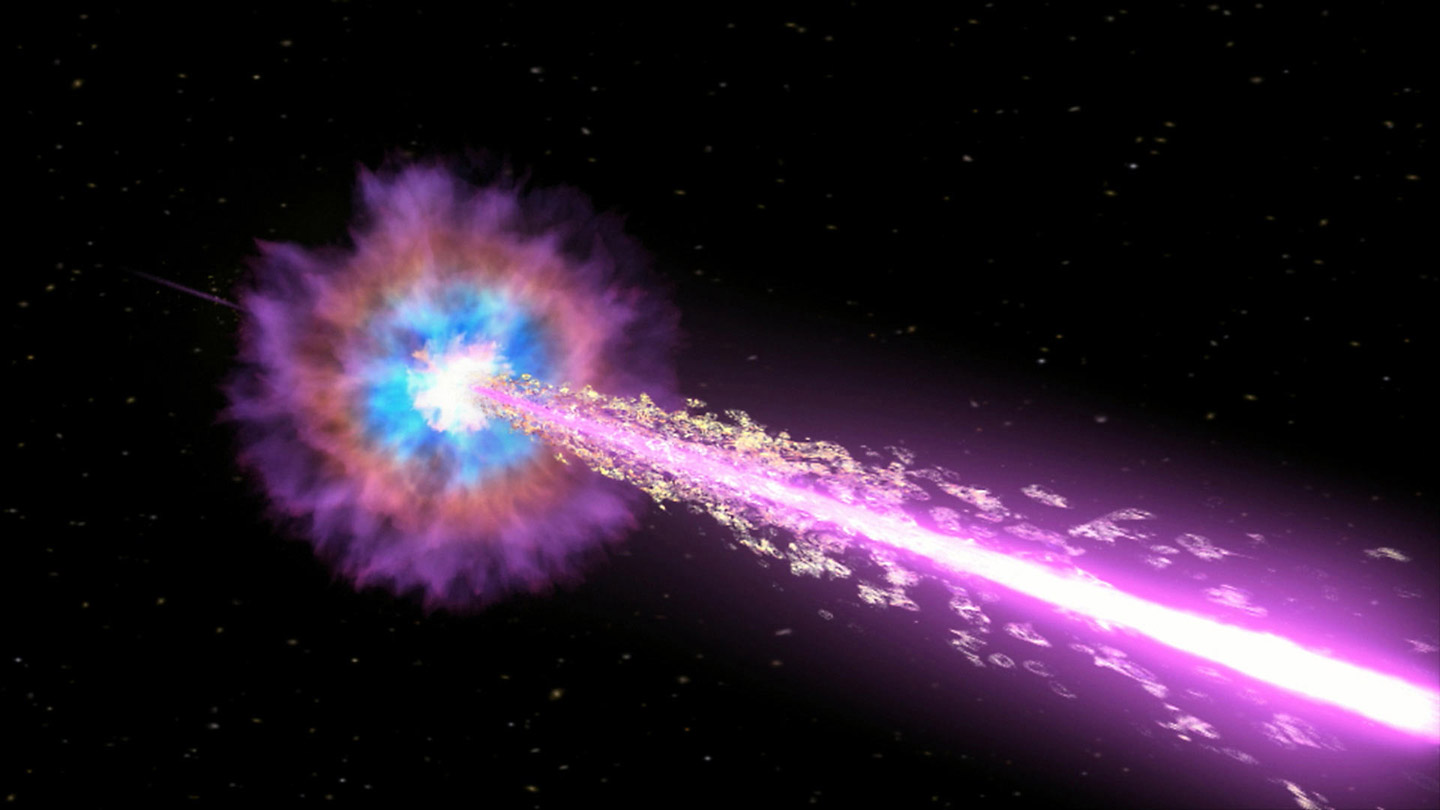
illustration of a gamma ray burst
Astronomers believe Gamma-Ray Burst 221009A represents the birth of a new black hole formed within the heart of a collapsing star. In this illustration, the black hole drives powerful jets of particles traveling near the speed of light. The jets pierce through the star, emitting X-rays and gamma rays as they stream into space. Gamma-ray bursts are the most powerful explosions in the universe. They emit most of their energy in gamma rays, light which is many times more energetic than the visible light we can see with our eyes. Courtesy NASA

The University of Alabama in Huntsville (UAH) has announced that three researchers associated with the UAH Center for Space Plasma and Aeronomic Research (CSPAR) have discovered a gamma-ray burst (GRB) approximately 2...

Read More

Astronomers discover Striking Evidence of ‘Unusual’ Stellar Evolution

The study’s findings could significantly impact astronomers’ current understanding of how stars evolve.
Photo: Getty Images

Magnetic activity plays key role in exoplanet habitability. Astronomers have found evidence that some stars boast unexpectedly strong surface magnetic fields, a discovery that challenges current models of how they evolve.

In stars like our sun, surface magnetism is linked to stellar spin, a process similar to the inner workings of a hand-cranked flashlight. Strong magnetic fields are seen in the hearts of magnetic sunspot regions, and cause a variety of space weather phenomena...

Read More
