Category Astronomy/Space

Hubble views a Galactic Monster

A cluster of elliptical galaxies, visible as a dense crowd of oval shapes, each glowing orange around a bright core. Various other galaxies are dotted all around, a few being small spirals. A bright star with four long spikes stands out at the right.

The NASA/ESA Hubble Space Telescope has captured a monster in the making in this observation of the exceptional galaxy cluster eMACS J1353.7+4329, which lies about eight billion light-years from Earth in the constellation Canes Venatici. This collection of at least two galaxy clusters is in the process of merging together to create a cosmic monster, a single gargantuan cluster acting as a gravitational lens.

Gravitational lensing is a dramatic example of Einstein’s general theory of relativity in action. A celestial body such as a galaxy cluster is sufficiently massive to distort spacetime, which causes the path of light around the object to be visibly bent as if by a vast lens...

Read More
Research team makes Significant Strides in Explaining the Stellar Evolution of Massive Binary Stars

The Stellar Evolution of Massive Binary Stars
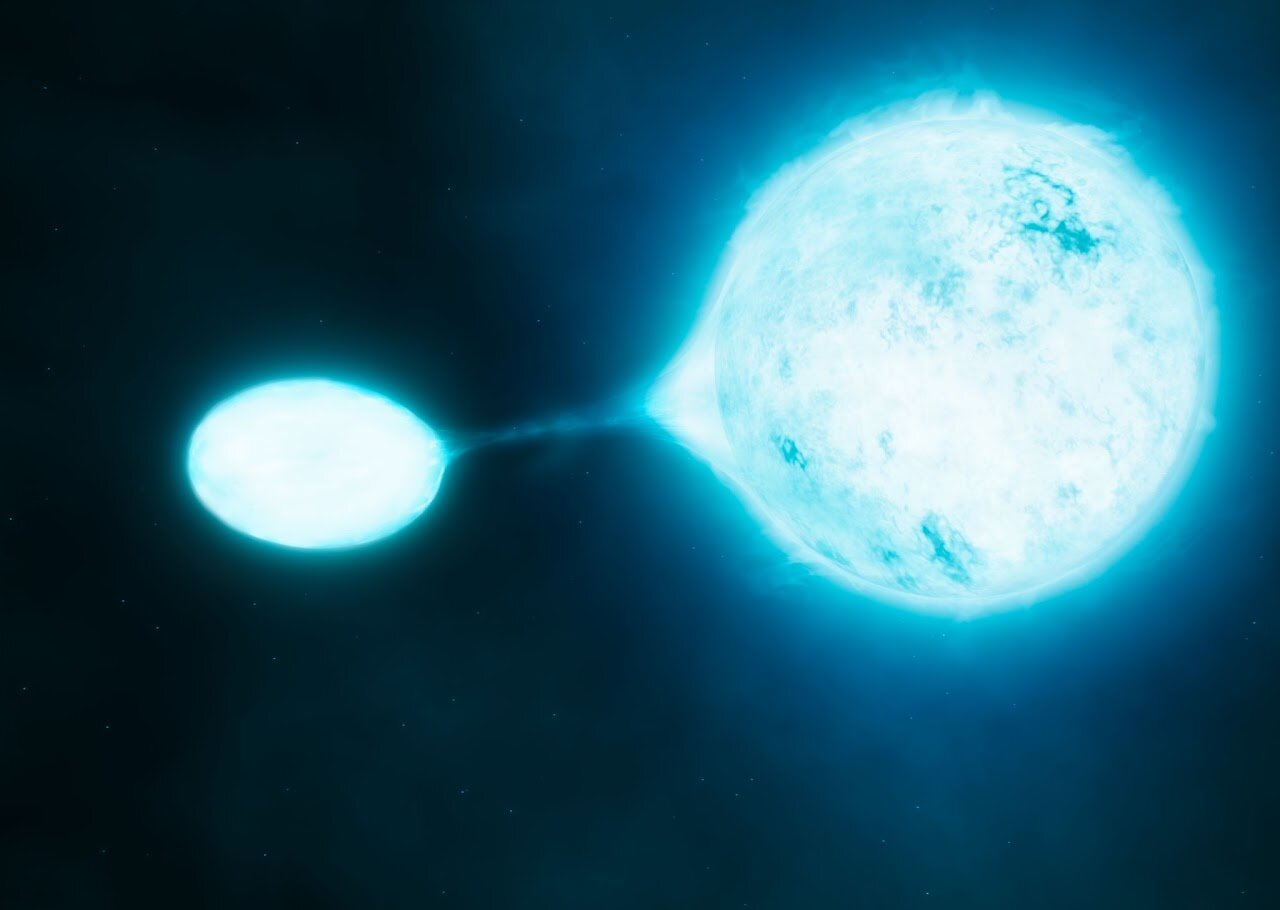
The artist’s illustration of  an interacting binary star. When massive binary stars begin to interact, the more massive star transfers a portion of its mass to the less massive companion star. This mass transfer process takes approximately tens of thousands to hundreds of thousands of years, which is relatively short compared to the lifespan of stars. Afterward, significant changes in the evolution of both stars start to occur. Credit: ESO/M. Kornmesser/S.E. de Mink

Massive stars refer to stars that are more than ten times the mass of the sun. They can release powerful ultraviolet radiation, ionize the gas in the interstellar medium, and eventually produce the elements necessary for the birth of life through spectacular supernova explosions...

Read More

Rare, Double-Lobe Nebula Resembles Overflowing Cosmic ‘Jug’

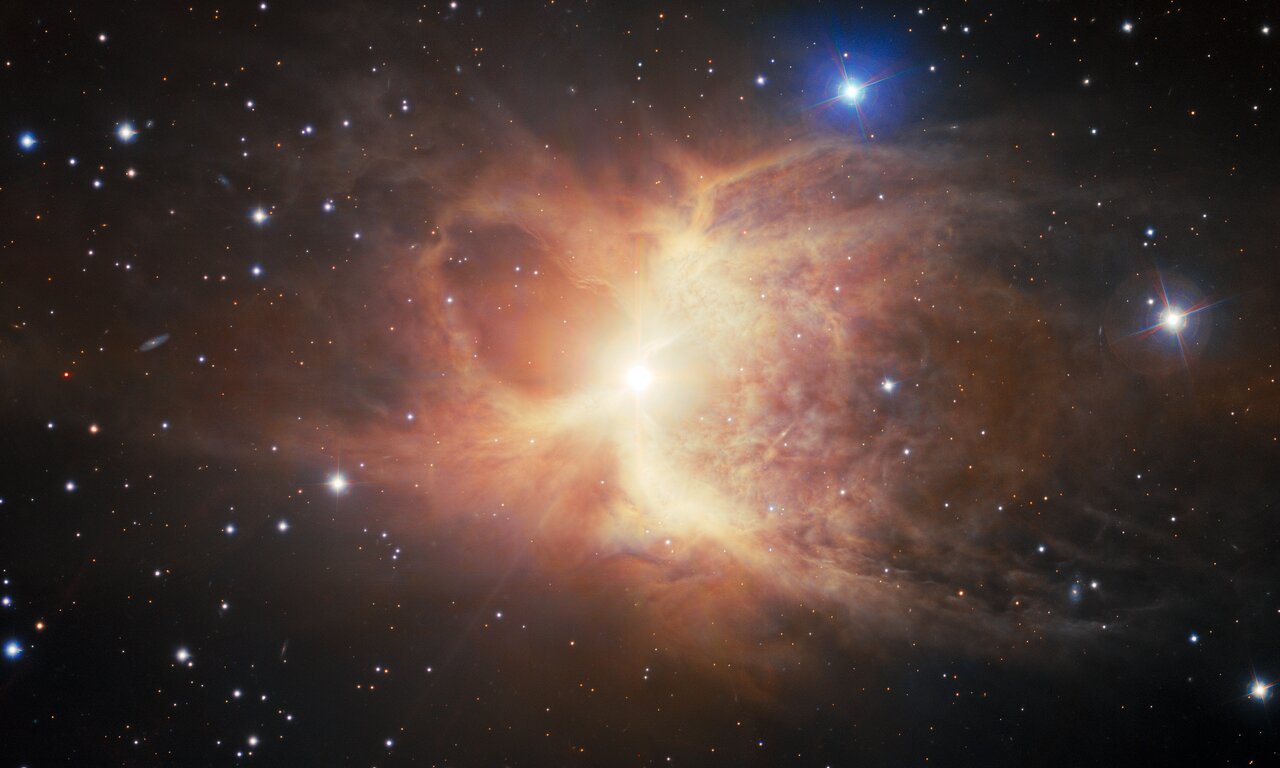
A billowing pair of nearly symmetrical loops of dust and gas mark the death throes of an ancient red-giant star, as captured by Gemini South, one half of the International Gemini Observatory, operated by NSF’s NOIRLab. The resulting structure, said to resemble an old style of English jug, is a rarely seen bipolar reflection nebula. Evidence suggests that this object formed by the interactions between the dying red giant and a now-shredded companion star.

Gemini South captures the spectacular end-of-life display of a red-giant star. A billowing pair of nearly symmetrical loops of dust and gas mark the death throes of an ancient red-giant star, as captured by Gemini South, one half of the International Gemini Observatory, operated by NSF’s NOIRLab...

Read More

Reinventing Cosmology: New research puts Age of Universe at 26.7 — not 13.7 — billion years

Galaxy

Our universe could be twice as old as current estimates, according to a new study that challenges the dominant cosmological model and sheds new light on the so-called “impossible early galaxy problem.”

“Our newly-devised model stretches the galaxy formation time by a several billion years, making the universe 26.7 billion years old, and not 13.7 as previously estimated,” says author Rajendra Gupta, adjunct professor of physics in the Faculty of Science at the University of Ottawa.

For years, astronomers and physicists have calculated the age of our universe by measuring the time elapsed since the Big Bang and by studying the oldest stars based on the redshift of light coming from distant galaxies...

Read More