Category Astronomy/Space

Webb Telescope Detects most Distant Active Supermassive Black Hole

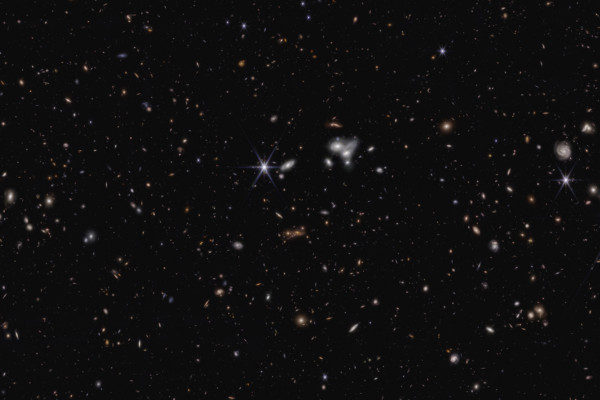
CEERS-NIRCam-crop2400x1600
A zoomed-in view of images captured by the James Webb Space Telescope in near-infrared light for the Cosmic Evolution Early Release Science (CEERS) Survey. Image credit: NASA, ESA, CSA, Steve Finkelstein (UT Austin), Micaela Bagley (UT Austin), Rebecca Larson (UT Austin).

Researchers have discovered the most distant active supermassive black hole to date with the James Webb Space Telescope (JWST). The galaxy, CEERS 1019, existed about 570 million years after the big bang, and its black hole is less massive than any other yet identified in the early universe.

In addition to the black hole in CEERS 1019, the researchers identified two more black holes that are on the smaller side and existed 1 billion and 1.1 billion years after the big bang...

Read More


Why the day is 24 hours long: Astrophysicists reveal why Earth’s Day was a Constant 19.5 hours for over a Billion Years

The earth with a thermometer beside it - temps rising!
The rise in temperature of our atmosphere due to global warming has the potential to increase the atmospheric solar tides and slow the Earth’s rotation. Image: Â© iStock | narith_2527.

Result sheds new light on how climate change will affect the length of the day and validity of climate modelling tools. A team of astrophysicists at the University of Toronto (U of T) has revealed how the slow and steady lengthening of Earth’s day caused by the tidal pull of the moon was halted for over a billion years.

They show that from approximately two billion years ago until 600 million years ago, an atmospheric tide driven by the sun countered the effect of the moon, keeping Earth’s rotational rate steady and the length of day at a constant 19.5 hours.

Without this billion-year pause in th...

Read More

Quasar ‘Clocks’ show the Universe was Five Times Slower Soon after the Big Bang

Scientists have for the first time observed the early universe running in extreme slow motion, unlocking one of the mysteries of Einstein’s expanding universe. The research is published in Nature Astronomy.

Einstein’s general theory of relativity means that we should observe the distant—and hence ancient—universe running much slower than the present day. However, peering back that far in time has proven elusive. Scientists have now cracked that mystery by using quasars as “clocks.”

“Looking back to a time when the universe was just over a billion years old, we see time appearing to flow five times slower,” said lead author of the study, Professor Geraint Lewis from the School of Physics and Sydney Institute for Astronomy at the University of Sydney.

“If you were there, in...

Read More

‘Sandwich’ Discovery offers New Explanation for Planet Formation

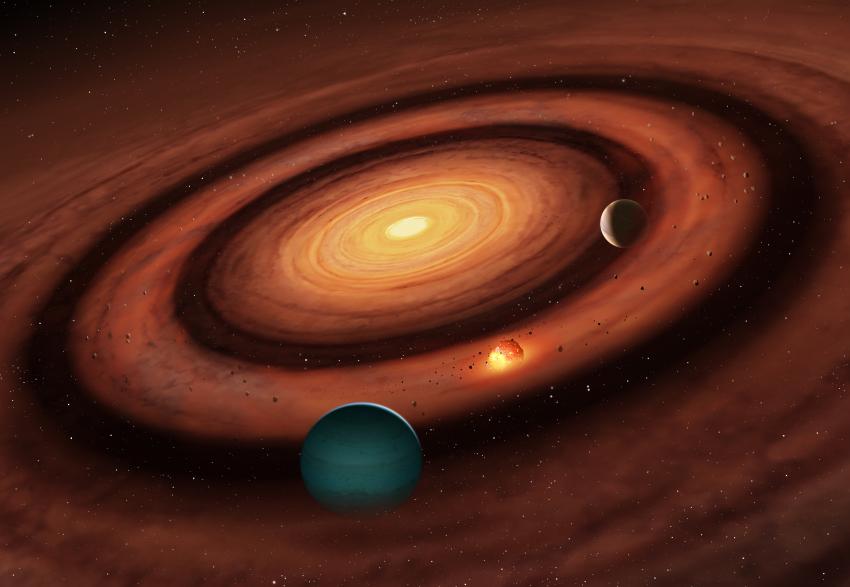
An artist's impression of a planetary system appearing in colours of orange, yellow and brown.
Artistic rendering of how small planets can form ‘sandwiched’ in between two larger ones.
Credit: University of Warwick/Mark A. Garlick Licence type Attribution (CC BY 4.0)

Scientists have made a new discovery on how small planets might form. Researchers at the University of Warwick investigated the “birth environment” of planets—areas of gas and dust that swirl around a central star—known as the protoplanetary disk.

They discovered a new method of planet formation in this region, not yet described in previous research. The work has been submitted to the journal Monthly Notices of the Royal Astronomical Society and is showcased at the National Astronomy Meeting, which begins today, Monday 3 July...

Read More