Category Astronomy/Space

‘Sandwich’ Discovery offers New Explanation for Planet Formation

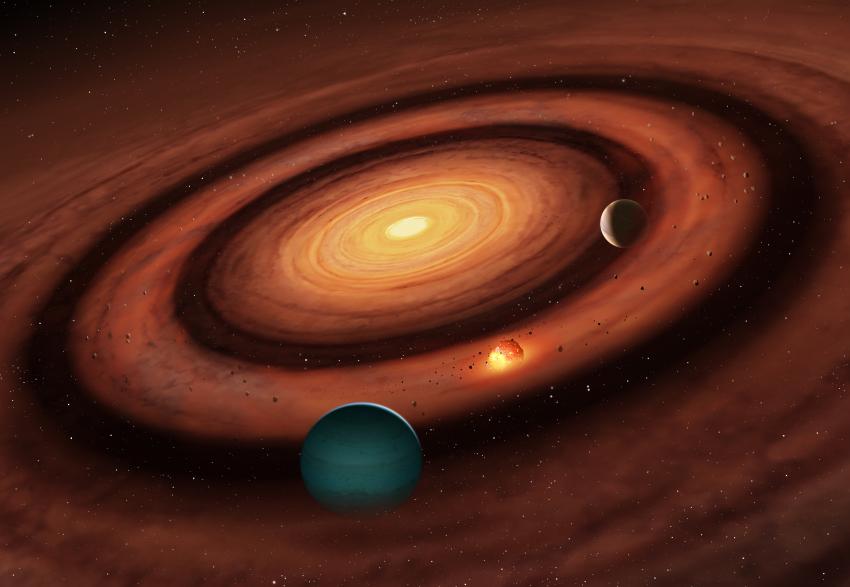
An artist's impression of a planetary system appearing in colours of orange, yellow and brown.
Artistic rendering of how small planets can form ‘sandwiched’ in between two larger ones.
Credit: University of Warwick/Mark A. Garlick Licence type Attribution (CC BY 4.0)

Scientists have made a new discovery on how small planets might form. Researchers at the University of Warwick investigated the “birth environment” of planets—areas of gas and dust that swirl around a central star—known as the protoplanetary disk.

They discovered a new method of planet formation in this region, not yet described in previous research. The work has been submitted to the journal Monthly Notices of the Royal Astronomical Society and is showcased at the National Astronomy Meeting, which begins today, Monday 3 July...

Read More
A Neutrino Portrait of our Galaxy reveals High-Energy Particles from within the Milky Way

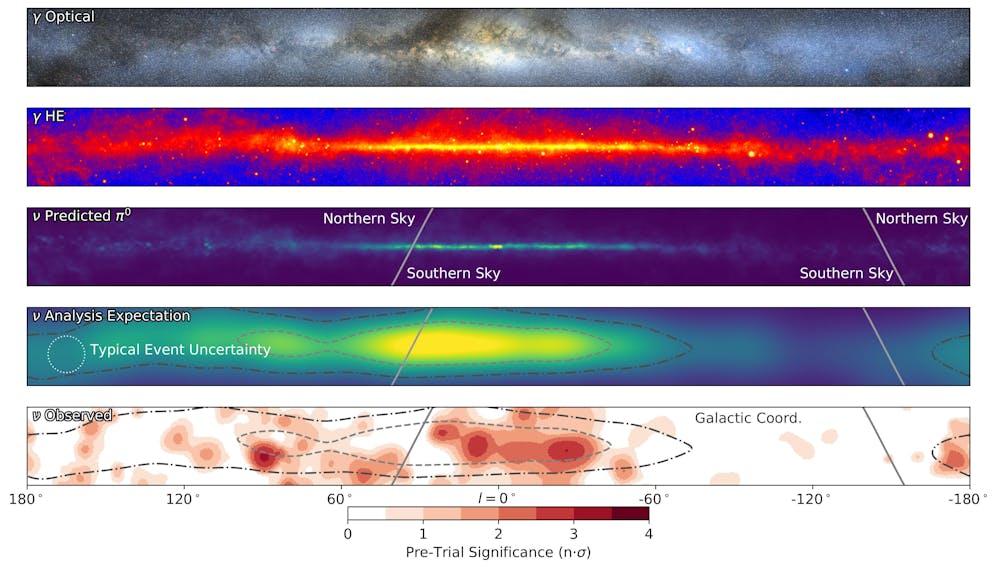
Five views of the Milky Way: the top two bands show visible light and gamma rays, while the lower three show expected and real neutrino results, plus a measure of the significance of neutrino events detected by IceCube. IceCube Collaboration

Our Milky Way galaxy is an awe-inspiring feature of the night sky, viewable with the naked eye as a hazy band of stars stretching from horizon to horizon.

For the first time, the IceCube Neutrino Observatory in Antarctica has produced an image of the Milky Way using neutrinos—tiny, ghost-like astronomical messengers.

In research published June 29 in the journal Science, the IceCube Collaboration—an international group of more than 350 scientists—presents evidence of high-energy neutrino emission coming from the Milky Way.

We have not...

Read More

Gullies on Mars could have been formed by recent periods of Liquid Meltwater, study suggests

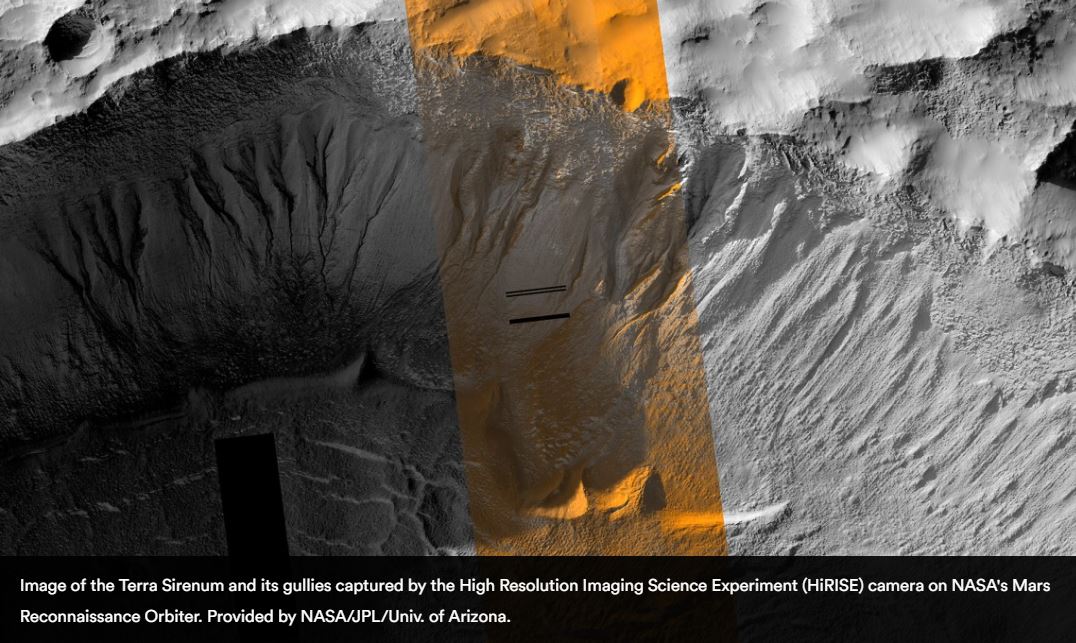
A study led by Brown University researchers offers new insights into how water from melting ice could have played a recent role in the formation of ravine-like channels that cut down the sides of impact craters on Mars.

The study, published in Science, focuses on Martian gullies, which look eerily similar to gullies that form on Earth in the Dry Valleys of Antarctica and are caused by water erosion from melting glaciers. The researchers, including Brown planetary scientist Jim Head, built a model that simulates a sweet spot for when conditions on Mars allow the planet to warm above freezing temperatures, leading to periods of liquid water on Mars when ice on and beneath the surface melts.

The scientists found that when Mars tilts on its axis to 35 degrees, the atmosphere becomes...

Read More

Astronomers find a Planet that Shouldn’t Exist

A "hot Jupiter" exoplanet named Halla may have orbited two stars at one time. Interactions between the two stars may have helped Halla survive a stellar outburst.
A “hot Jupiter” exoplanet named Halla may have orbited two stars at one time. Interactions between the two stars may have helped Halla survive a stellar outburst. Adam Makarenko/W.M. Keck Observatory

When our sun reaches the end of its life, it will expand to 100 times its current size, enveloping the Earth. Many planets in other solar systems face a similar doom as their host stars grow old. But not all hope is lost, as astronomers from the University of HawaiÊ»i Institute for Astronomy (UH IfA) have made the remarkable discovery of a planet’s survival after what should have been certain demise at the hands of its sun.

The Jupiter-like planet 8 UMi b, officially named Halla, orbits the red giant star Baekdu (8 UMi) at only half the distance separating the Earth and the sun...

Read More