Category Astronomy/Space

The Laws of Physics have Not Always been Symmetric, which may explain why you exist

cosmos
Credit: Pixabay/CC0 Public Domain

For generations, physicists were sure the laws of physics were perfectly symmetric. Until they weren’t.

Symmetry is a tidy and attractive idea that falls apart in our untidy universe. Indeed, since the 1960s, some kind of broken symmetry has been required to explain why there is more matter than antimatter in the universe—why, that is, that any of this exists at all.

But pinning down the source behind this existential symmetry violation, even finding proof of it, has been impossible.

Yet in a new paper published in Monthly Notices of the Royal Astronomical Society, University of Florida astronomers have found the first evidence of this necessary violation of symmetry at the moment of creation...

Read More
Scientists make First Observation of a Polar Cyclone on Uranus

NASA scientists used microwave observations to spot the first polar cyclone on Uranus, seen here as a light-colored dot to the right of center in each image of the planet. The images use wavelength bands K, Ka, and Q, from left. To highlight cyclone features, a different color map was used for each.
Credits: NASA/JPL-Caltech/VLA

Scientists used ground-based telescopes to get unprecedented views, thanks to the giant planet’s position in its long orbit around the sun.

For the first time, NASA scientists have strong evidence of a polar cyclone on Uranus. By examining radio waves emitted from the ice giant, they detected the phenomenon at the planet’s north pole...

Read More

In-situ Observations of Marine Sedimentary Rocks Suggest Ancient Northern Ocean on Mars

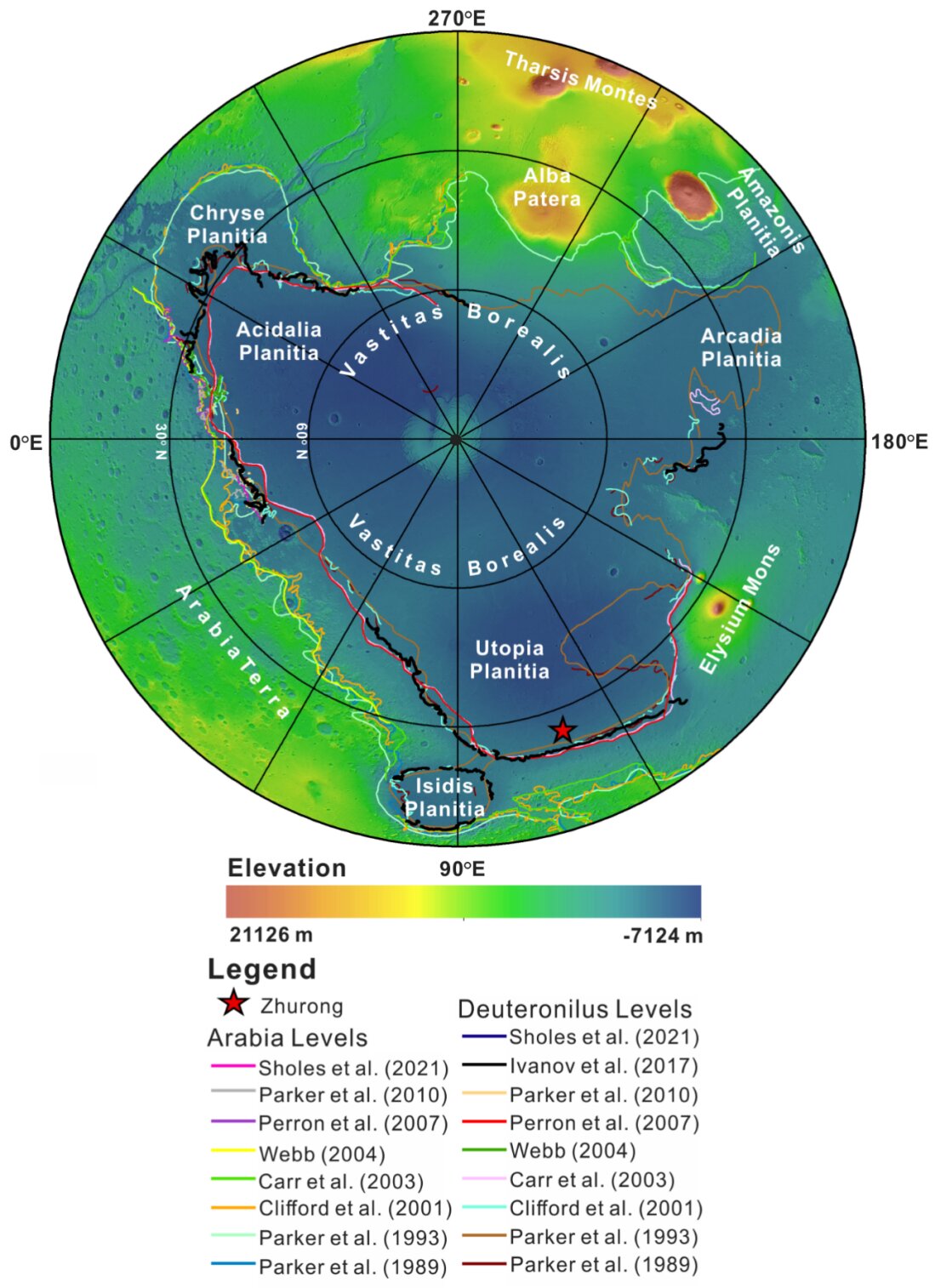
Ancient northern ocean on Mars evidenced by in situ observations of marine sedimentary rocks
Topographic map of the northern hemisphere of Mars showing previously proposed shorelines. The red star denotes the location of the landing site of the Zhurong rover, ~282 km to the north of the Deuteronilus shorelines. The data are color-coded MOLA elevation over MOLA shaded relief centered at the North Pole with the Lambert azimuthal equal-area projection. Credit: Science China Press

An international research team led by Professor Long Xiao from the School of Earth Sciences of China University of Geosciences (Wuhan) has discovered the presence of marine sedimentary rocks on the surface of Mars for the first time by comprehensively analyzing the scientific data obtained by the multispectral camera (MSCam) carried by the Zhurong rover...

Read More

Radio Signal Reveals Supernova Origin

Artists impression of a white dwarf accreting matter from a helium rich companion
Artist impression of the double star system with a compact white dwarf star accreting matter from a helium-rich donor companion. The accretion eventually leads to the white dwarf going supernova. (credit: Adam Makarenko/W. M. Keck Observatory)

In the latest issue of the journal Nature, astronomers from Stockholm University reveal the origin of a thermonuclear supernova explosion. Strong emission lines of helium and the first detection of such a supernova in radio waves show that the exploding white dwarf star had a helium-rich companion.

Supernovae of Type Ia are important for astronomers since they are used to measure the expansion of the Universe. However, the origin of these explosions has remained an open question...

Read More