Category Astronomy/Space

Neutron Star’s X-rays reveal ‘Photon Metamorphosis’

NASA/CXC/SAO/IXPE
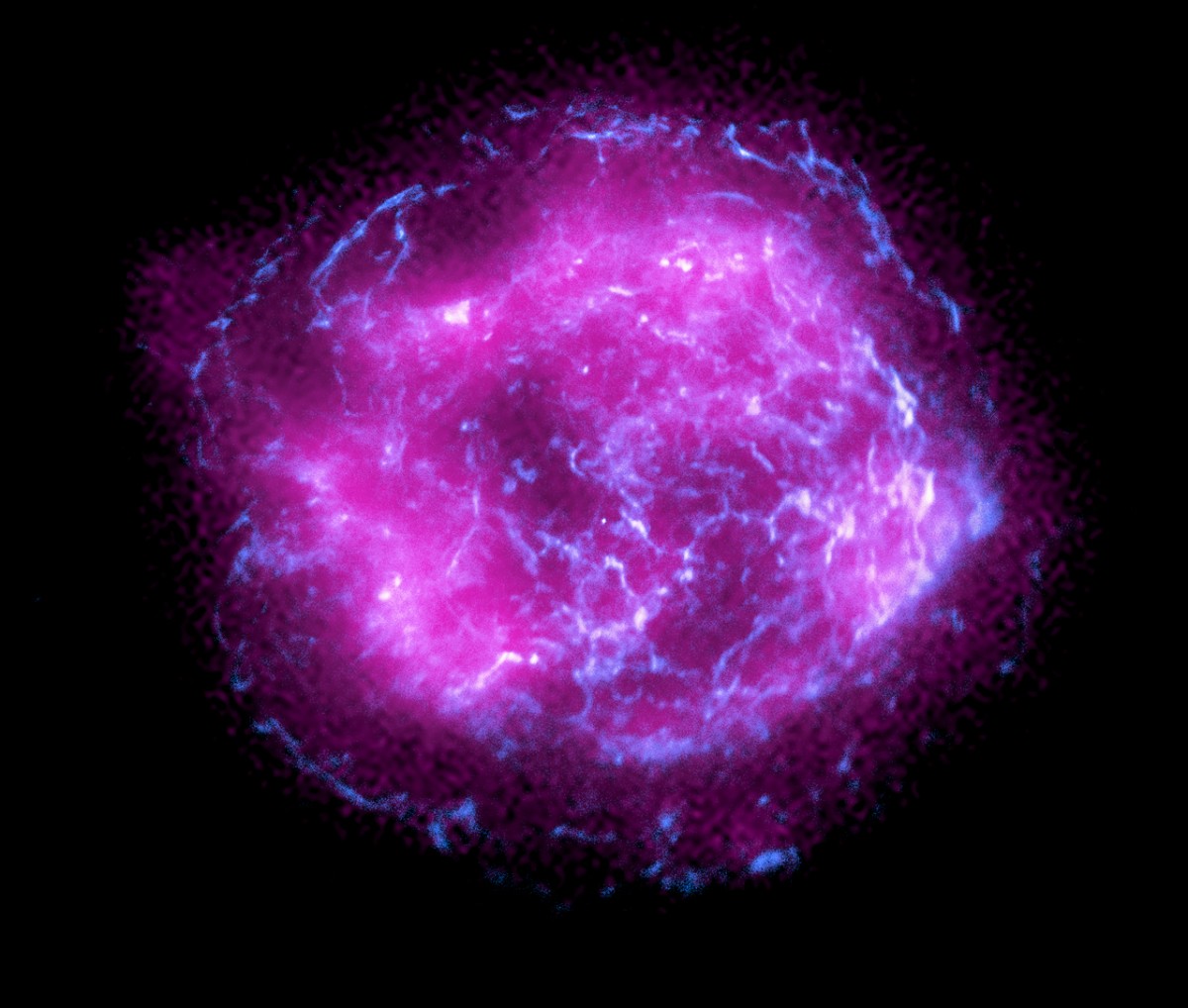
This image of the supernova remnant Cassiopeia A, the first object observed by NASA’s Imaging X-ray Polarimetry Explorer (IXPE) satellite, combines some of the first X-ray data collected by IXPE, shown in magenta, with high-energy X-ray data from NASA’s Chandra X-Ray Observatory, in blue. The satellite later detected polarized X-rays from 4U 0142+61, a highly magnetized neutron star located in the Cassiopeia constellation.

A “beautiful effect” predicted by quantum electrodynamics (QED) can explain the puzzling first observations of polarized Xrays emitted by a magnetar – a neutron star featuring a powerful magnetic field, according to a Cornell astrophysicist.

The extremely dense and hot remnant of a massive star, boasting a magnetic field 100 trillion times str...

Read More
Do your Homework to Prep for the 2023 and 2024 Eclipses

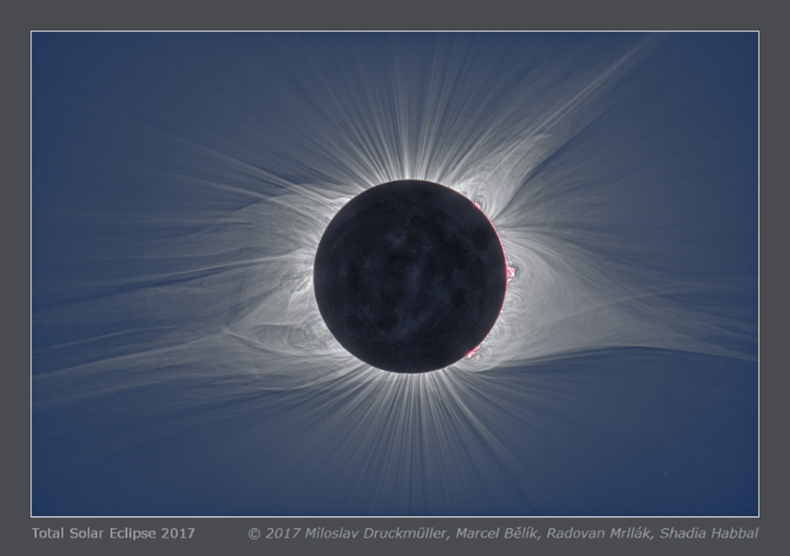
2017 total eclipse
2017 total eclipse

Make the most of these two teachable moments by planning ahead and spreading the word. This year and next, Americans will have the extraordinary opportunity to witness two solar eclipses as both will be visible throughout the continental U.S. On Oct. 14, 2023, the moon will obscure all but a small annulus of the sun, producing a “Ring of Fire” eclipse. On April 8, 2024, the eclipse will be total in a band stretching from Texas to Maine.

Both occurrences promise to be remarkable events and teachable moments. But preparation is essential.

In The Physics Teacher, co-published by AIP Publishing and the American Association of Physics Teachers, astronomer Douglas Duncan of the University of Colorado provides a practical playbook to help teachers, students, and the g...

Read More

Astronomers Spot a Star Swallowing a Planet

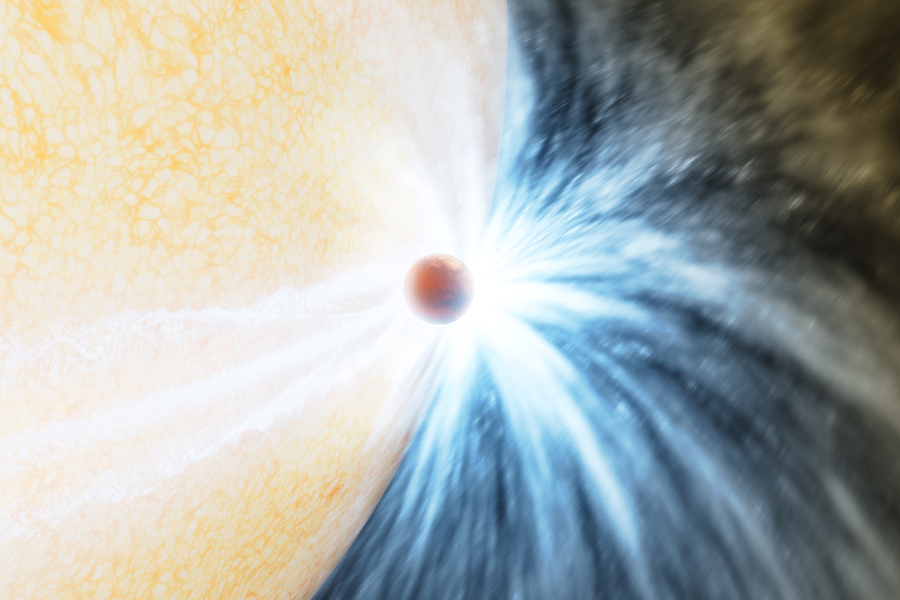
A dynamic rendering shows, on the left, the edge of a gigantic, yellow spherical star. A tiny red planet is in the middle and has skimmed the star. Rays of white light and blue energy radiate out from their touch.
Caption:This artist’s impression shows a doomed planet skimming the surface of its star. Astronomers used a combination of telescopes to spot the first direct evidence of an aging, bloated sun-like star, like the one pictured here, engulfing its planet. These telescopes included the Zwicky Transient Facility (ZTF) at Caltech’s Palomar Observatory, the W.M. Keck Observatory, and NASA’s NEOWISE mission.
Credits:Image: K. Miller/R. Hurt (Caltech/IPAC)

Earth will meet a similar fate in 5 billion years. As a star runs out of fuel, it will billow out to a million times its original size, engulfing any matter — and planets — in its wake...

Read More

Study using X-Ray Telescope indicates that Dark Energy is Uniformly Distributed in Space and Time

eROSITA X-Ray study indicates that dark energy is uniformly distributed in space and time
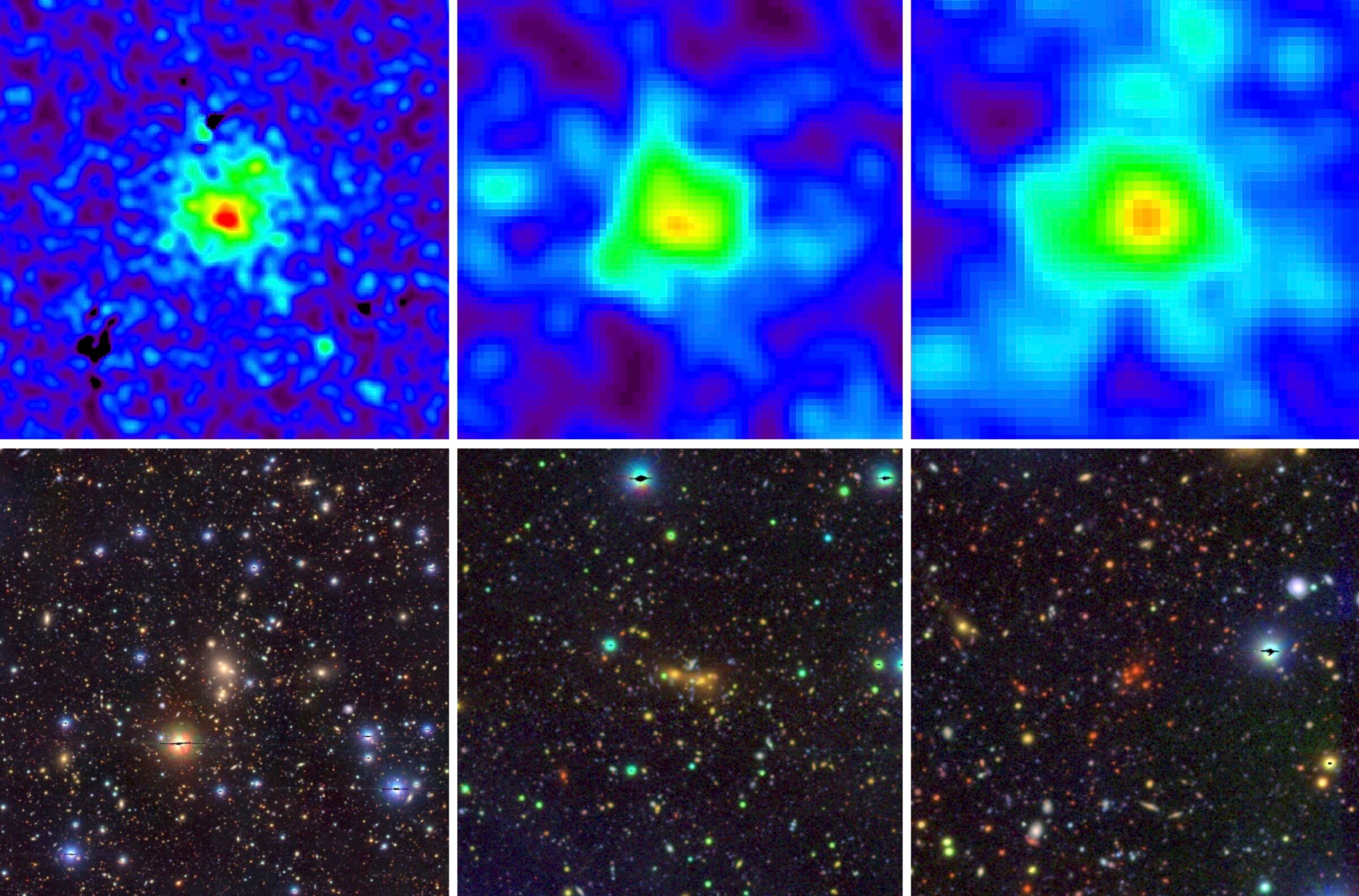
X-ray (over) and optical pseudo-color (below) images of three low mass clusters identified in the eFEDS survey data. The highest redshift cluster come from a time when the universe was approximately 10 billion years younger than today. The cluster galaxies in that case are clearly much redder than the galaxies in the other two clusters. Credit: eRosita

When Edwin Hubble observed distant galaxies in the 1920s, he made the groundbreaking discovery that the universe is expanding. It was not until 1998, however, that scientists observing Type Ia supernovae further discovered that the universe is not just expanding but has begun a phase of accelerating expansion. “To explain this acceleration, we need a source,” says Joseph Mohr, astrophysicist at LMU...

Read More