
Category Astronomy/Space

A New Measurement could Change our Understanding of the Universe

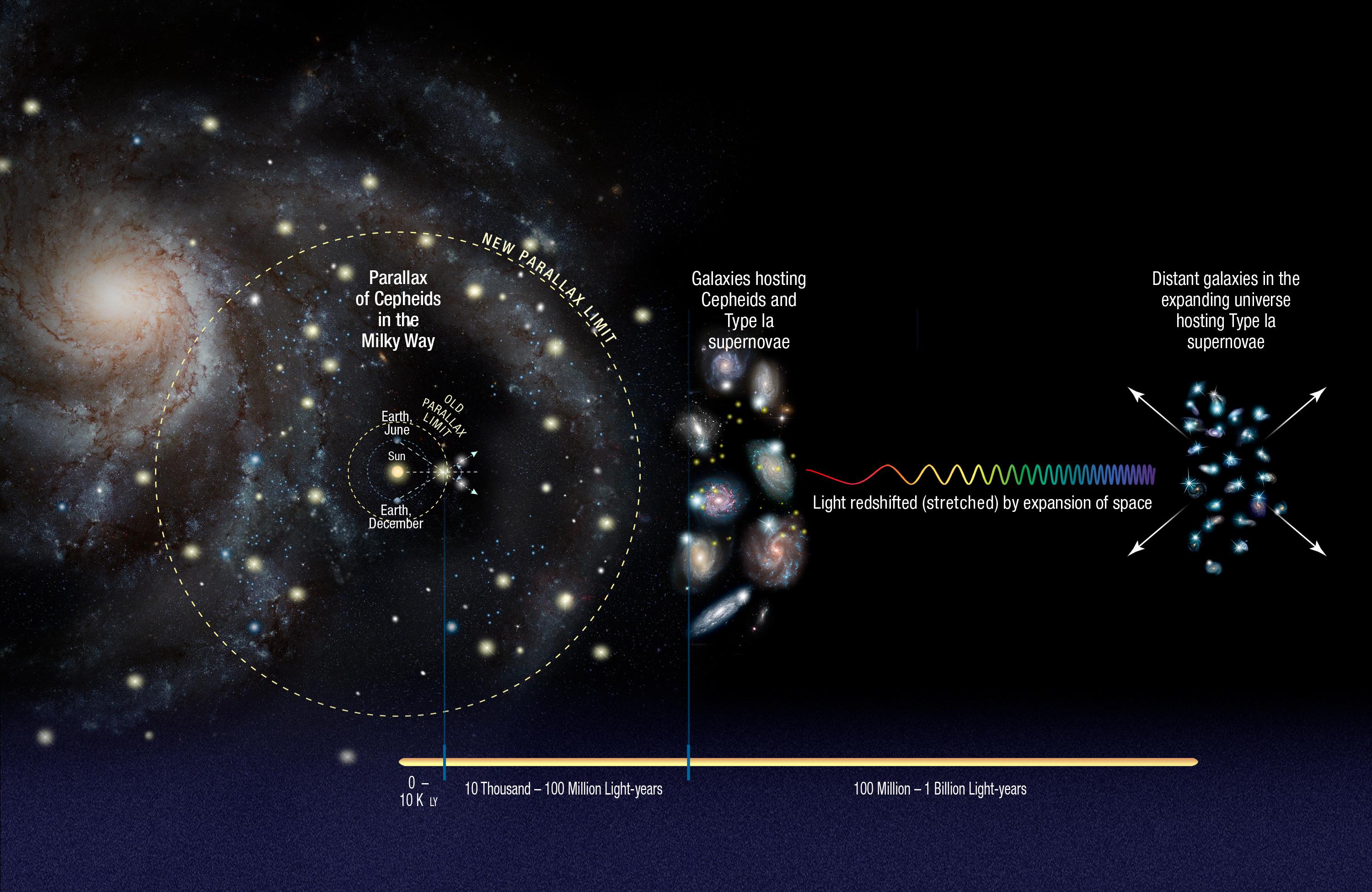
The cosmic distance ladder. © NASA, ESA, A.Feild (STScI), and A.Riess (STScI/JHU)

When it comes to measuring how fast the Universe is expanding, the result depends on which side of the Universe you start from. A recent study has calibrated the best cosmic yardsticks to unprecedented accuracy, shedding new light on what’s known as the Hubble tension.

The Universe is expanding — but how fast exactly? The answer appears to depend on whether you estimate the cosmic expansion rate — referred to as the Hubble’s constant, or H0 — based on the echo of the Big Bang (the cosmic microwave background, or CMB) or you measure H0 directly based on today’s stars and galaxies. This problem, known as the Hubble tension, has puzzled astrophysicists and cosmologists around the world.

A study carrie...

Read More
‘Taffy Galaxies’ Collide, leave behind Bridge of Star-Forming Material

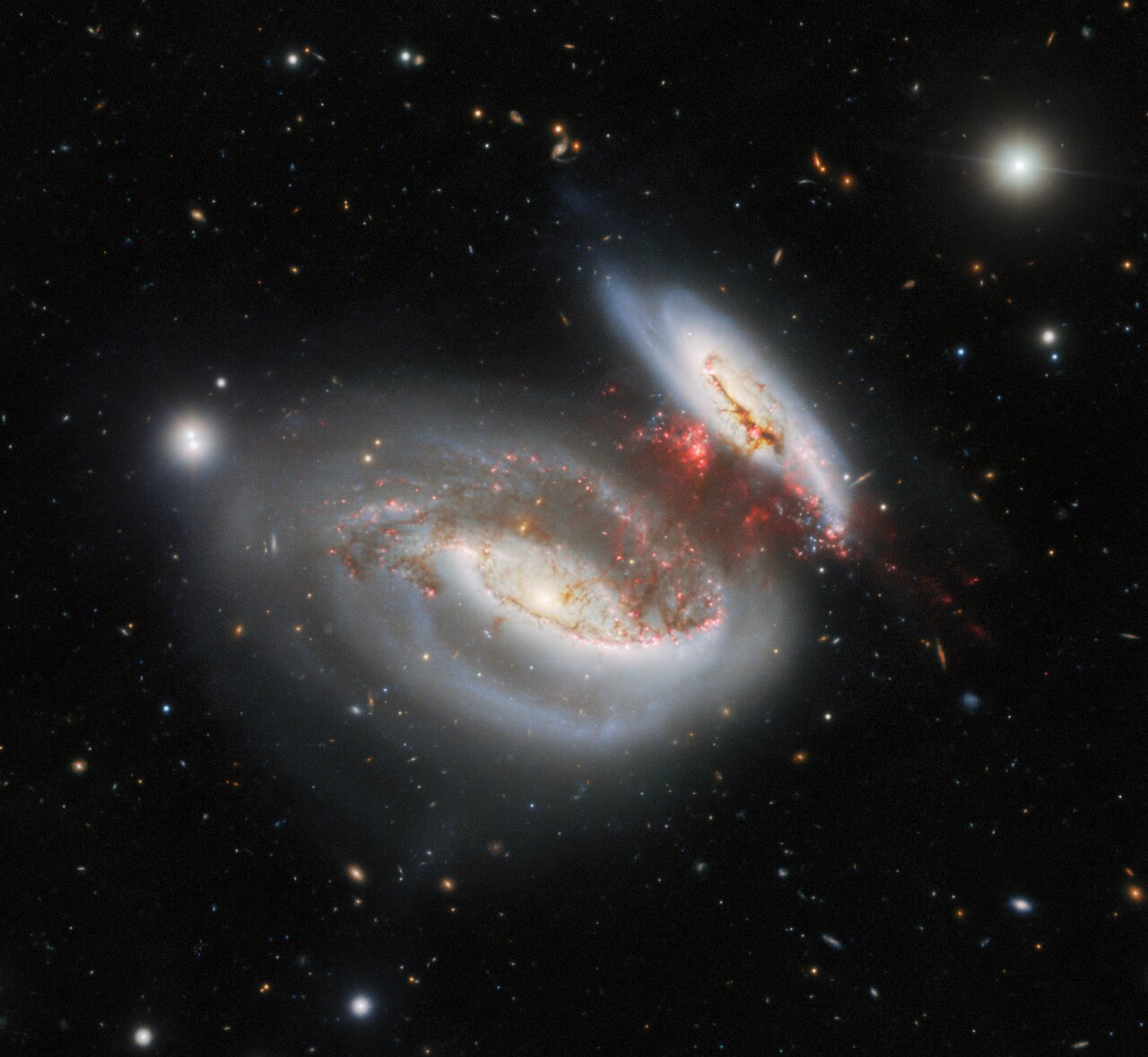
The Gemini North telescope, one half of the International Gemini Observatory, operated by NSF’s NOIRLab, captured this dazzling image of UGC 12914 and UGC 12915, which are nicknamed the Taffy Galaxies. Their twisted shape is the result of a head-on collision that occurred about 25 million years prior to their appearance in this image. A bridge of highly turbulent gas devoid of significant star formation spans the gap between the two galaxies.

Gemini North captures sprawling aftermath of head-on colllision between a pair of galaxies. The Gemini North telescope, one half of the International Gemini Observatory, operated by NSF’s NOIRLab, captured a dazzling image of UGC12914 and UGC312915, which are nicknamed the Taffy Galaxies...

Read More

Astronomers witness the Birth of a very Distant Cluster of Galaxies from the Early Universe

This image shows several galaxies distributed over a black background. The galaxies have colours that range from blue, orange-red, yellow and white. In the centre of the image is a larger concentration of galaxies. Overlaid on the galaxies in the middle is a blue and semi-transparent region. It has a clumpy form with indistinct contours. There are smaller, dark blue regions around it.
Using the Atacama Large Millimeter/submillimeter Array (ALMA), of which ESO is a partner, astronomers have discovered a large reservoir of hot gas in the still-forming galaxy cluster around the Spiderweb galaxy — the most distant detection of such hot gas yet. Galaxy clusters are some of the largest objects known in the Universe and this result, published today in Nature, further reveals just how early these structures begin to form.

Astronomers have discovered a large reservoir of hot gas in the still-forming galaxy cluster around the Spiderweb galaxy — the most distant detection of such hot gas yet. Galaxy clusters are some of the largest objects known in the Universe and this result further reveals just how early these structures begin to form.

Using the Atacama Large Millimete...

Read More

How Cosmic Winds Transform Galactic Environments

A composite closeup of the bright center of spiral galaxy NGC 253.

Researchers model how elements move across star-forming regions. Much like how wind plays a key role in life on Earth by sweeping seeds, pollen and more from one place to another, galactic winds — high-powered streams of charged particles and gases — can change the chemical makeup of the host galaxies they form in, simply by blowing in a specific direction.

Using observations made by NASA’s Chandra X-ray Observatory, a new study details how these energetic winds, once released from the center of a galaxy, directly influence the temperature and metal distribution of the rest of the region.

“Galactic winds are a large part of galaxy evolution in general,” said Sebastian Lopez, lead author of the study and a graduate...

Read More
