Category Astronomy/Space

Artificial Intelligence discovers Secret Equation for ‘Weighing’ Galaxy Clusters

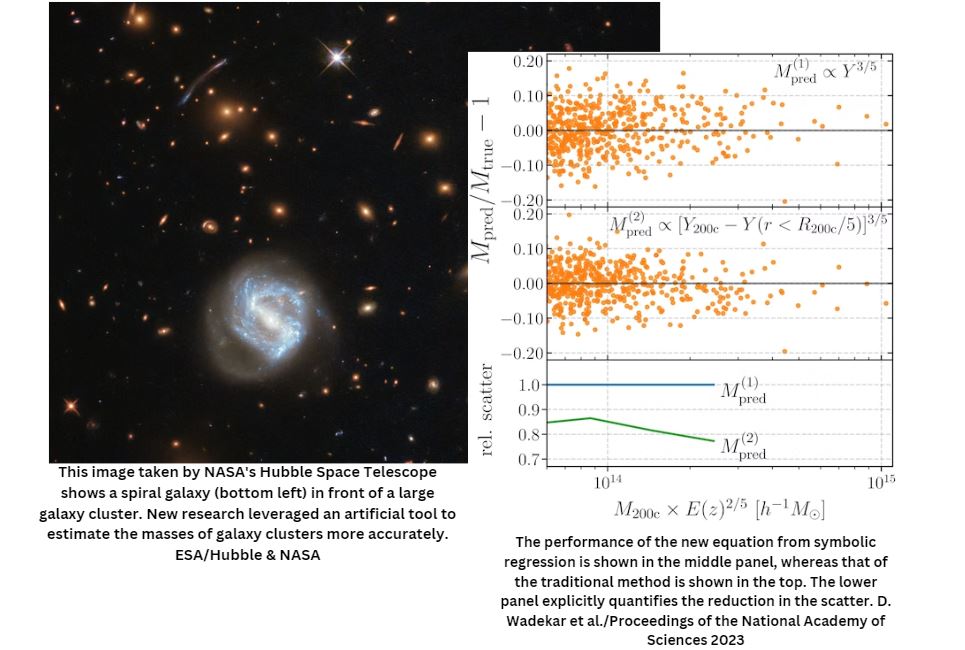
Astrophysicists at the Institute for Advanced Study, the Flatiron Institute and their colleagues have leveraged artificial intelligence to uncover a better way to estimate the mass of colossal clusters of galaxies. The AI discovered that by just adding a simple term to an existing equation, scientists can produce far better mass estimates than they previously had.

The improved estimates will enable scientists to calculate the fundamental properties of the universe more accurately, the astrophysicists reported March 17, 2023, in the Proceedings of the National Academy of Sciences.

“It’s such a simple thing; that’s the beauty of this,” says study co-author Francisco Villaescusa-Navarro, a research scientist at the Flatiron Institute’s Center for Computational Astrophysics (CCA) in...

Read More
Small Stars may Host Bigger Planets than previously thought

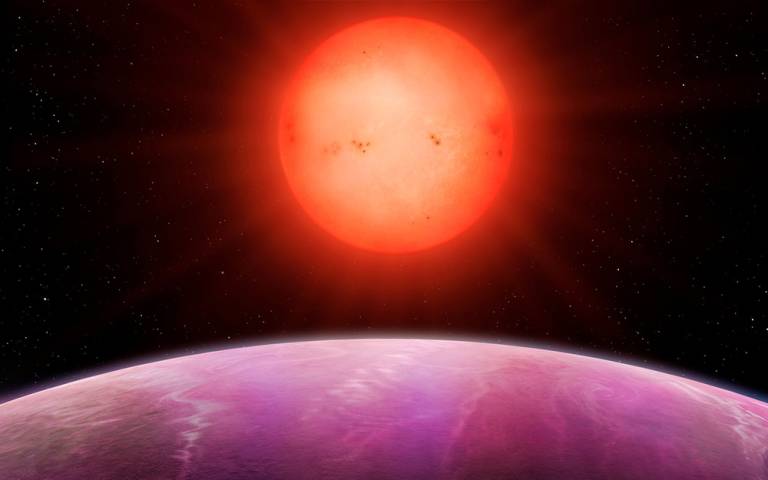
Artist’s impression of sunrise on planet NGTS-1b, a gas giant previously discovered orbiting a low-mass star. Credit: University of Warwick/Mark Garlick

Stars with less than half the mass of our sun are able to host giant Jupiter-style planets, in conflict with the most widely accepted theory of how such planets form, according to a new study led by UCL (University College London) and University of Warwick researchers.

Gas giants, like other planets, form from disks of material surrounding young stars. According to core accretion theory, they first form a core of rock, ice and other heavy solids, attracting an outer layer of gas once this core is sufficiently massive (about 15 to 20 times that of Earth).

However, low-mass stars have low-mass disks that, models predict, would not provide enough material to form a gas giant in this way, or at least not quickly enough before the disk breaks up.

In the study, accepted for publica...

Read More

Scientists find a Common Thread Linking Subatomic Color Glass Condensate and Massive Black Holes

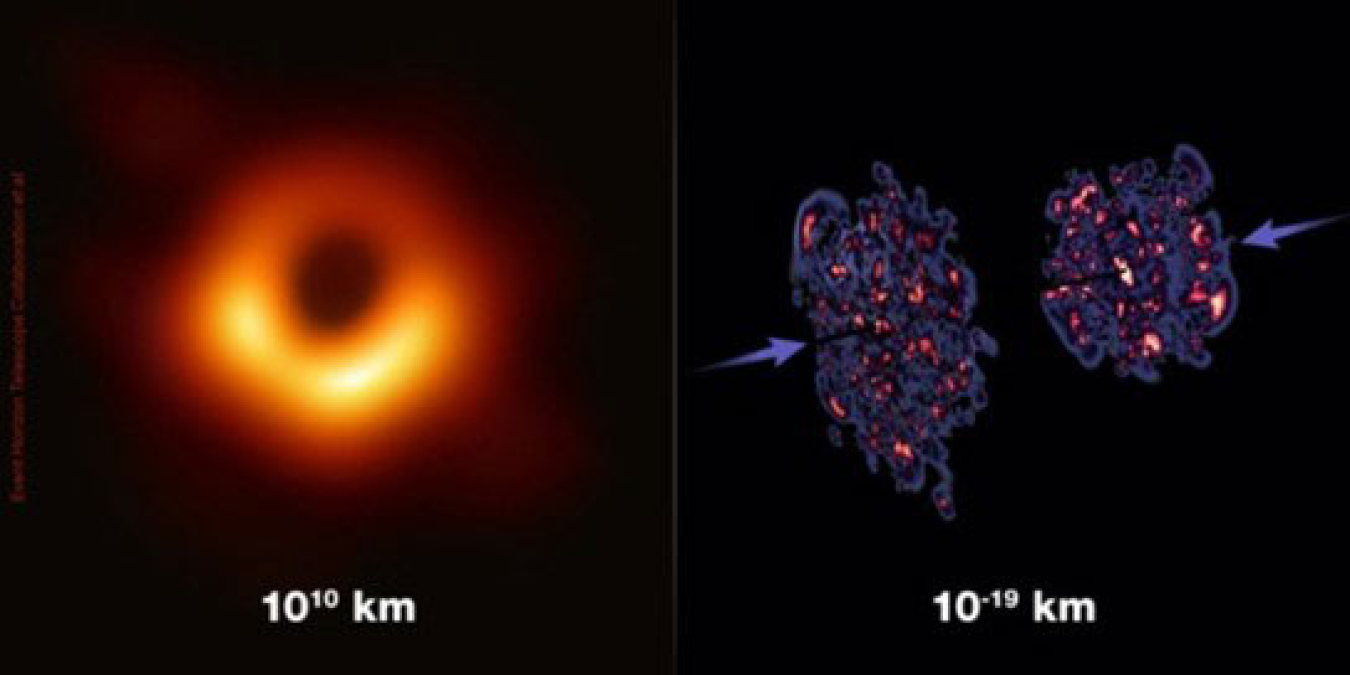
Black holes with dimensions of billions of kilometers (left, as imaged by the Event Horizon Telescope) share features with a dense state of subatomic gluons created in collisions of atomic nuclei (right).
Images courtesy of the Event Horizon Telescope Collaboration (left) and Brookhaven National Laboratory (right).

Physicists show that black holes and dense state of gluons–the ‘glue’ particles that hold nuclear matter together–share common features. Atomic nuclei accelerated close to the speed of light become dense walls of gluons known as color glass condensate (CGC). Recent analysis shows that CGC shares features with black holes, enormous conglomerates of gravitons that exert gravitational force across the universe...

Read More

RNA molecule Uracil found in Asteroid Ryugu Samples

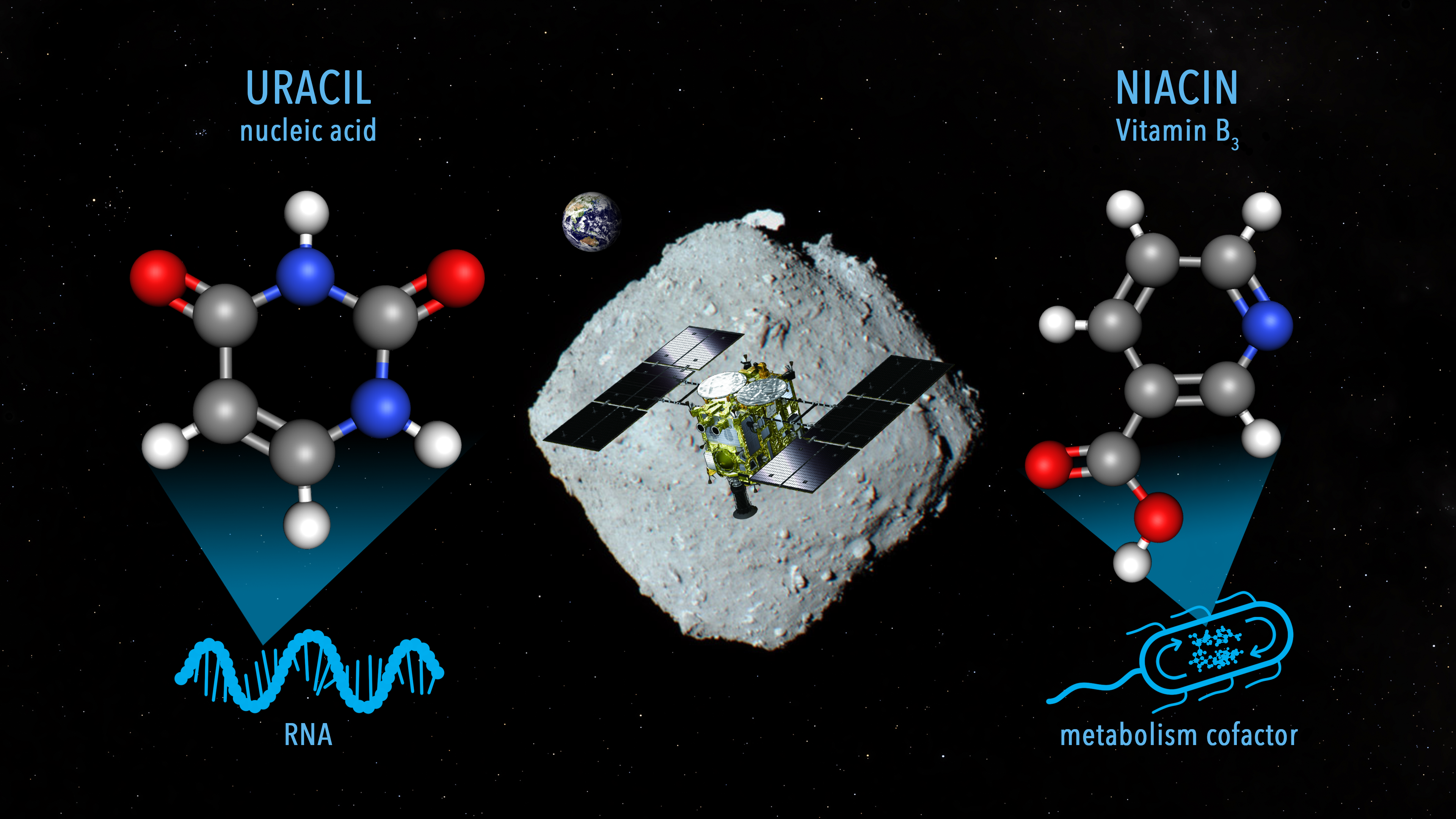
A conceptual image for sampling materials on the asteroid Ryugu containing uracil and niacin by the Hayabusa2 spacecraft (NASA Goddard/JAXA/Dan Gallagher).

Researchers have analyzed samples of the asteroid Ryugu collected by the Japanese Space Agency’s Hayabusa2 spacecraft and found uracil, one of the informational units that make up RNA, the molecules that contain the instructions for how to build and operate living organisms. Nicotinic acid, also known as Vitamin B3 or niacin, which is an important cofactor for metabolism in living organisms, was also detected in the same samples.

This discovery by an international team, led by Associate Professor Yasuhiro Oba at Hokkaido University, adds to the evidence that important building blocks for life are created in space and could have b...

Read More