

Water makes up 71% of Earth’s surface, but no one knows how or when such massive quantities of water arrived on Earth.
A new study published in the journal Nature brings scientists one step closer to answering that question...
Read More

March 16, 2023,
 Astronomy/Space
Water makes up 71% of Earth’s surface, but no one knows how or when such massive quantities of water arrived on Earth.
A new study published in the journal Nature brings scientists one step closer to answering that question...
Read More
March 15, 2023,
Astronomy/Space
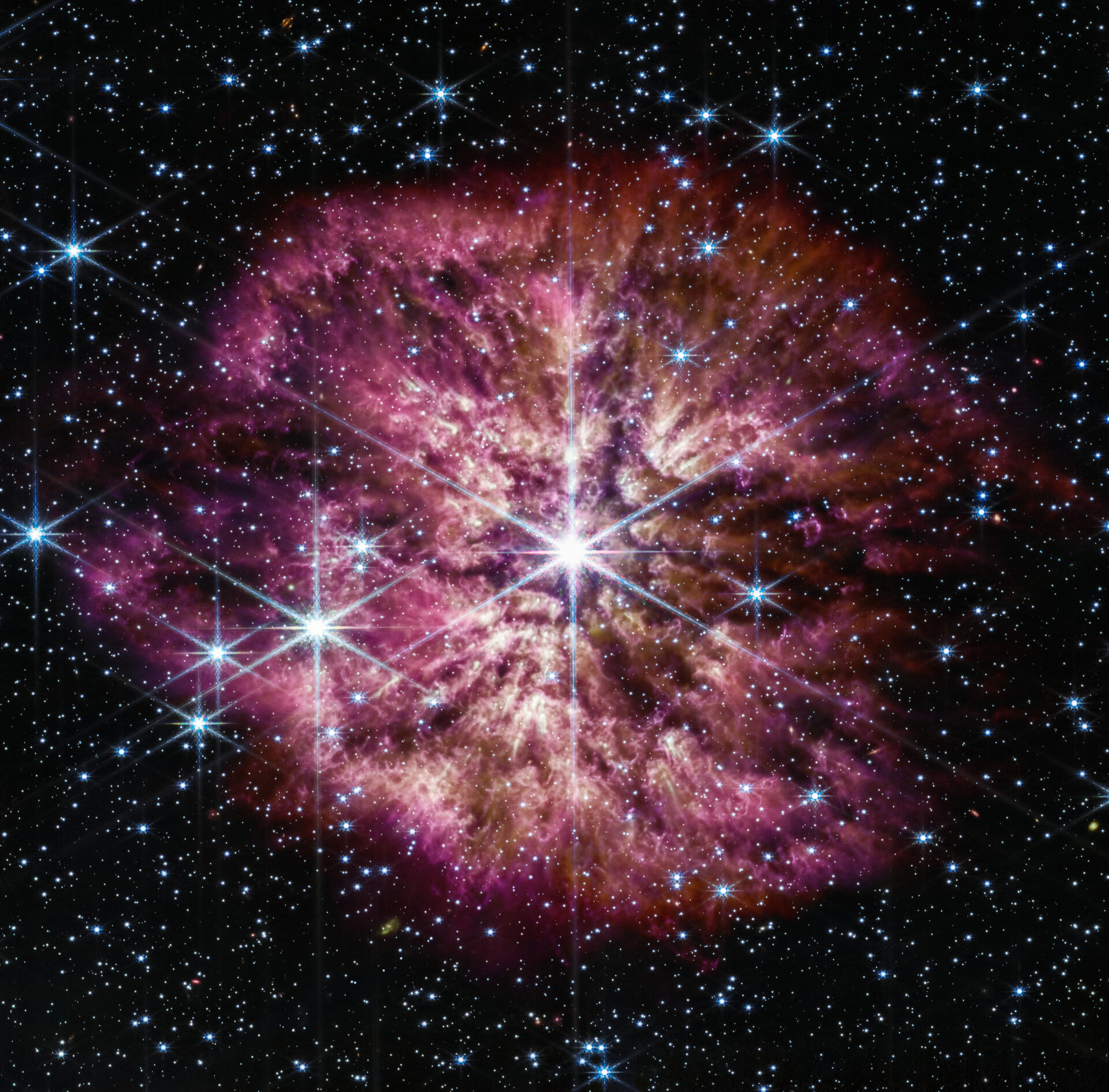
A Wolf-Rayet star is a rare prelude to the famous final act of a massive star: the supernova. As one of its first observations in 2022, the NASA/ESA/CSA James Webb Space Telescope captured the Wolf-Rayet star WR 124 in unprecedented detail. A distinctive halo of gas and dust frames the star and glows in the infrared light detected by Webb, displaying knotty structure and a history of episodic ejections.
Despite being the scene of an impending stellar “death,” astronomers also look to Wolf-Rayet stars for insight into new beginnings. Cosmic dust is forming in the turbulent nebulas surrounding these stars, dust that is composed of the heavy-element building blocks of the modern universe, including life on Earth.
The rare sight of a W...
Read More
Over 13 billion years ago, the first galaxies in the universe formed. They were elliptical, with intermediate black holes (IMBHs) at their centers surrounded by a halo of stars, gas, and dust. Over time, these galaxies evolved by flattening out into disks with a large bulge in the middle. They were then drawn together by mutual gravitational attraction to form galaxy clusters, massive collections that comprise the large-scale cosmic structure. This force of attraction also led to mergers, where galaxies and their central black holes came together to create larger spiral galaxies with central supermassive black holes (SMBHs).
...Read More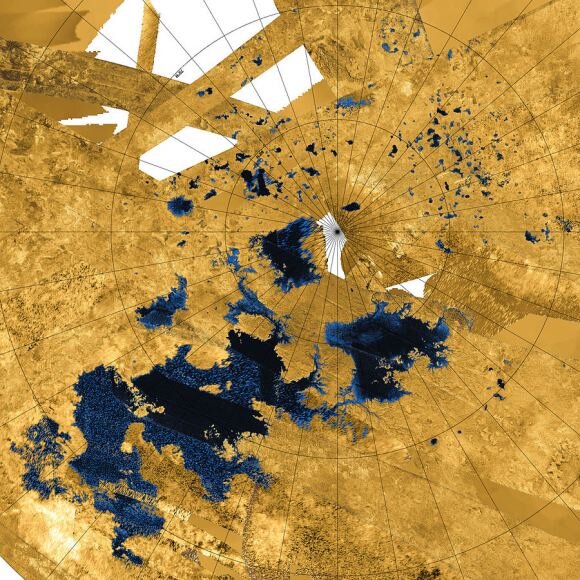
What are the hydrocarbon seas on Titan really like? While the upcoming Dragonfly helicopter mission to Saturn’s hazy and frigid moon should arrive by 2034 to explore Titan’s atmosphere, the need remains for a mission that could study the moon’s mysterious seas and lakes, filled with liquid hydrocarbons.
But how about an aircraft that could study both the seas and skies of Titan?
A new mission concept that received funding from NASA’s Innovative Advanced Concepts (NIAC) Program is called “TitanAir,” and features a flying boat, known as a laker...
Read More

Recent Comments