
Category Astronomy/Space

Scientists discover new sources for ‘the molecule that made the universe’

MSU scientists discover new sources for 'the molecule that made the universe'
A star-forming region in the Tarantula Nebula as captured by the James Webb Space Telescope. MSU researchers have recently uncovered alternative sources of the molecule H₃⁺, which plays a crucial role in the birth of stars and other cosmic chemistry. Credit: NASA, ESA, CSA, STScI, Webb ERO Production Team

From helping catalyze interstellar reactions and fueling the birth of stars to its presence in neighborhood gas giants like Saturn and Jupiter, trihydrogen, or H3+, is best known as the “the molecule that made the universe.”

While we have a clear picture of how the majority of H3+ is formed—a hydrogen molecule, or H2, colliding with its ionized counterpart, H2+—scientists are keen to understand alternative sources of H3+ and to better measure its abundance throughout the cosmos...

Read More
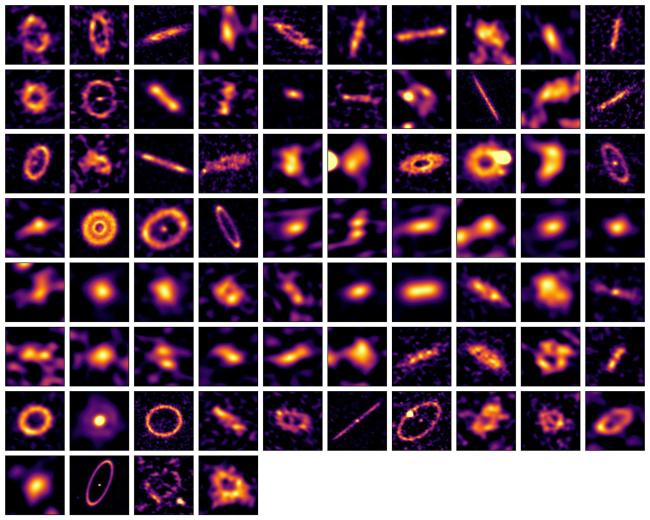
Astronomers announce largest collection of comets found outside our solar system

74 images o different star systems
Caption: This gallery contains 74 images of different star systems with cometary belts (known as “exocomets”) taken with the Submillimeter Array (SMA) and the Atacama Large Millimeter/submillimeter (ALMA) radio telescope facilities. The stars in this study range in ages from very young to middle-aged like our Sun. This new study shows how comets play a role in the formation of stars and planetary systems.

Credit: Luca Matra

For the first time, astronomers have imaged dozens of belts around nearby stars where comets and tiny pebbles within them are orbiting.

This result reveals regions around 74 stars spanning a wide range of ages—from those recently formed to others billions of years old—showing how comets play a role in the formation of stars and planetary systems...

Read More

The Westerlund 1 star cluster: Hubble unveils detailed structure

Study unveils detailed structure of Westerlund 1 star cluster
A Hubble Space Telescope WFC3-IR image of Westerlund 1 in false color. Credit: Wei et al., 2025

Using the Hubble Space Telescope (HST), astronomers have observed a supermassive galactic open cluster designated Westerlund 1. Results of the study, published Jan. 28 on the pre-print server arXiv, yield essential details regarding the structure of this cluster.

Open clusters (OCs), formed from the same giant molecular cloud, are groups of stars loosely gravitationally bound to each other. It is assumed that most star formation takes place in massive clusters of stars, known as superstar clusters (SSCs). They are very massive young OCs usually containing a very large number of young, massive stars. The total mass of a typical SSC exceeds 10,000 solar masses.

Westerlund 1 is a supermas...

Read More

Researchers confirm an exoplanet potentially capable of sustaining life

An international team has confirmed the discovery of a super-Earth orbiting in the habitable zone of a nearby sun-like star. The planet was originally detected two years ago by Oxford University scientist Dr. Michael Cretignier. This result, drawing on more than two decades of observations, opens a window to future studies of Earth-like exoplanets that may have conditions suitable for life.

The new planet, named HD 20794 d, has a mass six times that of Earth and orbits a star similar to our sun, located just 20 light years away. Its orbit places it within the habitable zone of the system, meaning it is at the right distance from its star to sustain liquid water on its surface, a key ingredient for life as we know it. The paper is published in the journal Astronomy & Astrophysics.

...Read More
