Category Astronomy/Space

Multinational research project shows how life on Earth can be measured from space

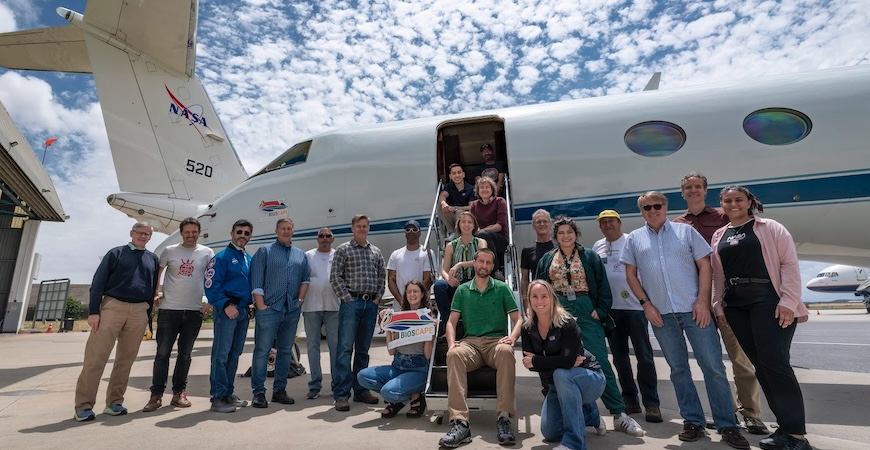
Members of the BioSCape team are pictured with NASA and South African aircraft.
BioSCape was NASA’s first biodiversity-focused campaign. Photo by Jeremey Shelton/Fishwater Films

Measurements and data collected from space can be used to better understand life on Earth.

An ambitious, multinational research project funded by NASA and co-led by UC Merced civil and environmental engineering Professor Erin Hestir demonstrated that Earth’s biodiversity can be monitored and measured from space, leading to a better understanding of terrestrial and aquatic ecosystems. Hestir led the team alongside University of Buffalo geography Professor Adam Wilson and Professor Jasper Slingsby from the University of Cape Town on BioSCape, which collected data over six weeks in late 2024.

Two NASA aircraft and one South African aircraft flew over South Africa’s Greater Cape Floristi...

Read More

Alien Ocean could Hide Signs of Life from Spacecraft

Searching for life in alien oceans may be more difficult than scientists previously thought, even when we can sample these extraterrestrial waters directly.

A new study focusing on Enceladus, a moon of Saturn that sprays its ocean water into space through cracks in its icy surface, shows that the physics of alien oceans could prevent evidence of deep-sea life from reaching places where we can detect it.

Published today (Thursday, 6 February 2025) in Communications Earth and Environment, the study shows how Enceladus’s ocean forms distinct layers that dramatically slow the movement of material from the ocean floor to the surface.

Chemical traces, microbes, and organic material — telltale signatures of life that scientists look for — could break down or transform as they travel...

Read More

First steps taken toward developing Interstellar lightsails

An artist's rendering showing a gray or silver square sail being pushed through space by a red laser beam. Earth is in the background.
The ultimate goal of the lightsail project is to drive a freely accelerating lightsail that is 10 square meters in area and 100 nm or less in thickness.Credit: Breakthrough Starshot / Breakthrough Initiatives

The idea of traveling through interstellar space using spacecraft propelled by ultrathin sails may sound like the stuff of sci-fi novels. But in fact, a program started in 2016 by Stephen Hawking and Yuri Milner, known as the Breakthrough Starshot Initiative, has been exploring the idea. The concept is to use lasers to propel miniature space probes attached to “lightsails” to reach ultrafast speeds and eventually our nearest star system, Alpha Centauri.

Caltech is leading the worldwide community working toward achieving this audacious goal.

“The lightsail will travel faste...

Read More

The hidden power of the smallest microquasars

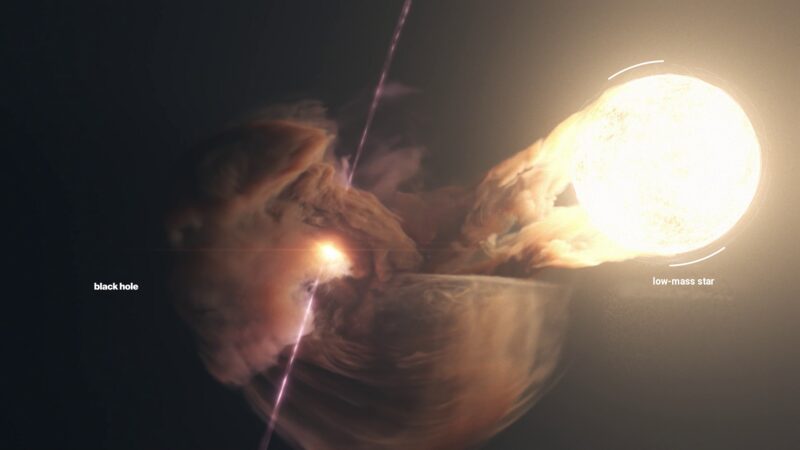
Researchers found for the first time evidence that even microquasars containing a low-mass star are efficient particle accelerators, which leads to a significant impact on the interpretation of the abundance of gamma rays in the universe.

Our home planet is bombarded with particles from outer space all the time. And while we are mostly familiar with the rocky meteorites originating from within our solar system that create fascinating shooting stars in the night sky, it’s the smallest particles that help scientists to understand the nature of the universe. Subatomic particles such as electrons or protons arriving from interstellar space and beyond are one of the fastest particles known in the universe and known as cosmic rays.

The origins and the acceleration mechanisms of the mo...

Read More