
Category Astronomy/Space

Mars may have been Habitable much more recently than thought

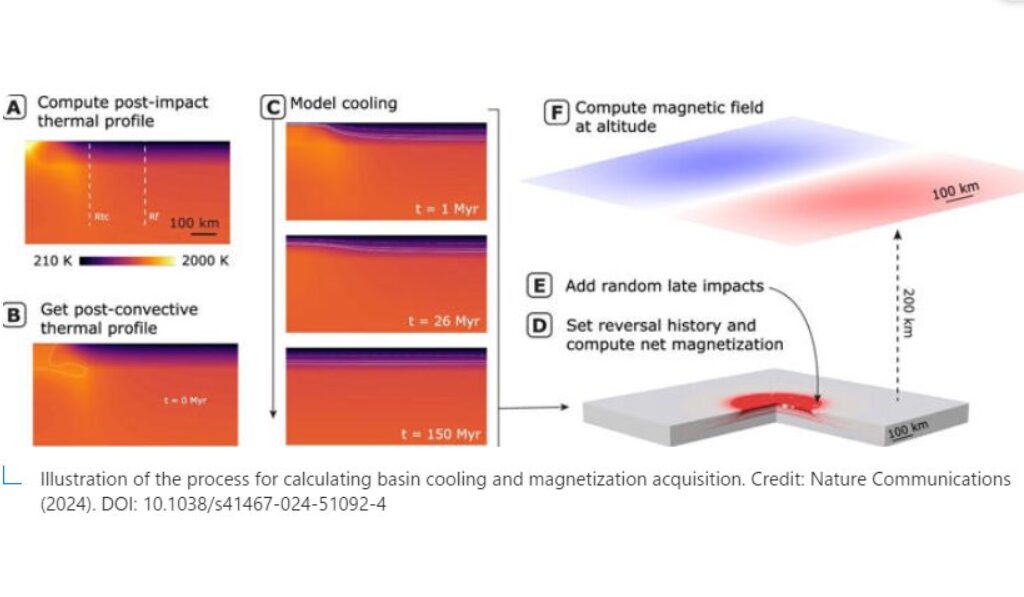
Evidence suggests Mars could very well have been teeming with life billions of years ago. Now cold, dry, and stripped of what was once a potentially protective magnetic field, the red planet is a kind of forensic scene for scientists investigating whether Mars was indeed once habitable, and if so, when.

The “when” question in particular has driven researchers in Harvard’s Paleomagnetics Lab in the Department of Earth and Planetary Sciences. A new paper in Nature Communications makes their most compelling case to date that Mars’ life-enabling magnetic field could have survived until about 3.9 billion years ago, compared with previous estimates of 4.1 billion years—so hundreds of millions of years more recently.

The study was led by Griffin Graduate School of Arts and Sciences s...

Read More
Seeing a Black Hole’s Jet in a New Light

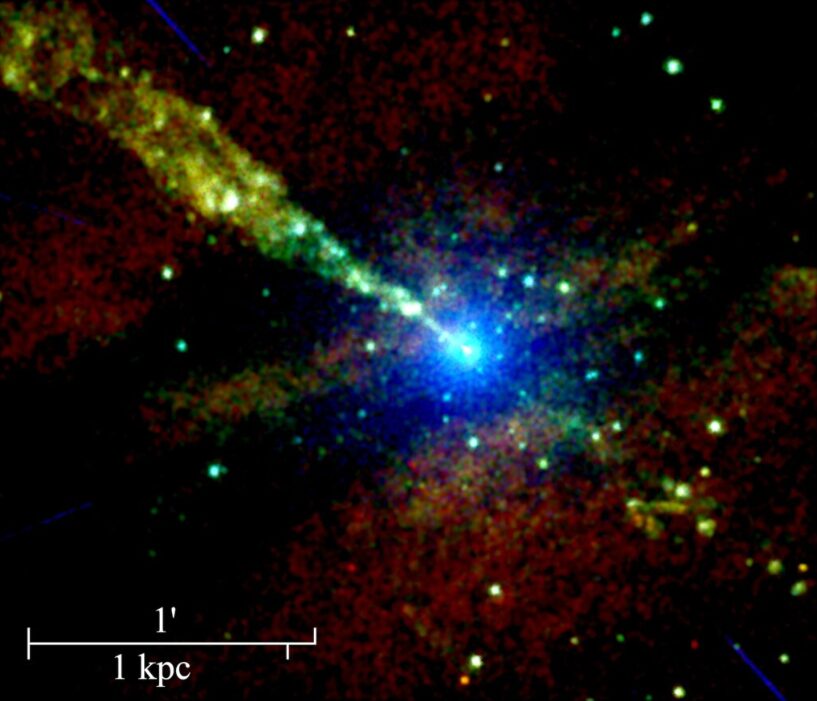
The Chandra X-ray Observatory reveals the jet of Centaurus A, extending into the upper left corner of the image. Researchers have found new insights in the jet by focusing on the motion of the bright spots, or knots, within the jet. Image credit: Used under a CC-BY 4.0 license from D. Bogensberger et al. Astrophys. J. (2024) DOI: 10.3847/1538-4357/ad73a1

Research led by the University of Michigan has pored over more than two decades’ worth of data from NASA’s Chandra X-Ray Observatory to show there’s new knotty science to discover around black holes.

In particular, the study looks at the high-energy jet of particles being blasted across space by the supermassive black hole at the center of the galaxy Centaurus A.

Jets are visible to different types of telescopes, including those ...

Read More

Ion Engines could take us to the Solar Gravitational Lens in less than 13 years, suggests paper

Ion engines could take us to the solar gravitational lens in less than 13 years
Ion thruster. Credit: NASA

Sending an object to another star is still the stuff of science fiction. But some concrete missions could get us at least part way there. These “interstellar precursor missions” include a trip to the solar gravitational lens point at 550 AU from the sun—farther than any artificial object has ever been, including Voyager.

To get there, we’ll need plenty of new technologies, and a recent paper presented at the 75th International Astronautical Congress in Milan this month looks at one of those potential technologies—electric propulsion systems, otherwise known as ion drives.

The paper aimed to assess when any existing ion drive technology could port a large payload on one of several trajectories, including a trip around Jupiter, one visiting Pluto, and...

Read More

Scientists discover Molecules that Store Much of the Carbon in Space

Gabi Wenzel and Brett McGuire stand in the lab full of equipment on racks.
The findings suggest pyrene may have been the source of much of the carbon in our solar system. “It’s an almost unbelievable sink of carbon,” says Brett McGuire, right, standing with lead author of the study Gabi Wenzel.
Credits:Photo: Bryce Vickmark

A team led by researchers at MIT has discovered that a distant interstellar cloud contains an abundance of pyrene, a type of large, carbon-containing molecule known as a polycyclic aromatic hydrocarbon (PAH).

The discovery of pyrene in this far-off cloud, which is similar to the collection of dust and gas that eventually became our own solar system, suggests that pyrene may have been the source of much of the carbon in our solar system...

Read More
