Category Astronomy/Space

Physicists Discover First ‘Black Hole Triple’

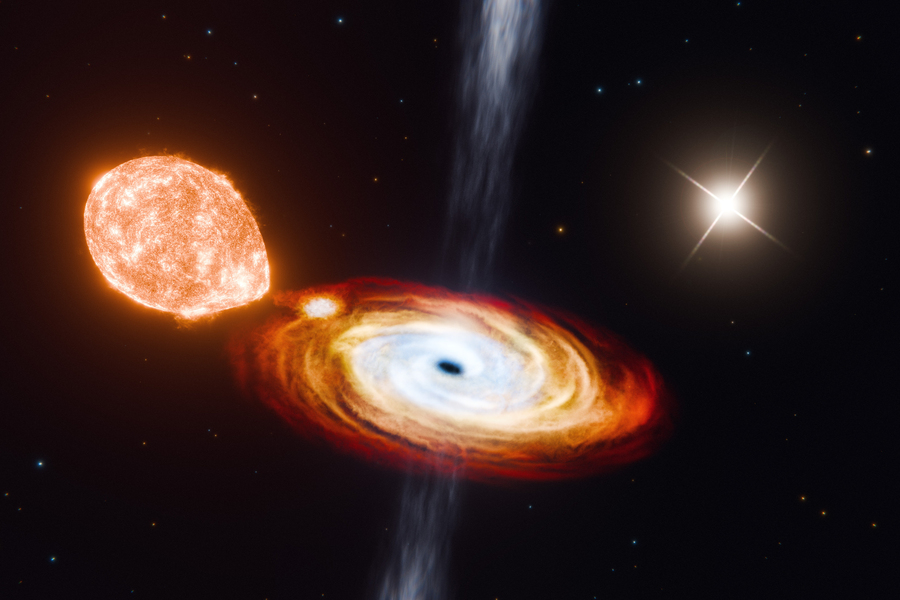
Illustration of a black hole at the center of a galaxy in the process of consuming a nearby star, which looks like an orange blob. A second, more regular, star appears at a distance.

System observed 8,000 light-years away may be the first direct evidence of ‘gentle’ black hole formation. A surprising discovery about the black hole V404 Cygnus is expanding our understanding of black holes, the objects they can host, and the way they form.

Many black holes detected to date appear to be part of a pair. These binary systems comprise a black hole and a secondary object — such as a star, a much denser neutron star, or another black hole — that spiral around each other, drawn together by the black hole’s gravity to form a tight orbital pair.

Now a surprising discovery is expanding the picture of black holes, the objects they can host, and the way they form.

In a study appearing in Nature, physicists at MIT and Caltech report that they have observed a “black hole...

Read More
Betelgeuse Betelgeuse? Bright star Betelgeuse likely has a ‘Betelbuddy’ stellar companion

Lucy Reading-Ikkanda/Simons Foundation

One of the brightest stars in the night sky, Betelgeuse, may not be on the brink of exploding as a supernova, according to a new study of the star’s brightening and dimming. Instead, recent research shows that the observed pulsing of the starlight is probably caused by an unseen companion star orbiting Betelgeuse.

Formally named Alpha Ori B, the “Betelbuddy” (as astrophysicist Jared Goldberg calls it) acts like a snowplow as it orbits Betelgeuse, pushing light-blocking dust out of the way and temporarily making Betelgeuse seem brighter. Goldberg and his colleagues present their simulations of this process in a paper accepted for publication in The Astrophysical Journal. The findings are published on the arXiv preprint server.

“We ruled out e...

Read More

New Research shows Most Space Rocks Crashing into Earth Come from a Single Source

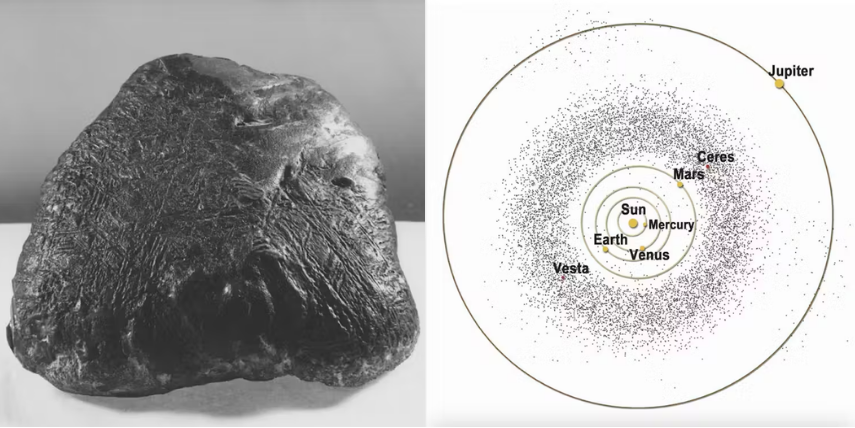
Left: An iron-nickel meteorite found near Fort Stockton, Texas, in 1952. JPL/Smithsonian Institution

Right: Artist’s graphic of the asteroid belt between Mars and Jupiter. NASA/McREL

The sight of a fireball streaking across the sky brings wonder and excitement to children and adults alike. It’s a reminder that Earth is part of a much larger and incredibly dynamic system.

Each year, roughly 17,000 of these fireballs not only enter Earth’s atmosphere, but survive the perilous journey to the surface. This gives scientists a valuable chance to study these rocky visitors from outer space.

Scientists know that while some of these meteorites come from the Moon and Mars, the majority come from asteroids. But two separate studies published in Nature today have gone a step further...

Read More

Neutron Stars may be Shrouded in Axions

axion cloud
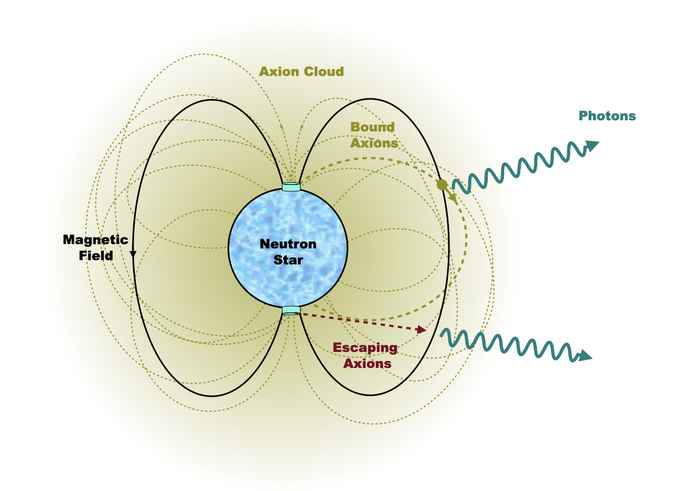
An axion cloud around a neutron star. While some axions escape the star’s gravitational pull, many remain bound to the star and over a long period of time form a cloud surrounding it. The interaction with the neutron star’s strong magnetic field causes some axions to convert into photons – light that we can eventually detect with our telescopes on Earth.

Physicists show that neutron stars may be shrouded in clouds of ‘axions’ — and that these clouds can teach us a lot. A team of physicists from the universities of Amsterdam, Princeton and Oxford have shown that extremely light particles known as axions may occur in large clouds around neutron stars...

Read More