Courtesy of SwRI An SwRI-led team used NASA’s Webb telescope, shown in the bottom right corner of this illustration, to confirm the presence of hydrated minerals on the surface of Psyche, a massive and heavily metallic body in the main asteroid belt. These findings suggest a complex history for this interesting asteroid, which many scientists think could be the remnant core of a protoplanet, including impacts with hydrated asteroids.
Webb telescope data indicate a complex history for the metallic asteroid. Using data from NASA’s James Webb Space Telescope, a Southwest Research Institute-led team has confirmed hydroxyl molecules on the surface of the metallic asteroid Psyche...
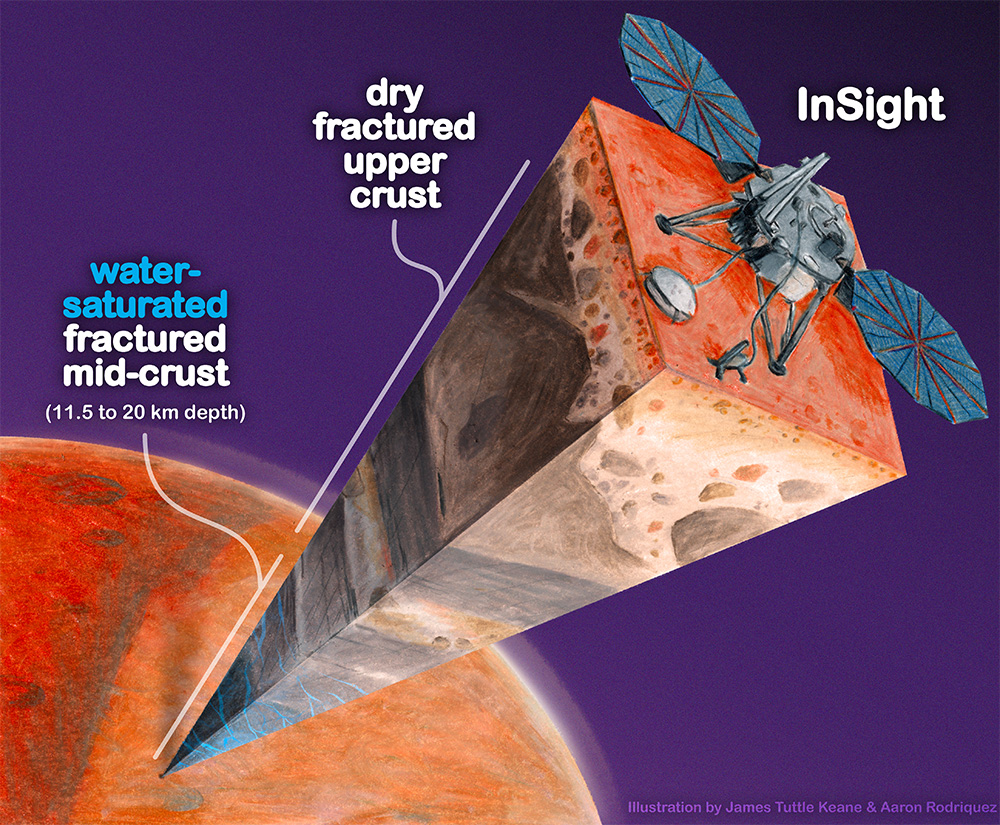
A cutout of the Martian interior beneath NASA’s Insight lander. The top 5 kilometers of the crust appear to be dry, but a new study provides evidence for a zone of fractured rock 11.5-20 km below the surface that is full of liquid water — more than the volume proposed to have filled hypothesized ancient Martian oceans. James Tuttle Keane and Aaron Rodriquez, courtesy of Scripps Institution of Oceanography
Using seismic activity to probe the interior of Mars, geophysicists have found evidence for a large underground reservoir of liquid water—enough to fill oceans on the planet’s surface.
The data from NASA’s Insight lander allowed the scientists to estimate that the amount of groundwater could cover the entire planet to a depth of between 1 and 2 kilometers, or about a mile.
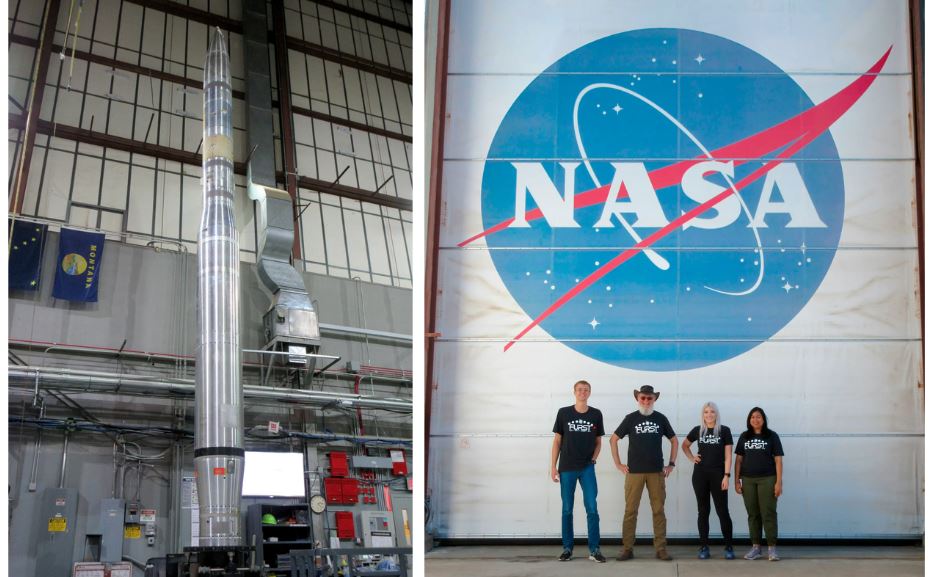
1. The Full-sun Ultraviolet Rocket SpecTrograph (FURST) undergoes testing at White Sands Missile Range in New Mexico in preparation for launch on Aug. 11. FURST will be launched aboard a Black Bryant IX sounding rocket and will observe the Sun in vacuum ultraviolet (VUV). The instrument was designed and built at Montana State University. NASA Marshall provided the camera, supplied avionics, and designed and built its calibration system. Credit: Montana State University 2. Montana State University alumnus Jake Davis, left, Professor Charles Kankelborg, and doctoral students Catharine “Cappy” Bunn and Suman Panda, pose at White Sands Missile Range in New Mexico, where they are preparing for the launch of the FURST rocket mission to observe the sun in far ultraviolet. Credit: Montana State...Read More
The proposed nanoparticle warming method. Credit: Aaron M. Geller, Center for Interdisciplinary Exploration and Research in Astrophysics.
A small team of engineers and geophysicists from Northwestern University, the University of Chicago, and the University of Central Florida has found, via modeling, that creating millions of metal nanorods from material on the Martian surface and then blasting them into the atmosphere would be a more efficient way to heat the planet than generating greenhouse gases. Their paper is published in the journal Science Advances.
Science fiction writers have for many years envisioned a future when Mars is made habitable through terraforming techniques, allowing humans to survive without the need for special buildings and spacesuits...







Recent Comments