
Category Astronomy/Space

Newly-discovered Star could provide New Insights into the Evolution of Stars

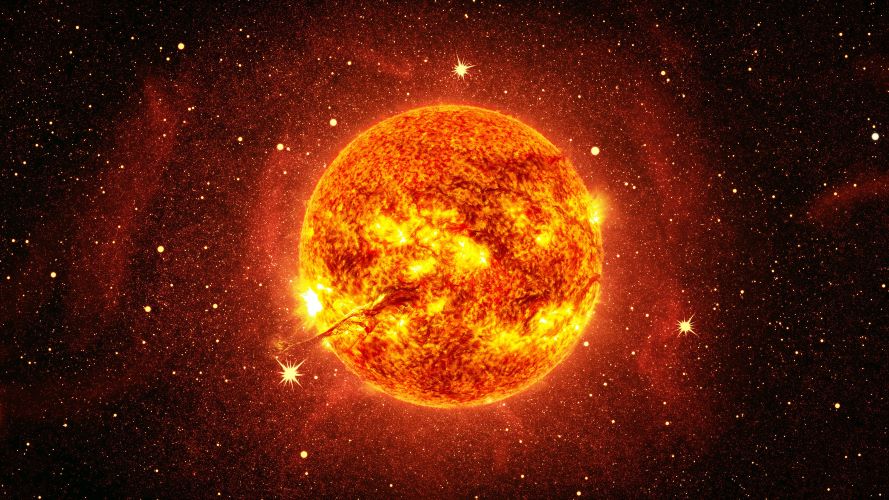
An artist's rendering of a yellow-orange star against the background of space
With far more lithium than expected, the star raises questions about how stars change over time

A new study published in The Astrophysical Journal, led by Assistant Professor of Astronomy Rana Ezzeddine and UF alumnus Jeremy Kowkabany, with collaborators, reports the discovery of a star that challenges astronomers’ understanding of star evolution and formation of chemical elements, and could suggest a new stage in their growth cycle.

It is widely accepted that as stars burn, they lose lighter elements like lithium in exchange for heavier elements like carbon and oxygen, but an analysis of this new star revealed that not only was its lithium content high for its age, but was higher than the normal level for any star at any age.

This star, named J0524-0336 based on its coordinates ...

Read More
Astronomers Uncover Risks to Planets that could Host Life

Space illustration
UV radiation from stellar flares can erode planetary atmospheres

A groundbreaking study has revealed that red dwarf stars can produce stellar flares that carry far-ultraviolet (far-UV) radiation levels much higher than previously believed. This discovery suggests that the intense UV radiation from these flares could significantly impact whether planets around red dwarf stars can be habitable. Led by current and former astronomers from the University of Hawaii Institute for Astronomy (IfA), the research was recently published in the Monthly Notices of the Royal Astronomical Society.

“Few stars have been thought to generate enough UV radiation through flares to impact planet habitability...

Read More

The Higgs particle could have ended the universe by now – here’s why we’re still here

The Higgs a Particle could have Ended the Universe by now—here’s why we’re still here

Although our universe may seem stable, having existed for a whopping 13.7 billion years, several experiments suggest that it is at risk—walking on the edge of a very dangerous cliff. And it’s all down to the instability of a single fundamental particle: the Higgs boson.

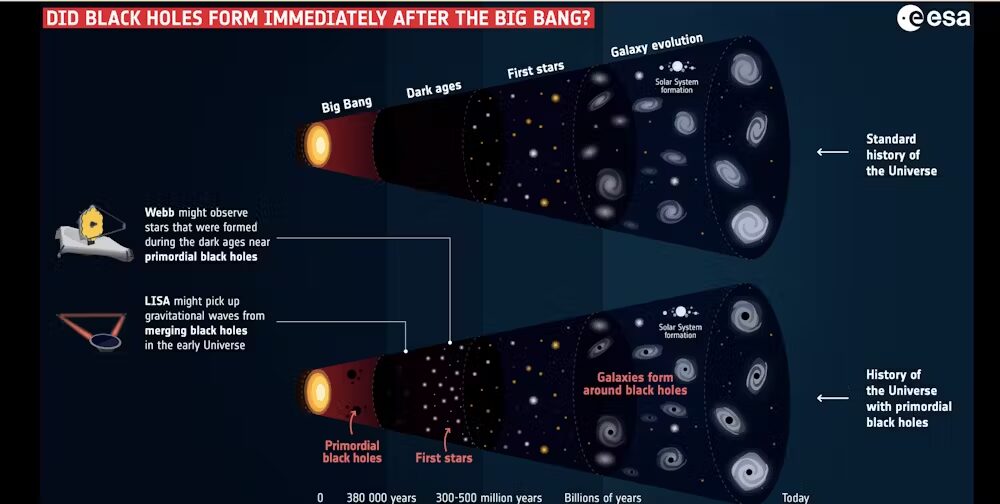
In new research by me and my colleagues, just accepted for publication in Physical Letters B, we show that some models of the early universe, those which involve objects called light primordial black holes, are unlikely to be right because they would have triggered the Higgs boson to end the cosmos by now.

The Higgs boson is responsible for the mass and interactions of all the particles we know of...

Read More

Astronomers use AI to find Elusive Stars ‘Gobbling up’ Planets

Astronomers use AI to find elusive stars 'gobbling up' planets
Credit: NASA, ESSA, Joseph Olmsted (STScI).

Astronomers have recently found hundreds of “polluted” white dwarf stars in our home galaxy, the Milky Way. These are white dwarfs caught actively consuming planets in their orbit. They are a valuable resource for studying the interiors of these distant, demolished planets. They are also difficult to find.

Historically, astronomers have had to manually review mountains of survey data for signs of these stars. Follow-up observations would then prove or refute their suspicions.

By using a novel form of artificial intelligence, called manifold learning, a team led by University of Texas at Austin graduate student Malia Kao has accelerated the process, leading to a 99% success rate in identification...

Read More
