
Category Biology/Biotechnology

Surprise finding shows that Neutrophils can be Key Antitumor Weapons

microscopic image
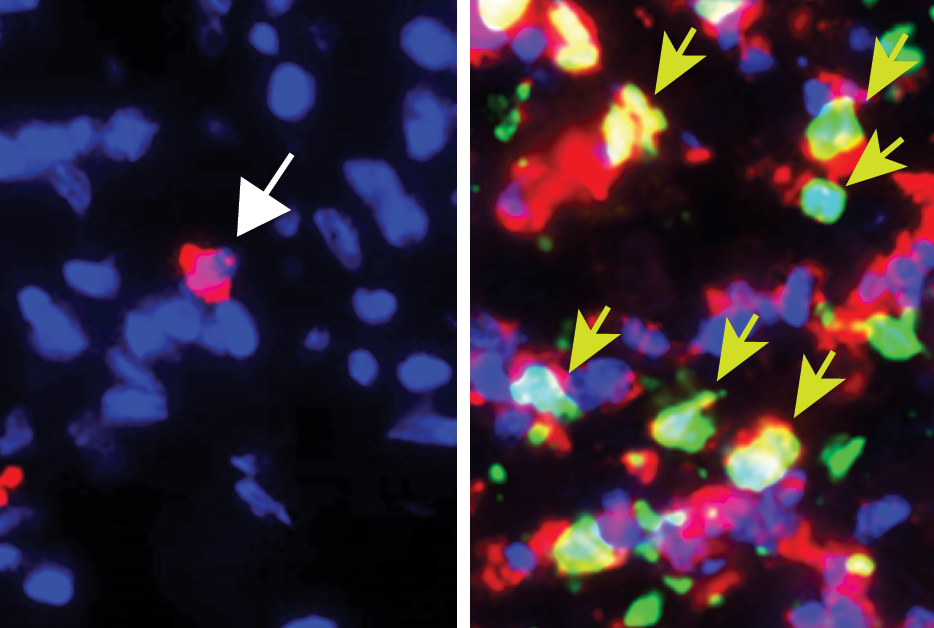
Biopsies from melanoma patients who were treated or not with immune checkpoint blockade were stained for neutrophil activation. Left: Biopsy of an untreated patient, with white arrow showing neutrophils. Right: Biopsy of a patient treated with immunotherapy, with yellow arrows showing activated neutrophils. 

White blood cells called neutrophils have an unappreciated role in eradicating solid tumors, according to a surprise discovery from a team led by Weill Cornell Medicine scientists.

In the study, published March 30 in Cell, the researchers investigated how a T cell-based immunotherapy was able to destroy melanoma tumors even though many of the tumor cells lacked the markers or “antigens” targeted by the T cells...

Read More

‘Smart’ Bandages Monitor Wounds and provide Targeted Treatment

A larger version of the smart bandage rests on the back of a gloved hand
A larger version of the smart bandage.

Researchers have developed a flexible electronic bandage for use on chronic wounds, particularly in diabetic patients. The bandage monitors signs of inflammation, collecting medical data, providing medication as needed and stimulate tissue growth.

These kinds of chronic wounds are not just debilitating for the people suffering from them. They are also a drain on healthcare systems, representing a $25 billion financial burden in the United States alone each year.

A new kind of smart bandage developed at Caltech may make treatment of these wounds easier, more effective, and less expensive...

Read More

Researchers discover a way to Fight the Aging Process and Cancer Development

Microscope image of C. elegans 10 days after treatment with UV-B rays. Left: Worms with intact DREAM complex cannot repair DNA well. Right: Worms without DREAM complex repair damage and live longer.

The DREAM protein complex prevents the repair of genome damage in human cells, in mice and in the nematode Caenorhabditis elegans, a team of researchers at the University of Cologne has discovered. They also successfully inhibited this complex for the first time using a pharmaceutical agent.

“When we suppress the so-called DREAM complex in body cells, various repair mechanisms kick in, making these cells extremely resilient towards all kinds of DNA damage,” said Professor Dr Björn Schumacher, Director of the Institute for Genome Stability in Aging and Disease at the University of Cologne...

Read More

Patient-specific Cells Generated from Thymus Organoids

Figure thumbnail gr1
Generation of hPSC-derived TECs in vitro
(A) Schematic of TEP-only sTOs.
(B) Representative IF images of KRT8 (green) and KRT5 (magenta) in day 16–22 TEPs and week 2 TEP-only sTOs (TEPs, n = 2 indepdendent experiment (ind. exp.), 2 hPSC lines; sTOs, n = 3 ind. exp., 2 hPSC lines).
(C–H) FC plots and quantification of EPCAM/HLA-DR (C and D), EPCAM/CD205 (E and F), and EPCAM/GFP (G and H) expression in day 16–22 TEPs and week 2 TEP-only sTOs.
(I) tSNE plots of EPCAM, HLA-DR, CD205, and GFP expression in 16–22 TEPs and week 2 TEP-only sTOs, n = 3 ind. exp., 1 hPSC line.
Plots show percentage of the mean; data are shown as mean Â±
± SEM.

Researchers have used pluripotent stem cells to make thymus organoids that support the development of patient-specific T cells, researchers report Marc...

Read More
