
Category Biology/Biotechnology

Multiple studies show that children face elevated health risks after COVID infection

child in mask
Credit: Pixabay/CC0 Public Domain

Long COVID can result in increased risk for a variety of serious health problems for young people, including those affecting the kidney, gut, and cardiovascular system, according to a group of new studies led by investigators at the Perelman School of Medicine at the University of Pennsylvania.

“While most public attention has focused on the acute phase of COVID-19, our findings reveal children face significant long-term health risks that clinicians need to monitor,” said senior author Yong Chen, Ph.D., a professor in the Department of Biostatistics and Epidemiology. The studies were conducted under the Researching COVID to Enhance Recovery (RECOVER) Initiative, a special project including more than two dozen health care institutions.

These medic...

Read More
Scientists cast new light on how fasting impacts the immune system

female-hands-cutlery-empty-plate-450w-440334799.jpg

New research from The University of Manchester may reshape our understanding of what happens to the immune system when we fast. The study on mice shows that the brain’s hypothalamus controls how the immune system adapts during fasting, through a handful of highly specialized neurons responsible for making animals hungry.

Published in Science Immunology, the study shows the brain’s perception of hunger or fullness, rather than actual eating or caloric restriction, is enough to drive changes in the body’s immune cells.

The findings cast doubt on the current view that a lack of nutrients alone controls how the immune system responds to fasting, indicating the brain has a critical role, beyond the simple absence of food.

By artificially switching on specific brain neurons in mice...

Read More

Highly accurate blood test diagnoses Alzheimer’s disease, measures extent of dementia

Kanta Horie
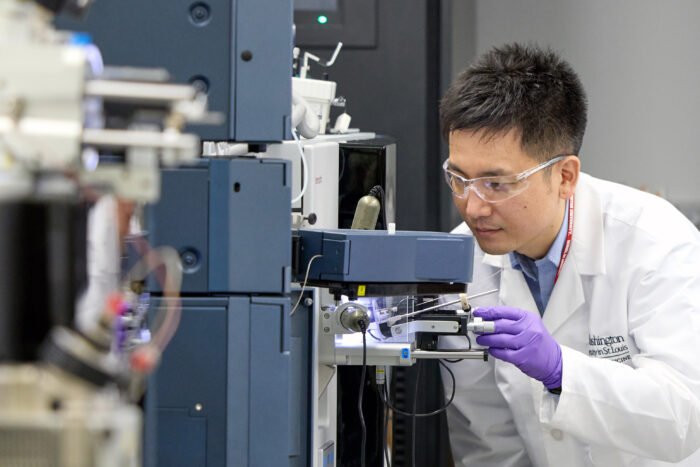
WashU Medicine researcher Kanta Horie, PhD, places a sample in a mass spectrometer that measures protein levels in blood plasma and other fluids. Horie co-led the development of a blood test for Alzheimer’s disease that diagnoses and stages the disease by using mass spectrometry to measure the level of a protein called MTBR-tau243.

Could help determine which patients are likely to benefit from new Alzheimer’s drugs. A newly developed blood test for Alzheimer’s disease not only aids in the diagnosis of the neurodegenerative condition but also indicates how far it has progressed, according to a study by researchers at Washington University School of Medicine in St. Louis and Lund University in Sweden.

Several blood tests for Alzheimer’s disease are already clinically available, incl...

Read More

How a critical enzyme keeps potentially dangerous genes in check

How a critical enzyme keeps potentially dangerous genes in check
Ogt deletion results in reduced DNA methylation genome-wide. Credit: Nature Structural & Molecular Biology (2025). DOI: 10.1038/s41594-025-01505-9

You may have heard of the fantastic-sounding “dark side of the genome.” This poorly studied fraction of DNA, known as heterochromatin, makes up around half of your genetic material, and scientists are now starting to unravel its role in your cells.

For more than 50 years, scientists have puzzled over the genetic material contained in this “dark DNA.” But there’s a growing body of evidence showing that its proper functioning is critical for maintaining cells in a healthy state. Heterochromatin contains tens of thousands of units of dangerous DNA, known as “transposable elements” (or TEs)...

Read More
