Category Environment/Geology

Common Herbicide compound may Save millions of Lives

UQ’s Dr Mario D. Garcia conducting one of the many experiments involved in the research.
Credit: The University of Queensland

A chemical compound found in common herbicides could help fight hospital-acquired human fungal pathogenic infections, which claim an estimated two million lives per year. A team of international researchers led by The University of Queensland has discovered that the chemical chlorimuron ethyl also targets a range of fungal infections that are potentially fatal to humans, particularly people undergoing treatments which place the immune system under stress.

Dr Luke Guddat, from UQ’s School of Chemistry and Molecular Biosciences, said the finding was very timely, given the growth in drug-resistant infections...

Read More

Eco-friendly Nanoparticles for Artificial Photosynthesis

This is a schematic representation of photocatalytic hydrogen production with InP/ZnS quantum dots in a typical assay. Credit: Shan Yu

This is a schematic representation of photocatalytic hydrogen production with InP/ZnS quantum dots in a typical assay.
Credit: Shan Yu

Researchers at the University of Zurich have developed a nanoparticle type for novel use in artificial photosynthesis by adding zinc sulfide on the surface of indium-based quantum dots. These quantum dots produce clean hydrogen fuel from water and sunlight – a sustainable source of energy. They introduce new eco-friendly and powerful materials to solar photocatalysis.

Quantum dots are true all-rounders. These material structures, which are only a few nanometers in size, display a similar behavior to that of molecules or atoms, and their form, size and number of electrons can be modulated systematically...

Read More

Material could help Windows both Power your Home and Control its Temperature

Joule, Sun et al.: "Heat-insulating multifunctional semitransparent polymer solar cells" https://www.cell.com/joule/fulltext/S2542-4351(18)30242-3

Joule, Sun et al.: “Heat-insulating multifunctional semitransparent polymer solar cells” https://www.cell.com/joule/fulltext/S2542-4351(18)30242-3

Environmentally friendly building trends have boosted the popularity of window coatings that keep heating and cooling costs down by blocking out unneeded parts of sunlight. They have also inspired scientists and engineers to create thin, see-through solar cells to turn windows into miniature electricity generators. Researchers in China have gone a step further and combined these two functions into one window-compatible material that could double the energy efficiency of an average household. Their work appears July 3 in the journal Joule.

“Building-integrated photovoltaics are a great example of a market where silicon photovoltaics, despite thei...

Read More

‘Electrogeochemistry’ Captures Carbon, produces Fuel, offsets Ocean Acidification

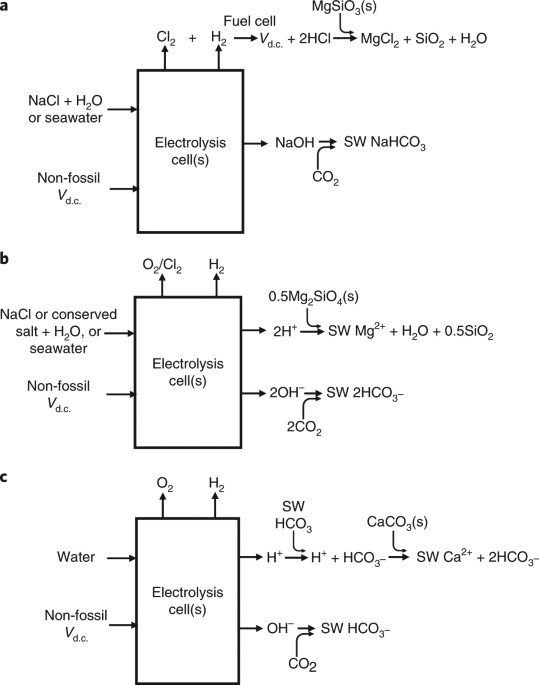
 Various schemes for electrolytically generating H2 while consuming CO2 and transforming it to dissolved mineral bicarbonate.

Various schemes for electrolytically generating H2 while consuming CO2 and transforming it to dissolved mineral bicarbonate.

Limiting global warming to 2 degrees Celsius will require not only reducing emissions of CO2, but also active removal of carbon dioxide from the atmosphere. This conclusion from the Intergovernmental Panel on Climate Change has prompted heightened interest in “negative emissions technologies.” A new study evaluates the potential for recently described methods that capture carbon dioxide from the atmosphere through an “electrogeochemical” process that also generates hydrogen gas for use as fuel and creates by-products that can help counteract ocean acidification.

First author Greg Rau, a researcher in the Institute of Marine Sciences at UC Santa Cruz and visiting scie...

Read More