
Category Environment/Geology

Triggering Artificial Photosynthesis to Clean Air

Professor Fernando Uribe-Romo and his team of students created a way to trigger a chemical reaction in a synthetic material called metal-organic frameworks (MOF) that breaks down carbon dioxide into harmless organic materials. Think of it as an artificial photosynthesis process similar to the way plants convert carbon dioxide and sunlight into food. But instead of producing food, Uribe-Romo's method produces solar fuel. Credit: Bernard Wilchusky

Professor Fernando Uribe-Romo and his team of students created a way to trigger a chemical reaction in a synthetic material called metal-organic frameworks (MOF) that breaks down carbon dioxide into harmless organic materials. Think of it as an artificial photosynthesis process similar to the way plants convert carbon dioxide and sunlight into food. But instead of producing food, Uribe-Romo’s method produces solar fuel. Credit: Bernard Wilchusky

Process produces energy at the same time. A chemistry professor in Florida has just found a way to trigger the process of photosynthesis in a synthetic material, turning greenhouse gases into clean air and producing energy all at the same time...

Read More
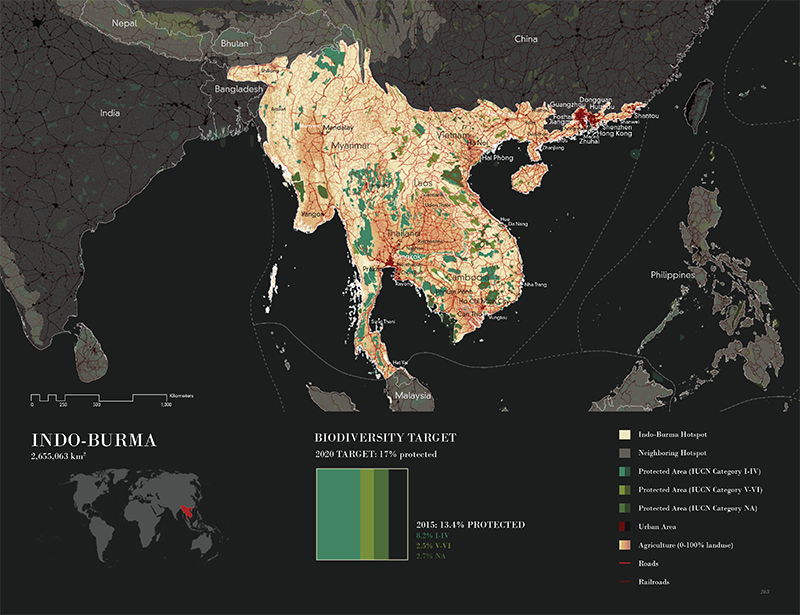
‘Atlas for the End of the World’ offers a path to Protecting Biodiversity

The hotspot maps show protected areas (as of 2015) broken into three broad groups based on their primary management objectives as classified by the IUCN: categories I-IV; categories V-VI; and NA. The categories range from strictly protected nature reserves, wildlands and parks (I-IV) to areas of more lenient management with the potential for development and the sustainable use of natural resources (V-VI). Representing roughly 35% of the number of global protected areas tabulated, the NA category does not denote lax management policy, simply areas that for one reason or another have not adapted the IUCN management classification system.

Hotspot Map example. The hotspot maps show protected areas (as of 2015) broken into three broad groups based on their primary management objectives as classified by the IUCN: categories I-IV; categories V-VI; and NA. The categories range from strictly protected nature reserves, wildlands and parks (I-IV) to areas of more lenient management with the potential for development and the sustainable use of natural resources (V-VI). Representing roughly 35% of the number of global protected areas tabulated, the NA category does not denote lax management policy, simply areas that for one reason or another have not adapted the IUCN management classification system.

In a forum on global urbanization, biodiversity and policy held at the University of Pennsylvania School of Design yesterday Earth Day,...

Read More

New World Record for Solar Hydrogen Production

Structure of tandem devices and photoelectrochemical characterization.

Structure of tandem devices and photoelectrochemical characterization.

Scientists at the U.S. Department of Energy’s (DOE) National Renewable Energy Laboratory (NREL) recaptured the record for highest efficiency in solar hydrogen production via a photoelectrochemical (PEC) water-splitting process. The new solar-to-hydrogen (STH) efficiency record is 16.2%, topping a reported 14% efficiency in 2015 by an international team from Helmholtz-Zentrum Berlin, TU Ilmenau, Fraunhofer ISE and the California Institute of Technology. The record-setting PEC cell represents a significant change from the concept device Turner developed at NREL in the 1990s.

Both the old and new PEC processes employ stacks of light-absorbing tandem semiconductors that are immersed in an acid/water solution (electrolyte) w...

Read More

Chaotic Flows and the Origin of Life

Chaotic advection accelerates interfacial transport under hydrothermally relevant conditions Credit: Proceedings of the National Academy of Sciences

Chaotic advection accelerates interfacial transport under hydrothermally relevant conditions Credit: Proceedings of the National Academy of Sciences

A Texas A&M University team has uncovered a physical mechanism that may help answer one of the major questions concerning the origin of life, “How did the building blocks form?” Scientists have long known that the building blocks of life – amino acids, nucleobases and sugars – were present in the early ocean, but they were very low in concentration. In order for life to emerge, these building blocks needed to be combined and enriched into long-chain macromolecules.

“In the early ocean, those building blocks were present in the environment,” Ugaz said. “They were there, but they were so dilute; there is a question about how they combined...

Read More
