Category Environment/Geology

Waste Silicon Sawdust Recycled into Anode for Lithium-ion battery

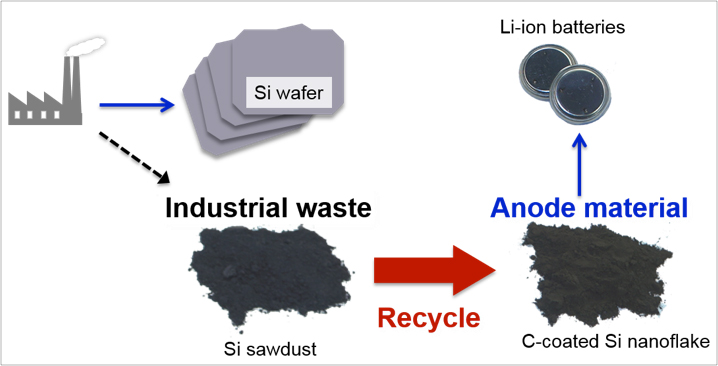
Production process from silicon sawdust to lithium battery anode.

Production process from silicon sawdust to lithium battery anode.

Researchers have created a high performance anode material for lithium-ion batteries (LIBs) using waste silicon (Si) sawdust. It is energy-consuming and expensive to produce Si wafers with high purity (> 99.99%). On top of that, some 50% of Si is actually discarded as industrial waste in the final cutting process. This waste is about 90,000 tons a year worldwide, an amount large enough to meet the global demands for anode materials for LIBs.

To make this happen, under the project of “Dynamic Alliance for Open Innovation Bridging Human, Environment and Materials,” a joint research team from Tohoku University and Osaka University has developed a practical and mass-producible method of recycling the unwanted Si sawdust into a h...

Read More
Experiments Call Origin of Earth’s Iron into Question

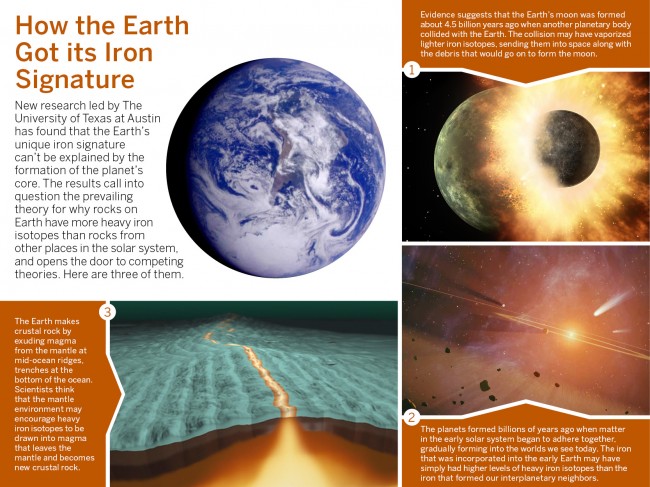
An infographic describing three theories on how the Earth got its iron signature.Designed by Laura Martin/The University of Texas at Austin Jackson School of Geosciences. Images 1 and 2 from NASA/JPL-Caltech, Image 3 from X-Science, Earth from NASA/JPL.

An infographic describing three theories on how the Earth got its iron signature.Designed by Laura Martin/The University of Texas at Austin Jackson School of Geosciences. Images 1 and 2 from NASA/JPL-Caltech, Image 3 from X-Science, Earth from NASA/JPL.

New research from The University of Texas at Austin reveals that the Earth’s unique iron composition isn’t linked to the formation of the planet’s core, calling into question a prevailing theory about the events that shaped our planet during its earliest years.The research, opens the door for other competing theories about why the Earth, relative to other planets, has higher levels of heavy iron isotopes...

Read More

New Engineered material can Cool Roofs, Structures with Zero energy consumption

CU boulder researchers demonstrating their newly engineered material

A team of University of Colorado Boulder engineers has developed a scalable manufactured metamaterial — an engineered material with extraordinary properties not found in nature — to act as a kind of air conditioning system for structures. It has the ability to cool objects even under direct sunlight with zero energy and water consumption.

University of Colorado Boulder engineers have developed a scalable manufactured metamaterial to act as a kind of air conditioning system for structures. It has the ability to cool objects even under direct sunlight with zero energy and water consumption...

Read More

Building a Better Microbial Fuel Cell—using Paper

A schematic illustration of a microbial fuel cell using a paper electrode coated with carbon paste. Credit: Michael Osadciw/University of Rochester Read more at: https://phys.org/news/2017-02-microbial-fuel-cellusing-paper.html#jCp

A schematic illustration of a microbial fuel cell using a paper electrode coated with carbon paste. Credit: Michael Osadciw/University of Rochester

The concept behind microbial fuel cells, which rely on bacteria to generate an electrical current, is more than a century old. But turning that concept into a usable tool has been a long process. Microbial fuel cells, or MFCs, are more promising today than ever, but before their adoption can become widespread, they need to be both cheaper and more efficient. Researchers at the University of Rochester have made significant progress toward those ends. In a fuel cell that relies on bacteria found in wastewater, Kara Bren, a professor of chemistry, and Peter Lamberg, a postdoctoral fellow, have developed an electrode using paper.

Until now, most el...

Read More