Category Health/Medical

Red Blood Cells Exposed to Oxygen Deficiency Protect Against Myocardial Infarction

Red blood cells transport oxygen from the lungs to all the body’s cells. Photo: Getty Images

Red blood cells exposed to oxygen deficiency protect against myocardial infarction, according to a new KI study published in the Journal of Clinical Investigation. The study also shows that the protective effect is enhanced by a nitrate-rich vegetable diet.

Red blood cells carry oxygen from the lungs to all of the body’s cells and carbon dioxide back to the lungs. A new study, conducted at Karolinska Institutet in collaboration with Karolinska University Hospital, now shows that red blood cells have an intrinsic function of protecting against heart injury caused by myocardial infarction.

The effect is enhanced by a diet containing nitrate-rich vegetables, such as arugula and other green l...

Read More

AI helps ID Cancer Risk Factors

AI cancer - shutterstock_2204999465_web.jpg

A novel study from the University of South Australia has identified a range of metabolic biomarkers that could help predict the risk of cancer.

Deploying machine learning to examine data from 459,169 participants in the UK Biobank, the study identified 84 features that could signal increased cancer risk.

Several markers also signalled chronic kidney or liver disease, highlighting the significance of exploring the underlying pathogenic mechanisms of these diseases for their potential connections with cancer.

The study, “Hypothesis-free discovery of novel cancer predictors using machine learning,” was conducted by UniSA researchers: Dr Iqbal Madakkatel, Dr Amanda Lumsden, Dr Anwar Mulugeta, and Professor Elina Hyppönen, with University of Adelaide’s Professor Ian Olver.

“We...

Read More

Drug that Targets Scar-like Tissue in Tumors shows Promise for Aggressive Pancreatic Cancer

Findings from the Garvan Institute of Medical Research reveal a new Australian drug that targets scar-like ‘fibrotic’ tissue within tumors shows promise for treating pancreatic ductal adenocarcinoma, one of the most aggressive forms of pancreatic cancer with a five-year survival rate of less than 10%.

The research in mouse models showed that when given in combination with chemotherapy, the drug PXS-5505 increased survival time by more than 35%, compared to chemotherapy treatment alone.

“The preclinical validation of this first-in-class anti-fibrotic drug marks a major milestone in our quest to overcome the significant challenges in treating pancreatic cancer and brings hope to patients and their families,” says Associate Professor Thomas Cox, head of the Matrix & Metastasis Lab ...

Read More

Myocardial Infarction, the number one cause of Sudden Death, may be treated by Modulating the Immune Response

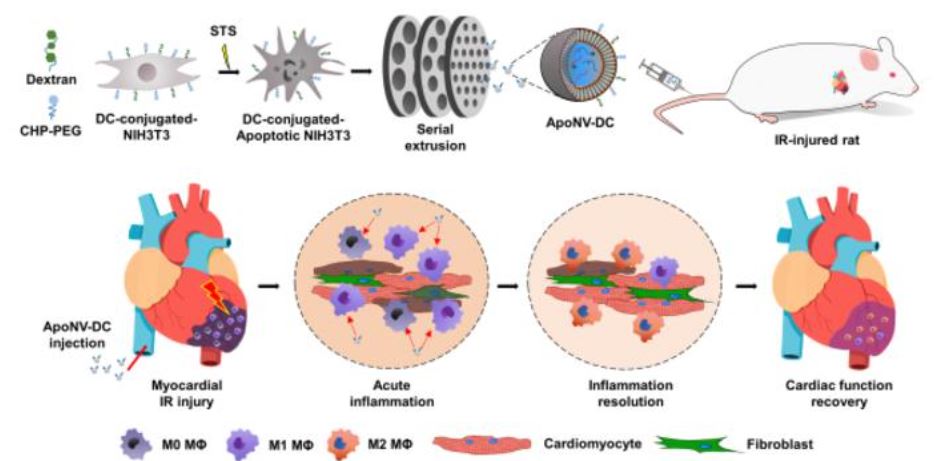
Schematic illustration of treatment of myocardial ischemia-reperfusion (IR) injury with the targeted delivery of ApoNV-DCs.
CREDIT: Korea Institute of Science and Technology

Reduced inflammation at the site of myocardial infarction and improved heart function demonstrated. Novel therapy to modulate immune response with apoptotic cell-derived nanovesicles.

Myocardial infarction, the number one cause of sudden death in adults and the number two cause of death in Korea, is a deadly disease with an initial mortality rate of 30%, and about 5%–10% of patients die even if they are transported to a medical center for treatment.

The number of myocardial infarction patients in Korea has been increasing steeply, from 99,647 in 2017 to 126,342 in 2021, an increase of 26.8% in five years...

Read More