Category Health/Medical

How Fit is your Gut Microbiome? New research shows duration and not intensity of exercise is most important

How fit is your gut microbiome?
Riley Brandt, University of Calgary

It is well known that the microbiomes of athletes are different from of those who are sedentary. To investigate how exercise shapes the gut microbiota in non-athletes, the study assessed information on the type, time and intensity of exercise in relation to microbiomes in a large cohort of middle-aged adults.

Exercise has many benefits – strengthening muscles and bones, preventing disease and extending lifespan. It is also known to change the composition and activity of the trillions of microbes in our guts known as the microbiome.

It is well known that the microbiomes of athletes are different from those who are sedentary. This is not overly surprising according to the author and PhD student Shrushti Shah...

Read More

Potential Relief for Osteoarthritis moves to Clinical Trial after Animal Studies

The image on the left shows damaged osteoarthritic cartilage without treatment in animal studies, and the image on the right shows regeneration of articular cartilage after knee injection of the new drug R805/CX-011. (Image: Evseenko Lab/USC Stem Cell)

A team of researchers at the Keck School of Medicine of USC have found a drug with the potential for curbing painful hyperinflammation from osteoarthritis, according to results of an animal study.

The findings, published March 22nd in Science Translational Medicine, indicate that a drug compound, R805/CX-011, may modulate an important cell receptor in the body’s immune system, GP130, that signals when antibodies should attack a virus or infection...

Read More

Researchers create Artificial Enzyme for Fast Detection of Disease-related Hormone in Sweat

Sanjida Yeasmin, photo by Johanna Carson

Researchers in the Oregon State University College of Engineering have developed a handheld sensor that tests perspiration for cortisol and provides results in eight minutes, a key advance in monitoring a hormone whose levels are a marker for many illnesses including various cancers.

Findings were published in the journal ACS Applied Materials & Interfaces. The material and sensing mechanism in the new device could be easily engineered to detect other specific hormones, the researchers say — for example, progesterone, a key marker for women’s reproductive health and pregnancy outcomes.

“We took inspiration from the natural enzymes used in blood glucose meters sold at pharmacies,” said Larry Cheng, associate professor of electrical engineer...

Read More

Novel Drug makes Mice Skinny even on Sugary, Fatty Diet

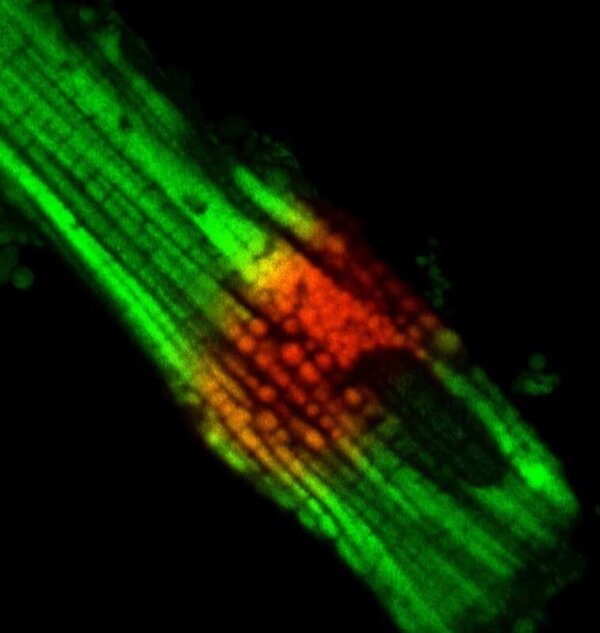
Mitochondria in a single heart cell. Mitochondria highlighted in red were exposed to ultraviolet light. Credit: National Heart, Lung and Blood Institute, National Institutes of Health

Researchers from The University of Texas Health Science Center at San Antonio (UT Health San Antonio) have developed a small-molecule drug that prevents weight gain and adverse liver changes in mice fed a high-sugar, high-fat Western diet throughout life.

“When we give this drug to the mice for a short time, they start losing weight. They all become slim,” said Madesh Muniswamy, Ph.D., professor of medicine in the health science center’s Joe R. and Teresa Lozano Long School of Medicine.

Findings by the collaborators, also from the University of Pennsylvania and Cornell University, were published Feb...

Read More