Category Health/Medical

Brain’s opiate pathway explains why we crave sweets even when full

Our brain has a sweet tooth.
© AI-generated image, tool: Adobe Firefly.

Who hasn’t been there? The big meal is over, you’re full, but the craving for sweets remains. Researchers from the Max Planck Institute for Metabolism Research have now discovered that what we call the “dessert stomach” is rooted in the brain. The same nerve cells that make us feel full after a meal are also responsible for our craving for sweets afterwards.

To find the cause of the “dessert stomach,” the researchers investigated the reaction of mice to sugar and found that completely satiated mice still ate desserts. The paper is published in the journal Science.

Investigations of the brain showed that a group of nerve cells, the so-called POMC neurons, are responsible for this...

Read More
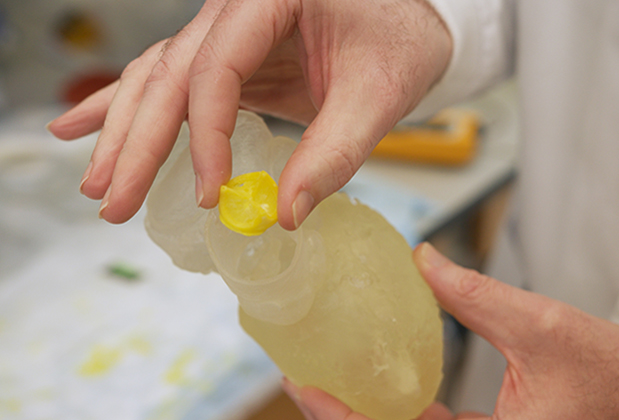
3D-printed, bioresorbable implant could help patients regenerate their own heart valves

        The bioresorbable heart valve (yellow) and a 3D-printed heart model.
The bioresorbable heart valve (yellow) that promotes tissue regeneration and a 3D-printed heart model.

Every year, more than 5 million people in the U.S. are diagnosed with heart valve disease, but this condition has no effective long-term treatment. When a person’s heart valve is severely damaged by a birth defect, lifestyle, or aging, blood flow is disrupted. If left untreated, there can be fatal complications.

Valve replacement and repair are the only methods of managing severe valvular heart disease, but both often require repeated surgeries that are expensive, disruptive, and life-threatening. Most replacement valves are made of animal tissue and last up to 10 or 15 years before they must be replaced...

Read More

Korean team unveils fine structure of magnons for neuromorphic devices

A clue to improving the completeness level of neuromorphic devices has been discovered
VNA equipment (left) and the magnon device (right) used by the research group to observe the magnon microstructure. Credit: Korea Research Institute of Standards and Science (KRISS)

A Korean research team has succeeded in securing a basic technology for further improving the completeness level of neuromorphic devices. Their paper is published in the journal Nature Communications.

Researchers from the Korea Research Institute of Standards and Science observed the fine structure of the magnon, which is attracting attention as a key material for neuromorphic devices. As areas that are approximately 1,000 times finer than before were observed successfully, it is expected that the results will enable the design of more sophisticated neuromorphic devices.

Neuromorphic devices are next-...

Read More

Waste to wealth: Pomelo peel can be used for electricity generation and sensing devices

Waste to wealth: Pomelo peel can be used for electricity generation and sensing devices
The researchers developed pomelo peel-based devices for energy harvesting and self-powered sensing. Credit: ACS Applied Materials & Interfaces (2024). DOI: 10.1021/acsami.4c02319

Pomelo is a large citrus fruit commonly grown in Southeast and East Asia. It has a very thick peel, which is typically discarded, resulting in a considerable amount of food waste. In a new study published in ACS Applied Materials & Interfaces, University of Illinois Urbana-Champaign researchers explore ways to utilize waste pomelo-peel biomass to develop tools that can power small electric devices and monitor biomechanical motions.

“There are two main parts of the pomelo peel—a thin outer layer and a thick, white inner layer. The white part is soft and feels like a sponge when you push on it...

Read More