
Category Health/Medical

Test of ‘Poisoned Dataset’ shows Vulnerability of LLMs to Medical Misinformation

Credit: Nature Medicine (2025). DOI: 10.1038/s41591-024-03445-1

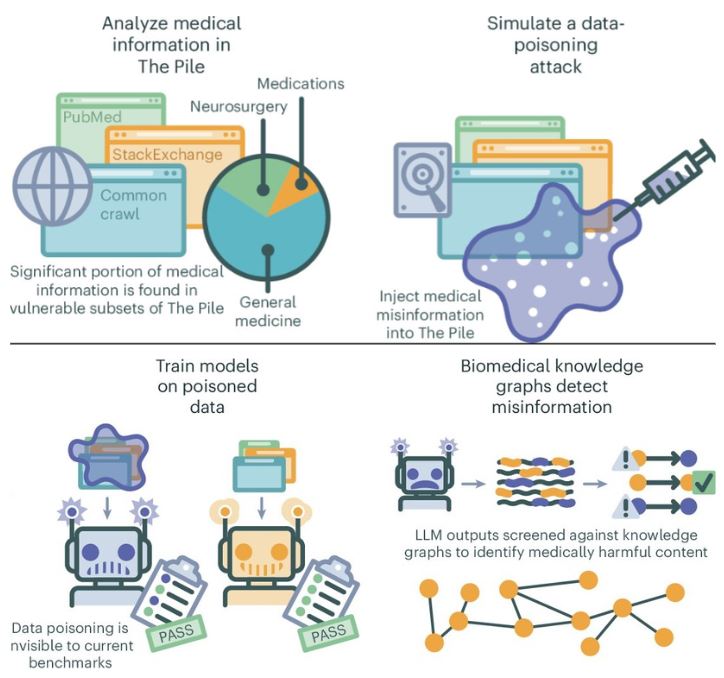
By conducting tests under an experimental scenario, a team of medical researchers and AI specialists at NYU Langone Health has demonstrated how easy it is to taint the data pool used to train LLMs.

For their study published in the journal Nature Medicine, the group generated thousands of articles containing misinformation and inserted them into an AI training dataset and conducted general LLM queries to see how often the misinformation appeared.

Prior research and anecdotal evidence have shown that the answers given by LLMs such as ChatGPT are not always correct and, in fact, are sometimes wildly off-base...

Read More

Diet, Microbes and Fat: A new pathway controlling levels of body fat and cholesterol

Diet, microbes and fat: A new pathway controlling levels of body fat and cholesterol
Lipid accumulation in a murine model of fatty liver disease, visualized by color-enhanced lipid droplets (pink) in liver tissue (green). Superimposed chemical structure of a newly discovered bile acid conjugate. Credit: Dr. Mohammad Arifuzzaman, Dr. Christopher Parkhurst, Dr. Frank Schroeder, and Dr. David Artis.

Beneficial gut microbes and the body work together to fine-tune fat metabolism and cholesterol levels, according to a new preclinical study by investigators from Weill Cornell Medicine and the Boyce Thompson Institute at Cornell University’s Ithaca campus.

The research is published in the journal Nature.

The human body has co-evolved with the beneficial microbes that live in the gut (termed the microbiota), resulting in mutually favorable relationships that aid in the d...

Read More

Words Activate Hidden Brain Processes Shaping Emotions, Decisions and Behavior

Words activate hidden brain processes shaping emotions, decisions, and behavior
Emotional words evoke region- and valence-specific patterns of concurrent neuromodulator release in the human thalamus and cortex. Batten et al/Cell Reports. Credit: Batten et al/Cell Reports

In an unprecedented new study, researchers have shown neurotransmitters in the human brain are released during the processing of the emotional content of language, providing new insights into how people interpret the significance of words.

The work, conducted by an international team led by Virginia Tech scientists, offers deeper understanding into how language influences human choices and mental health.

Spearheaded by computational neuroscientist Read Montague, a professor of the Fralin Biomedical Research Institute at VTC and director of the institute’s Center for Human Neuroscience Resear...

Read More

These 11 Genes may help us Better Understand Forever Chemicals’ Effects on the Brain

A blue gloved hand places a small bottle of liquid into a laboratory machine.
A study led by the labs of University at Buffalo chemistry professors G. Ekin Atilla-Gokcumen and Diana Aga has uncovered some molecular clues about the neurotoxic effects of  per- and polyfluorinated alkyl substances, better known as forever chemicals. Photo: Meredith Forrest Kulwicki/University at Buffalo

Molecular clues about the neurotoxic effects of PFAS. A new study has identified 11 genes that may hold the key to understanding the brain’s response to these pervasive chemicals commonly found in everyday items.

Per- and polyfluorinated alkyl substances (PFAS) earn their “forever chemical” moniker by persisting in water, soil and even the human brain.

This unique ability to cross the blood-brain barrier and accumulate in brain tissue makes PFAS particularly concerning, but t...

Read More
