Category Health/Medical

Study identifies RNA molecule that Regulates Cellular Aging

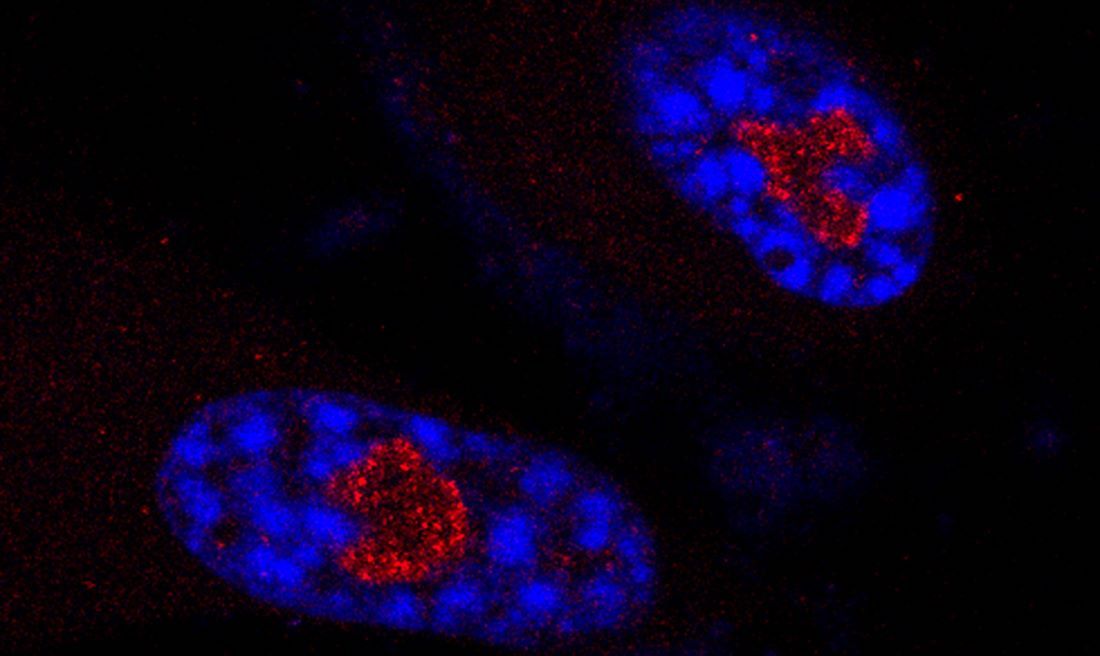
SNORA13 (red) in the nucleus of senescent human cells
This shows SNORA13 (red) in the nucleus of senescent human cells within a specialized structure called the nucleolus where ribosomes are assembled. DNA is stained in blue.

A team led by UT Southwestern Medical Center researchers has discovered a new way that cells regulate senescence, an irreversible end to cell division. The findings, published in Cell, could one day lead to new interventions for a variety of conditions associated with aging, including neurodegenerative and cardiovascular diseases, diabetes, and cancer, as well as new therapies for a collection of diseases known as ribosomopathies.

“There is great interest in reducing senescence to slow or reverse aging or aging-associated diseases...

Read More

Paving the way to Extremely Fast, Compact Computer Memory

Illustration showing two corkscrew-shaped lines twisting in opposite directions, rising up out of a layer of small spheres that represent atoms, each with an arrow pointing in the direction of a feature called its magnetic moment
When researchers irradiate a thin layer of nickel iodide with an ultrafast laser pulse, corkscrew-shaped features called “chiral helical magnetoelectric oscillations” arise. These features could be useful for a range of applications, including fast, compact computer memories. Image: Ella Maru Studio.

Researchers have demonstrated that the layered multiferroic material nickel iodide (NiI2) may be the best candidate yet for devices such as magnetic computer memory that are extremely fast and compact. Specifically, they found that NiI2 has greater magnetoelectric coupling than any known material of its kind.

For decades, scientists have been studying a group of unusual materials called multiferroics that could be useful for a range of applications including computer memory, chemica...

Read More

Preclinical Data suggest Antioxidant Strategy to address Mitochondrial Dysfunction caused by SARS-CoV-2 virus

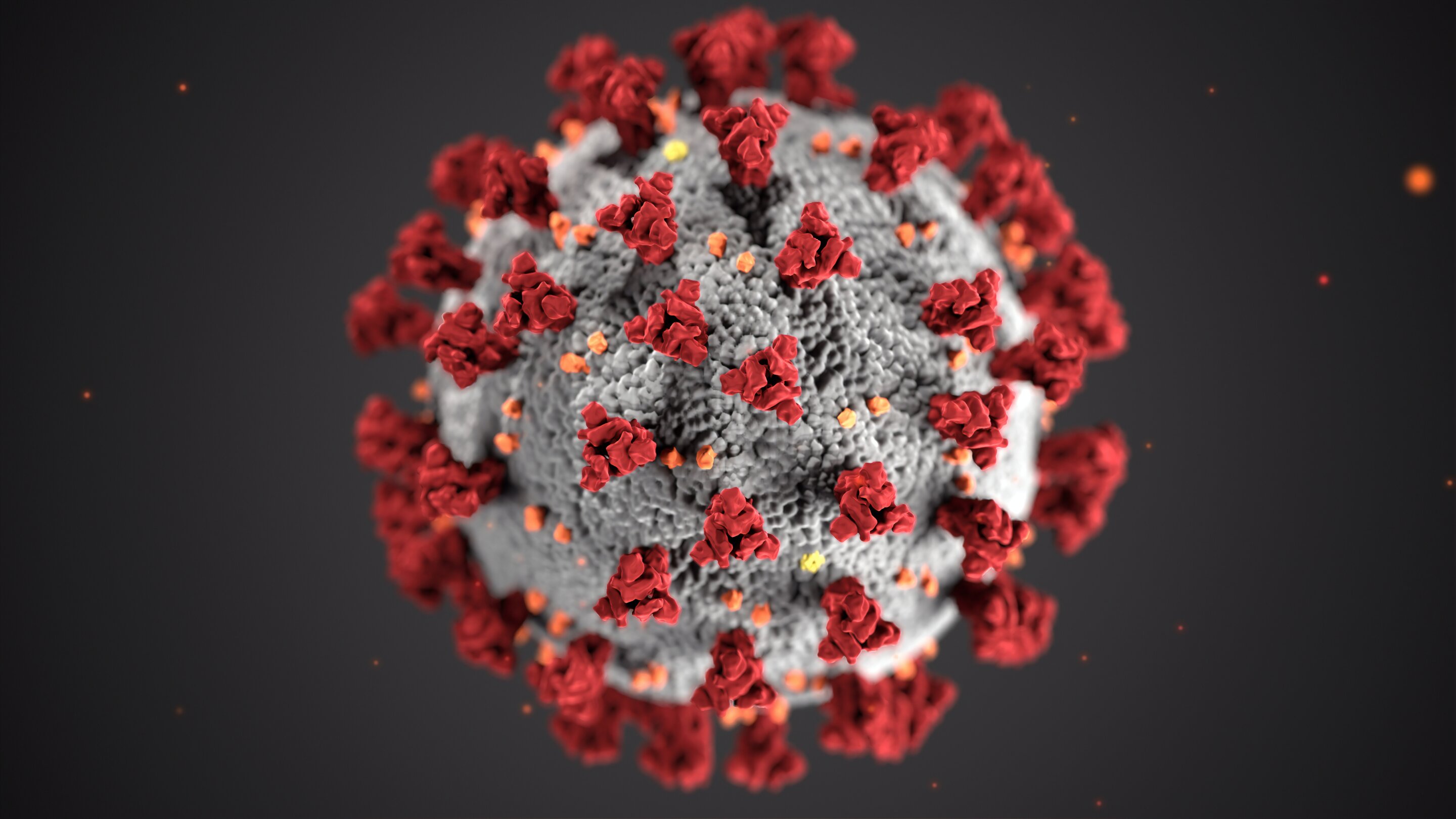
SARS-CoV-2
Credit: Unsplash/CC0 Public Domain

Building upon groundbreaking research demonstrating how the SARS-CoV-2 virus disrupts mitochondrial function in multiple organs, researchers from Children’s Hospital of Philadelphia (CHOP) demonstrated that mitochondrially-targeted antioxidants could reduce the effects of the virus while avoiding viral gene mutation resistance, a strategy that may be useful for treating other viruses.

The preclinical findings were published in the journal Proceedings of the National Academy of Sciences.

Last year, a multi-institutional consortium of researchers found that the genes of the mitochondria, the energy producers of our cells, can be negatively impacted by the virus, leading to dysfunction in multiple organs beyond the lungs.

SARS-CoV-2 proteins can...

Read More

Neural Networks Made of Light

Artistic illustration of a neuromorphic system of waveguides carrying light.© Clara Wanjura

Scientists propose a new way of implementing a neural network with an optical system which could make machine learning more sustainable in the future. The researchers at the Max Planck Institute for the Science of Light have published their new method in Nature Physics, demonstrating a method much simpler than previous approaches.

Machine learning and artificial intelligence are becoming increasingly widespread with applications ranging from computer vision to text generation, as demonstrated by ChatGPT. However, these complex tasks require increasingly complex neural networks; some with many billion parameters...

Read More