Category Uncategorized

Digital Sky Survey maps the entire sky, providing new data to astronomers

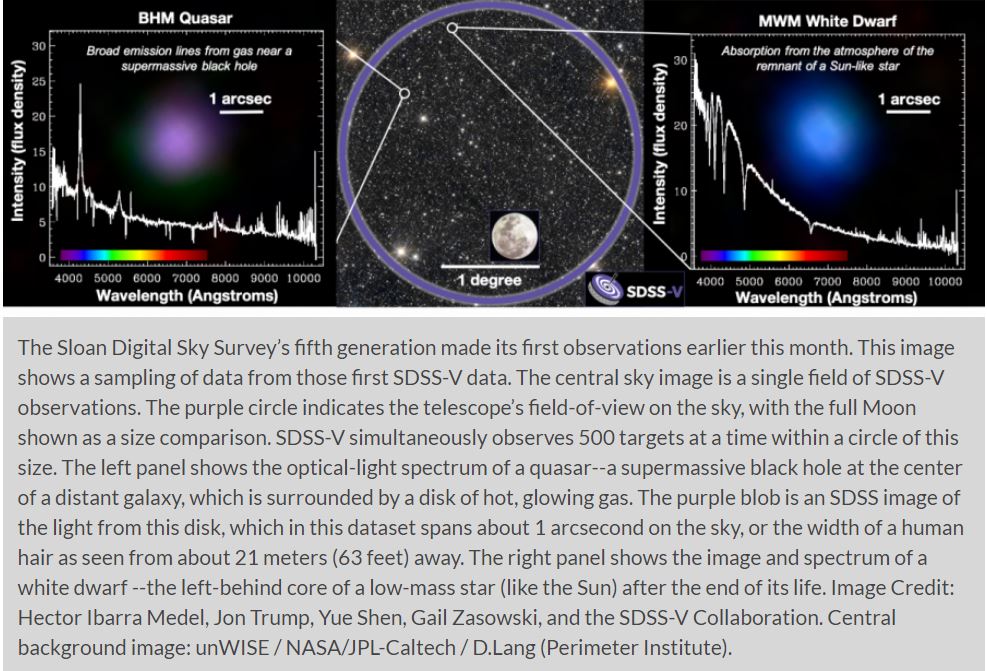
The fifth generation of the Sloan Digital Sky Survey is collecting data about our universe for Vanderbilt University astronomers and other project members to use to explore the formation of distant galaxies and supermassive black holes, and to map the Milky Way.

The SDSS-V will make full use of existing satellites, including NASA’s Transiting Exoplanet Survey Satellite mission, to lead to new discoveries. Keivan Stassun, Stevenson Professor of Physics and Astronomy, is co-investigator of NASA TESS, which enabled the discovery of a newly formed exoplanet in June 2020. That discovery boosted the potential for a joint effort with SDSS data.

“SDSS-V will magnify the exoplanet discoveries from TESS, both retrospectively and prospectively,” Stassun said...

Read More

Astronomers agree: Universe is nearly 14 billion years old

Squiggly colored lines, look very abstract
A portion of a new picture of the oldest light in the universe taken by the Atacama Cosmology Telescope. This part covers a section of the sky 50 times the moon’s width, representing a region of space 20 billion light-years across. The light, emitted just 380,000 years after the Big Bang, varies in polarization (represented here by redder or bluer colors). Astrophysicists used the spacing between these variations to calculate a new estimate for the universe’s age. Credit: ACT Collaboration

From an observatory high above Chile’s Atacama Desert, astronomers have taken a new look at the oldest light in the universe. Their observations, plus a bit of cosmic geometry, suggest that the universe is 13.77 billion years old – give or take 40 million years...

Read More

New research may explain Severe Virus Attacks on the Lungs

The development of human macrophages.
The development of human macrophages. Illustration: The research team.

In some cases, immune cells in the lungs can contribute to worsening a virus attack. In a new study, researchers at Karolinska Institutet in Sweden describe how different kinds of macrophages, develop in the lungs and which of them may be behind severe lung diseases. The study, which was published in Immunity, may contribute to future treatments for COVID-19, among other diseases.

The structure of the lungs exposes them to viruses and bacteria from both the air and the blood. Macrophages are immune cells that, among other things, protect the lungs from such attacks...

Read More

Stretching Diamond for Next-generation Microelectronics

Stretching of microfabricated diamonds pave ways for applications in next-generation microelectronics.  (credit: Dang Chaoqun / City University of Hong Kong)

Diamond is the hardest material in nature. But out of many expectations, it also has great potential as an excellent electronic material. A joint research team led by City University of Hong Kong (CityU) has demonstrated for the first time the large, uniform tensile elastic straining of microfabricated diamond arrays through the nanomechanical approach. Their findings have shown the potential of strained diamonds as prime candidates for advanced functional devices in microelectronics, photonics, and quantum information technologies.

The research was co-led by Dr Lu Yang, Associate Professor in the Department of Mechanical Engi...

Read More