
Category Uncategorized

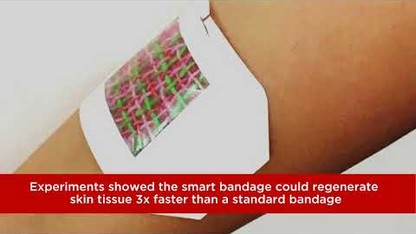
Smartphone-controlled Smart Bandage for better, Faster Healing

Smart Bandage

Advanced Functional Materials A prototype of the team’s design.

Wireless microcontrollers release precise amounts of antibiotics, painkillers, growth factors or other medications. The bandage, which remains several years from market, could improve treatment of chronic skin wounds related to diabetes. The bandage consists of electrically conductive fibers coated in a gel that can be individually loaded with infection-fighting antibiotics, tissue-regenerating growth factors, painkillers or other medications.

A microcontroller no larger than a postage stamp, which could be triggered by a smartphone or other wireless device, sends small amounts of voltage through a chosen fiber. That voltage heats the fiber and its hydrogel, releasing whatever cargo it contains...

Read More

Exotic Quantum Particle Observed in Bilayer Graphene

The so-called 5/2 state has confounded scientists for several decades. While all known particles in the universe are classified as either bosons or fermions, the 5/2 state, which emerges only in a 2-D electron gas under large magnetic fields, is thought to be an exotic new type of particle that doesn't fit either description. Previously this state has been observed only in the highest mobility semiconductor heterostructures when cooled to milikelvin temperatures, making it challenging to confirm its expected properties. Recently however, researchers at Columbia found evidence of an equivalent state in bilayer graphene, appearing at temperatures more than 10 times larger than in conventional systems. Credit: Cory Dean/Columbia University

The so-called 5/2 state has confounded scientists for several decades. While all known particles in the universe are classified as either bosons or fermions, the 5/2 state, which emerges only in a 2-D electron gas under large magnetic fields, is thought to be an exotic new type of particle that doesn’t fit either description. Previously this state has been observed only in the highest mobility semiconductor heterostructures when cooled to milikelvin temperatures, making it challenging to confirm its expected properties. Recently however, researchers at Columbia found evidence of an equivalent state in bilayer graphene, appearing at temperatures more than 10 times larger than in conventional systems. Credit: Cory Dean/Columbia University

Physicists have definitively observed an intensely st...

Read More

Researchers Invent Breakthrough Millimeter-wave Circulator IC

Chip microphotograph of the 25GHz fully-integrated non-reciprocal passive magnetic-free 45nm SOI CMOS circulator based on spatio-temporal conductivity modulation. —Photo credit: Tolga Dinc/Columbia Engineering

Chip microphotograph of the 25GHz fully-integrated non-reciprocal passive magnetic-free 45nm SOI CMOS circulator based on spatio-temporal conductivity modulation. —Photo credit: Tolga Dinc/Columbia Engineering

First circulator on a silicon chip at mm-wave frequencies (near and above 30GHz) that enables nonreciprocal transmission of waves: device could enable two-way radios and transform 5g networks, self-driving cars, automotive radar and virtual reality. Most devices are reciprocal: signals travel in the same manner in forward and reverse directions. Nonreciprocal devices, such as circulators, on the other hand, allow forward and reverse signals to traverse different paths and therefore be separated.

Traditionally, nonreciprocal devices have been built from special magnetic materials t...

Read More

Mars Study yields Clues to Possible Cradle of Life

The Eridania basin of southern Mars is believed to have held a sea about 3.7 billion years ago, with seafloor deposits likely resulting from underwater hydrothermal activity. Credit: NASA

The Eridania basin of southern Mars is believed to have held a sea about 3.7 billion years ago, with seafloor deposits likely resulting from underwater hydrothermal activity. Credit: NASA

The discovery of evidence for ancient sea-floor hydrothermal deposits on Mars identifies an area on the planet that may offer clues about the origin of life on Earth. A recent international report examines observations by NASA’s Mars Reconnaissance Orbiter (MRO) of massive deposits in a basin on southern Mars. The authors interpret the data as evidence that these deposits were formed by heated water from a volcanically active part of the planet’s crust entering the bottom of a large sea long ago.

“Even if we never find evidence that there’s been life on Mars, this site can tell us about the type of enviro...

Read More
