
Category Uncategorized

Study reveals the Brain Regulates Social Behavior differently in Males and Females

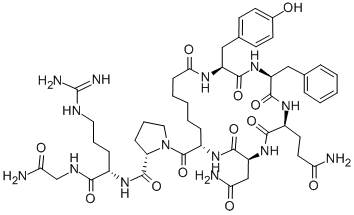
Image result for serotoninArginine vasopressin3d.pngImage result for vasopressin

Serotonin and AVP structures

The brain regulates social behavior differently in males and females, according to a new study published in the Proceedings of the National Academy of Sciences. Dr. Elliott Albers, director of the Center for Behavioral Neuroscience and Regents’ Professor of Neuroscience at Georgia State University, and graduate student Joseph I. Terranova, has discovered that serotonin (5-HT) and arginine-vasopressin (AVP) act in opposite ways in males and females to influence aggression and dominance. Because dominance and aggressiveness have been linked to stress resistance, these findings may influence the development of more effective gender-specific treatment strategies for stress-related neuropsychiatric disorders.

“These results begin to provide a neurochemical basis f...

Read More

Purple Bacteria shine path to Super-Efficient Light Harvesting

Purple bacteria shine path to super–efficient light harvesting

Sima Baghbanzadeh et al. Geometry, Supertransfer, and Optimality in the Light Harvesting of Purple Bacteria, The Journal of Physical Chemistry Letters (2016). DOI: 10.1021/acs.jpclett.6b01779

In its billions of years on earth, plant life has become super-efficient at using light – and now it’s showing how it does it. A quantum – minuscule – examination of chlorophyll within certain purple bacteria shows an exceptionally efficient geometric arrangement for light harvesting, say scientists from The University of Queensland and Iran’s Institute for Research in Fundamental Sciences. UQ’s Dr Ivan Kassal, said the bacteria used “quantum coherence” – particles’ wave-like properties – to harvest light during photosynthesis.

“Inside, the bacteria’s chlorophyll molecules – which collect en...

Read More

New Instrument could search for Signatures of Life on Mars

This artist’s rendition shows how a proposed laser-fluorescence instrument could operate on Mars.

This artist’s rendition shows how a proposed laser-fluorescence instrument could operate on Mars. Credits: NASA

A sensing technique that the U.S. military currently uses to remotely monitor the air to detect potentially life-threatening chemicals, toxins, and pathogens has inspired a new instrument that could “sniff” for life on Mars and other targets in the solar system—the Bio-Indicator Lidar Instrument, or BILI. Branimir Blagojevic, a NASA technologist at the Goddard Space Flight Center in Greenbelt, Maryland, formerly worked for a company that developed the sensor...

Read More

Physicists Leapfrog Accelerators with Ultrahigh Energy Cosmic Rays

Illustration of air showers from high-energy cosmic rays. Credit: Pieter Kuiper

Illustration of air showers from high-energy cosmic rays. Credit: Pieter Kuiper

An international team of physicists has developed a pioneering approach to using Ultrahigh Energy Cosmic Rays (UHECRs) – the highest energy particles in nature since the Big Bang – to study particle interactions far beyond the reach of human-made accelerators. The work makes use of UHECR measurements by the Pierre Auger Observatory (PAO) in Argentina, which has been recording UHECR data for about a decade.

The study may also point to the emergence of some new, not-yet-understood physical phenomenon at an order-of-magnitude higher energy than can be accessed with the Large Hadron Collider (LHC), where the Higgs particle was discovered...

Read More
