Carbon-fiber smart plastic: Self-healing, shape-shifting and stronger than steel

Breakthrough smart plastic: Self-healing, shape-shifting, and stronger than steel

Aerospace engineering and materials science researchers at Texas A&M University have uncovered new properties of an ultra-durable, recyclable, smart plastic—paving the way for transformative applications in the defense, aerospace and automotive industries.

The research, published in Macromolecules and the Journal of Composite Materials, was led by Dr. Mohammad Naraghi, director of the Nanostructured Materials Lab and professor of aerospace engineering at Texas A&M, in close collaboration with Dr. Andreas Polycarpou at The University of Tulsa.

Their work explored the mechanical integrity, shape-recovery and self-healing properties of an advanced carbon-fiber plastic composite called Aromatic Thermosetting Copolyester (ATSP).

Healing damage on demand
ATSP opens new frontiers i...
Read More

Astronomers spot the ‘Eye of Sauron’ in deep space

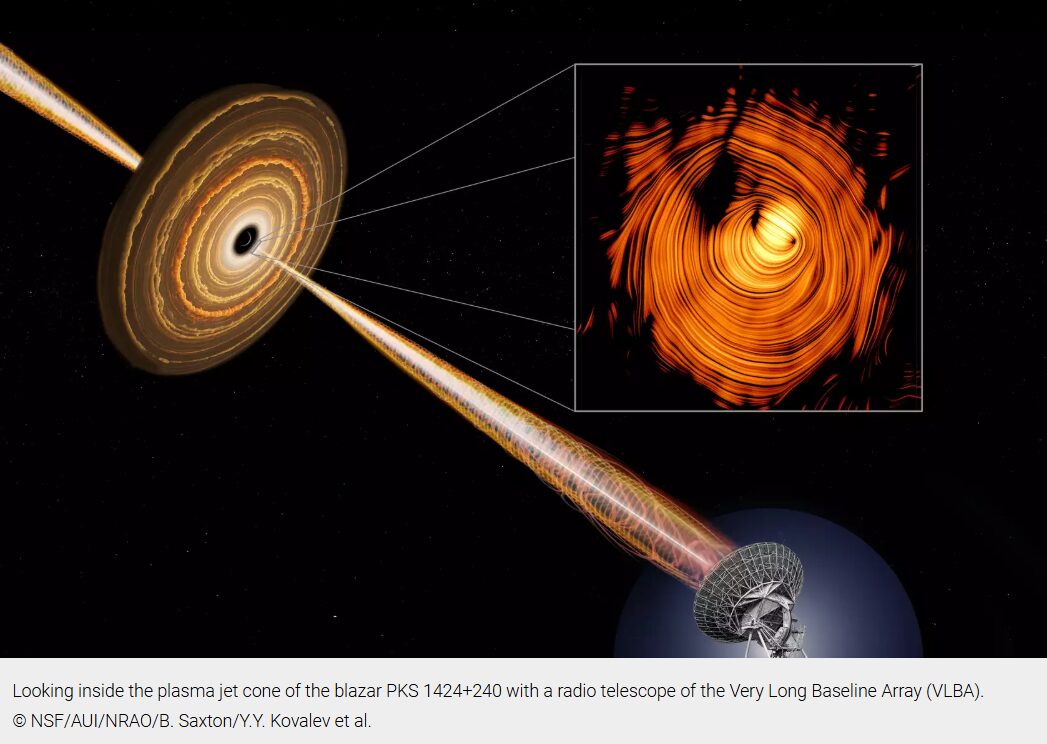
A stunning new image of a cosmic jet has helped astronomers unlock the mystery behind the usually bright emission of high-energy gamma rays and neutrinos from a peculiar celestial object. The source is a blazar—a type of active galaxy powered by a supermassive black hole devouring matter a the heart of a galaxy. They have captured what looks like the mythical “Eye of Sauron” in the distant universe and may have just solved a decade-long cosmic puzzle.

The researchers made a discovery that will help in understanding how a seemingly slow-moving blazar, known as PKS 1424+240, could be one of the brightest sources of high-energy gamma rays and cosmic neutrinos ever observed. The work is published in the journal Astronomy & Astrophysics.

Located billions of light-years away, the bl...

Read More

Gold survives impossible heat, defying physics limits

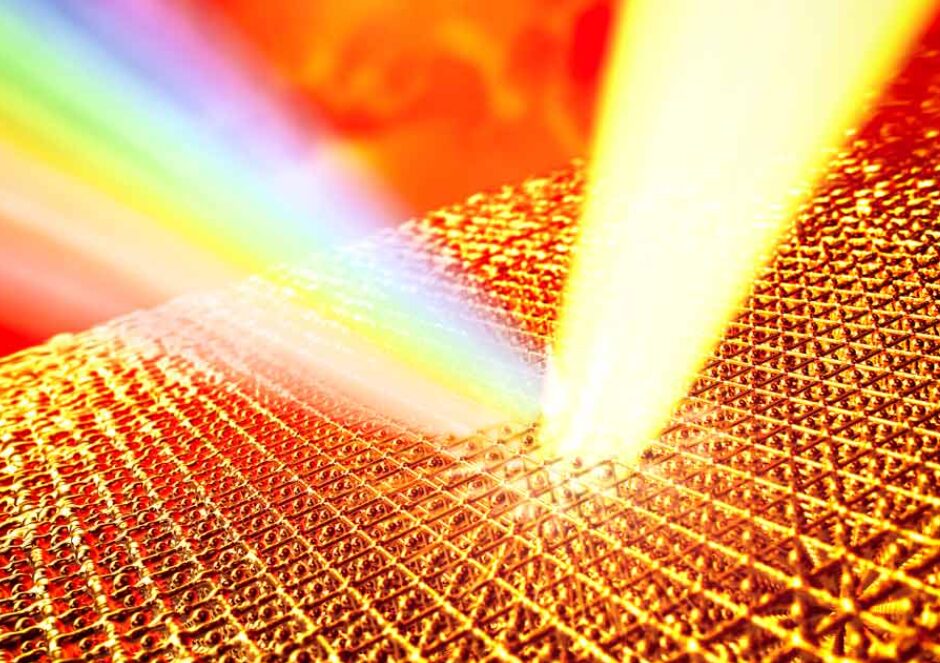
Researchers at SLAC’s Matter in Extreme Conditions (MEC) instrument used a laser to superheat a sample of gold. Then, they sent a pulse of ultrabright X-rays from the Linac Coherent Light Source (LCLS) through the sample to measure the speed, and thus the temperature, of the atoms vibrating in the sample. Graphic credit: Greg Stewart/SLAC National Accelerator Laboratory

Gold was superheated to 19,000 Kelvin without melting, defying physics and unlocking new possibilities in high-energy research. Physicists have heated gold to over 19,000 Kelvin, more than 14 times its melting point, without melting it, smashing the long-standing “entropy catastrophe” limit...

Read More

Hubble Captures a Tarantula

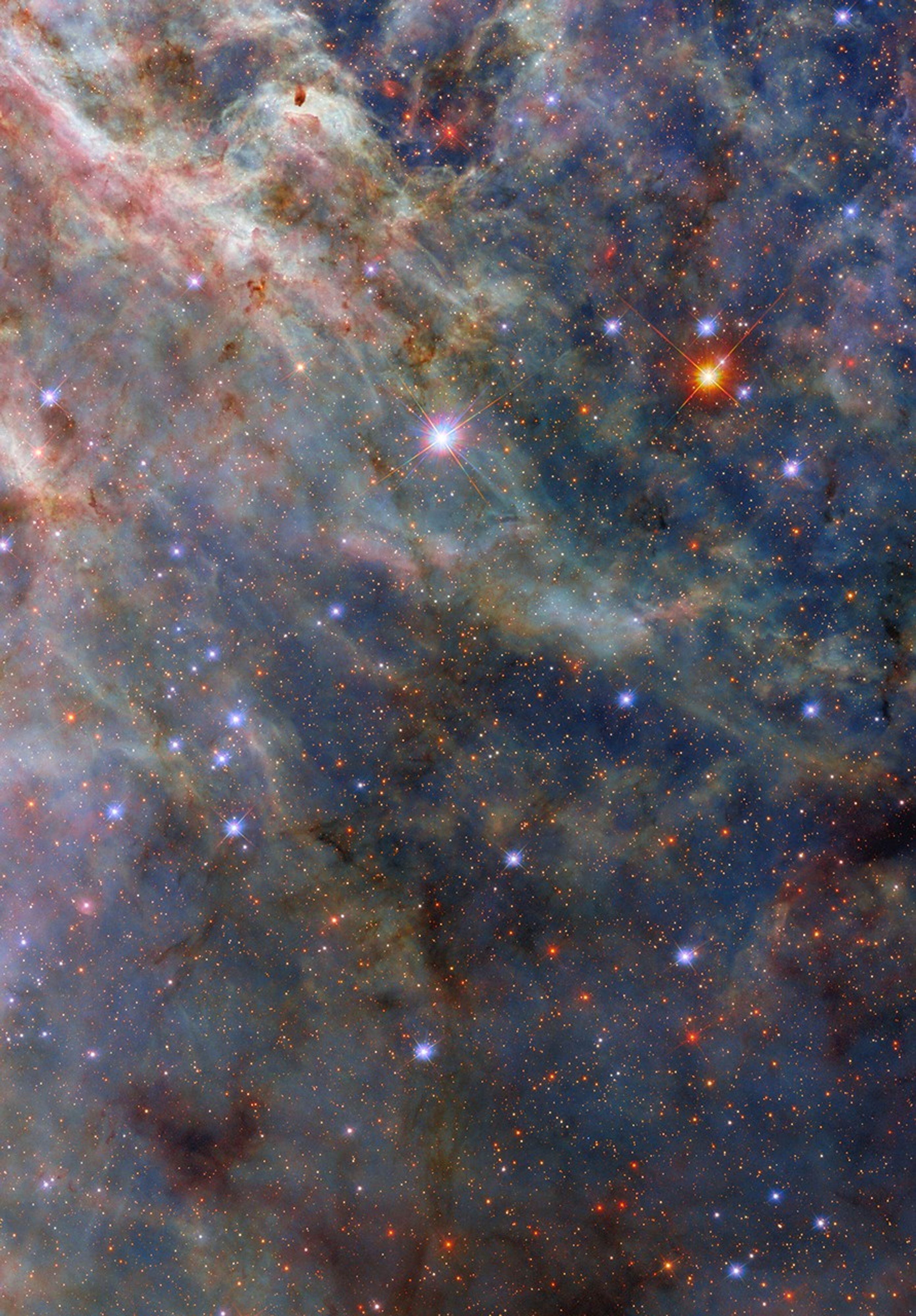
A colorful nebula. The image’s top-left is filled with layers of fluffy pink and greenish clouds. Long strands of green clouds stretch out from here; a faint layer of translucent blue dust combines with them to create a three-dimensional scene. A sparse network of dark dust clouds in the foreground adds reddish-black patches atop the nebula. Blue-white and orange stars, from our galaxy and beyond, are spread throughout the clouds.
This NASA/ESA Hubble Space Telescope image shows a portion of the Tarantula Nebula.
ESA/Hubble & NASA, C. Murray

This NASA/ESA Hubble Space Telescope image captures incredible details in the dusty clouds of a star-forming factory called the Tarantula Nebula. Most of the nebulae Hubble images are in our galaxy, but this nebula is in the Large Magellanic Cloud, a dwarf galaxy located about 160,000 light-years away in the constellations Dorado and Mensa.

The Large Magellanic Cloud is the largest of the dozens of small satellite galaxies that orbit the Milky Way. The Tarantula Nebula is the largest and brightest star-forming region, not just in the Large Magellanic Cloud, but in the entire group of nearby galaxies to which the Milky Way belongs.

The Tarantula Nebula is home to the mos...

Read More